
Verizon’s Moat Is Earthbound — The Threat Is Not
 By
Levi
By
Levi
Verizon has not had an easy stretch.
The stock trades near $45, and years of sluggish growth, intense promotional competition, and a substantial debt burden have kept investor enthusiasm measured. None of those concerns will surprise anyone who follows the name.
But underneath the familiar complaints, something less familiar is taking shape. The ground beneath the telecom model is shifting — and the challenge is not coming from another tower operator.
It is coming from orbit.
On its face, the comparison sounds absurd. Satellites against cell towers. Signals traveling hundreds of miles through space against equipment bolted to a pole down the street. And the physics does not lie.
A signal from low-Earth orbit still faces limitations indoors, underground, and around dense physical obstructions. Terrestrial networks remain far better suited to carrying heavy data traffic through populated areas.
So the satellite operators are not trying to replace every tower. They are building around the places towers fail to reach.
The Rise of the Space Hybrid
The emerging model is neither purely terrestrial nor purely satellite. It is hybrid.
Ground networks carry the dense urban and indoor traffic. Satellite direct-to-device service fills the gaps beyond tower coverage, providing connectivity in rural areas, on remote roads, offshore, and during disruptions that disable local infrastructure.
The customer may not need to know which network is carrying the signal. That handoff is the product.
SpaceX moved materially closer to controlling that experience when the FCC approved its acquisition of roughly 65 megahertz of nationwide spectrum from EchoStar in May. The transactions include AWS-4, H-block, and unpaired AWS-3 licenses, with the original AWS-4 and H-block agreement valued at approximately $17 billion. The spectrum can support terrestrial, satellite, and hybrid uses.
In plain terms, SpaceX is no longer limited to building direct-to-cell service around spectrum controlled by someone else. It now owns a meaningful set of keys.
That does not mean SpaceX has announced a nationwide terrestrial carrier or MVNO strategy. It has not. But the pieces required to create a much more independent connectivity platform are beginning to accumulate.
Satellites. Spectrum. Launch capability. And direct-to-device connectivity to ordinary phones.
A Battle of Speed and Reach
For the person holding the phone, the competition comes down to a trade-off. Speed, or reach. Verizon owns the speed.
Its terrestrial 5G network carries far more capacity, offers lower latency, and performs better inside buildings and densely populated areas. For streaming, gaming, large downloads, and ordinary daily use in a city, satellites are not close to replacing it.
But satellite networks own a different advantage. Reach.
They can extend service into areas where tower economics break down. They can provide redundancy when storms, fires, or other disruptions take terrestrial infrastructure offline. They do not need to outperform urban 5G everywhere.
They only need to work where the tower does not. “Excellent in most places” remains a compelling product. But “good enough in far more places” is becoming one too.
An Uneasy Alliance
The carriers have noticed. On May 14, Verizon, AT&T, and T-Mobile announced an agreement in principle to form a joint venture that would pool limited spectrum resources and create a unified platform for satellite-based direct-to-device services.
Three companies that rarely agree on much have found common ground above the Earth. Note the phrase agreement in principle.
There is no definitive agreement yet. No final financial structure. No guaranteed deployment schedule. The venture remains subject to negotiation and closing conditions.
It is an intention, not yet a network. But the intention itself tells us something.
The proposed platform would aim to reduce dead zones, improve emergency redundancy, establish common technical standards, and make it easier for multiple satellite operators to integrate with terrestrial carriers.
The logic is sound. Close the gaps. Preserve the customer relationship. And keep the carriers positioned between the subscriber and the sky. It is both an infrastructure project and a defensive wall.
A Unique Irony
Here is the part that ought to make you smile.
Verizon and AT&T have backed AST SpaceMobile, a satellite network designed to complement their terrestrial systems and provide an alternative to Starlink’s direct-to-device ambitions.
Yet AST’s first five commercial BlueBird satellites reached orbit aboard a SpaceX Falcon 9.
Capital intended to support a Starlink competitor helped pay a SpaceX launch invoice.
AST has since diversified. Its next-generation satellites have also flown aboard India’s LVM3 and Blue Origin’s New Glenn, so it would be wrong to suggest that its future depends entirely on SpaceX.
Still, the early irony remains. One of the carrier-backed responses to SpaceX began its commercial life riding a SpaceX rocket. Sometimes the challenger also owns part of the road leading to the challenge.
The Bottom Line for Investors
Satellite connectivity will not outperform Verizon in a crowded city. It does not have to. For millions of people who travel through rural corridors, work offshore, live beyond reliable tower coverage, or need emergency redundancy, reach carries value of its own.
That creates a long-term competitive question for the entire carrier group. If a hybrid provider can combine terrestrial service with nearly ubiquitous satellite coverage, how much pricing power remains attached to the traditional network moat?
For the income investor, Verizon’s case has not disappeared.
At the current share price and dividend rate, the annualized yield is roughly 6.2%. Verizon also expects at least $21.5 billion in free cash flow for 2026, giving the company meaningful capacity to support the dividend, invest in its network, and defend its position.
The balance sheet remains heavy. Verizon reported $158.2 billion of total debt at year-end 2025 and $142.5 billion of unsecured debt at the end of the first quarter. But this is not a company without resources. It is a mature incumbent being forced to adapt while still generating substantial cash.
The moat that made Verizon Verizon was always the ground itself — towers, spectrum, fiber, and a physical network no newcomer could easily reproduce.
That moat remains intact. It is simply no longer the only moat that matters. The challenge is arriving from a direction those towers were never built to face.
So what is crowd behavior telling us now?
Sentiment Speaks
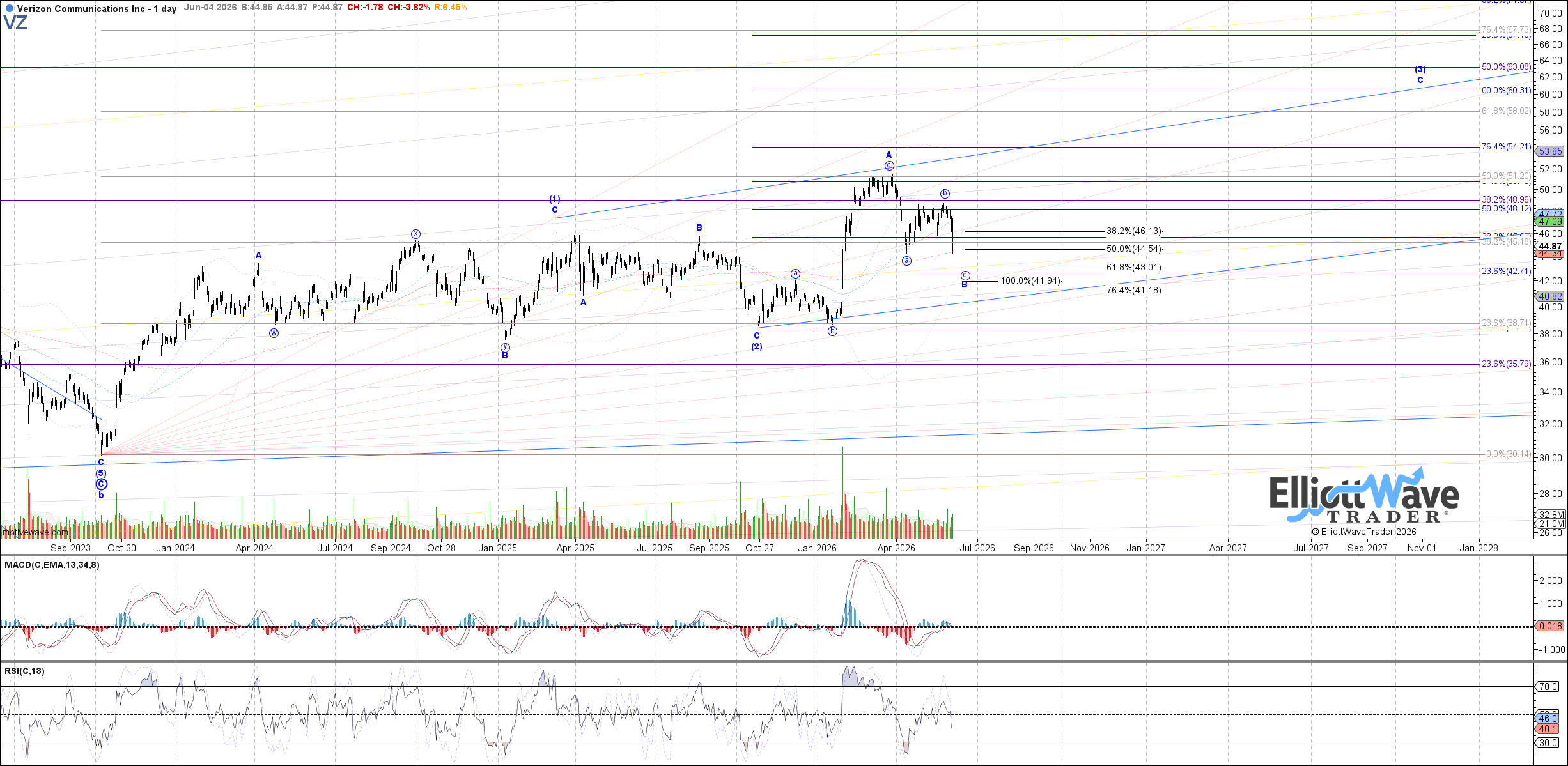
Both Garrett and Zac are tracking similar structures here.
VZ appears likely to establish a low in the $42–$43 area. A wider wave (2) could still carry price lower, potentially into the high $30s, but that remains the lower-probability path at present.
The next low should produce a reaction that forms five waves higher. That would be our first meaningful indication that the selling phase has completed.
From there, a corrective pullback should set the stage for a larger advance. The standard target overhead reaches toward $60–$63 for wave (3). As the five-wave C wave of (3) develops, its internal subdivisions should provide increasingly precise guidance.
A sustained break below $41 would shift probabilities toward the wider wave (2) scenario before the larger advance attempts to resume.
The market does not need to settle the satellite debate before price can turn. It only needs the current selling structure to complete.
Conclusion
Two pictures. One evolving setup.
The business story says Verizon’s ground-based moat is no longer the only one that matters. Satellite connectivity is becoming more capable, the carriers are organizing a collective response, and SpaceX now controls spectrum that could make its direct-to-device ambitions more independent.
The chart is telling us something else at the same time.
Even as those concerns build, the selling pressure visible on the chart may be nearing its floor. A low in the $42–$43 region, followed by five waves higher and a corrective pullback, would support the larger path toward $60–$63 in wave (3). A break below $41 would favor a wider wave (2) first.
The threat from orbit is real. So is the possibility of a sentiment turn beneath it.
The sky is shifting. But for now, so is the floor.
