
United’s CEO Thinks in Probabilities — You Should Too
 By
Levi
By
Levi
United Airlines (UAL) CEO Scott Kirby runs one of the world's largest airlines. He still can't play blackjack on the Las Vegas Strip. His résumé hints at why: bachelor's degrees in computer science and operations research from the Air Force Academy, a master's in operations research, and a stint as vice president of revenue management at America West. Applied probability, start to finish.
Then there’s card counting. Now, by a strict definition, some view this as gambling. Yes, it takes place at casinos, but only until the counter is discovered. Let’s look at the basics of what the counter does.
Counters are highly skilled mathematicians who don’t need a calculator in front of them to run the solutions. Counting tracks probabilities to shift the odds, which is why casinos ban people who can do it well.
Kirby became skilled enough that casinos banned him worldwide, according to a recent Wall Street Journal profile. The ban has outlasted his playing days. During Super Bowl week, he walked into the Bellagio to open a line of credit at the high-limit poker table, and a manager told him he was welcome at any game except blackjack. "It's been at least 15 years since I've played," Kirby told the Journal. "But I'm in the database."
Kirby isn’t the first to take this thinking beyond the table. Edward Thorp, the mathematician who proved that card counting works, later ran a quant fund that compounded at about 15% a year after fees for nearly two decades.
But let’s get back to Kirby and his methodology. He describes making decisions by expected value rather than emotion. As the CEO of UAL, he is attempting to build an edge in the industry. The de-commoditizing of travel: turning a seat bought on price alone into a product people choose, through premium cabins and a loyalty program that brought in $3.2 billion from its Chase co-branded card and other partners last year. This is Kirby's attempt at a moat. Whether he succeeds, price will tell.
Recently, we asked Lyn Alden to render an opinion on UAL.
Airlines including UAL are in decent shape overall. Their biggest current pressure comes in the form of high fuel costs, but they've been able to push that through to consumers.
In general, airlines lack significant economic moats and are prone to unexpected disruption, which makes them best used as trading stocks rather than long-term buy-and-hold compounders. — Lyn Alden
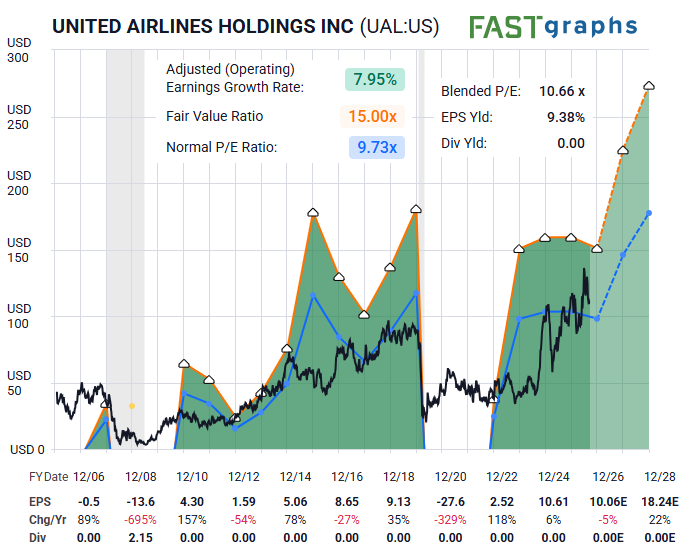
What’s our takeaway from this comment? We need an edge. We are seeking something that will define our probabilities in a trade setup. This is why we look to the probabilistic lens.
The Probabilistic Lens
Those who follow our work and the methodology that we share will be acquainted with how we use crowd behavior patterns to track and project probabilities. Sound like card counting? No, we are not card counters. But we measure the same thing: probabilities.
This probabilistic lens is math in motion. And the patterns that it forms via the structure of price on the chart are repeatable at all time frames. This is its power.
We can take UAL stock at this point and draw conclusions. The structure of price will give us context. Then, it will tell us what is most likely next. It will also provide specific parameters that show either further confirmation of our primary path or when it needs adjustment, even negation of our scenario.
Let’s get into the UAL trade setup as we see it.
Sentiment Speaks
Zac Mannes recently shared this Wave Setup for UAL.
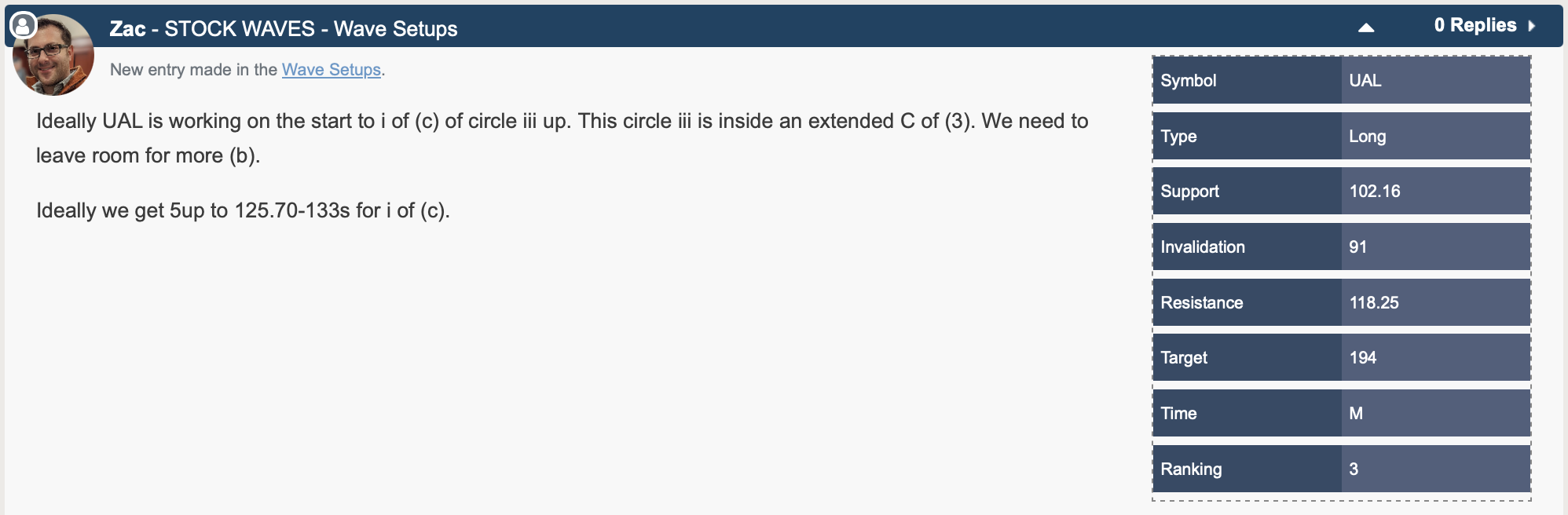
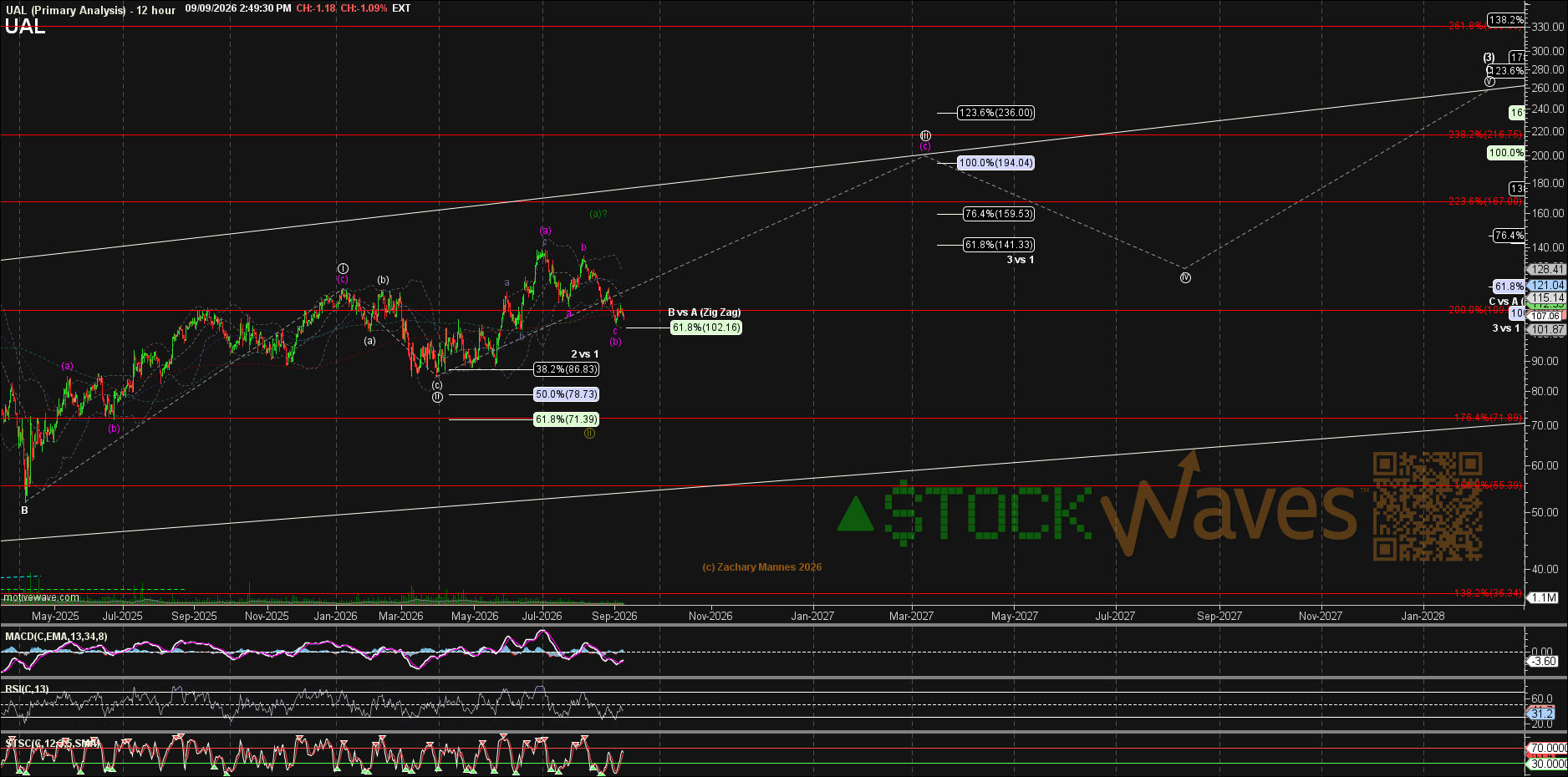
As you can observe, we have clean parameters for the path as drawn up. Note the context on the chart:
Garrett Patten is also seeing a similar story as he tracks it on his chart:
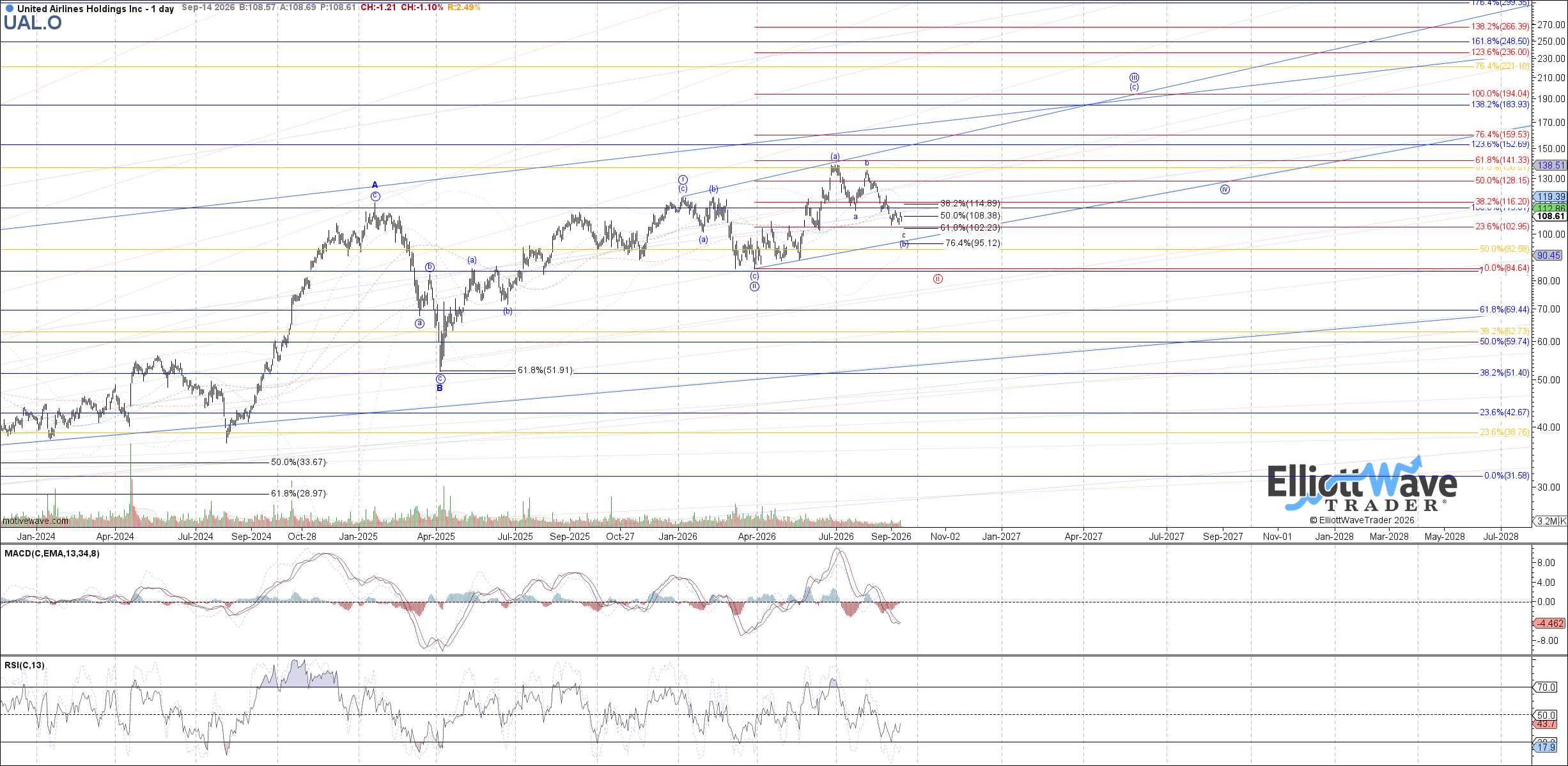
The crowd is painting its opinion via price on these charts. And we can read that as it continues in motion. A wider circle ‘ii’ low is plausible as an alternate scenario shared by both Zac and Garrett. The primary path tracks higher over the next several months. From about $108.50, with invalidation at $91, the $194 target offers roughly five dollars of potential reward for every dollar of risk.
Favorable headlines may accompany the anticipated rally. They haven't driven price so far: UAL beat earnings three quarters in a row and sold off each time. The crowd leads the turn.
Conclusion
How many use mathematics in their analysis and decision-making? At a glance, it may not seem like many. What if we are using math to make decisions and are individually not aware of this fact?
Collectively, our decisions can be tracked in real time and then plotted via mathematics. Fibonacci mathematics, to be exact. Socionomics, the theory Robert Prechter developed, holds that these patterns come from unconscious herding impulses rooted deep in the brain.
We all work in probabilities; some of us have learned how to measure them. Once you train yourself to recognize these patterns and to use the probabilistic lens in your decision-making process, you will never look at markets in the same way again.
Scott Kirby can walk into the Bellagio and play any game but blackjack. That doesn't stop his mind from running calculations and parsing probabilities. The same happens once you've learned this way of viewing the markets.
UAL is presenting us with a setup. Price will now keep score.
