
The World Runs on RAM and Only One American Company Makes It
 By
Levi
By
Levi
As AI shifts from training to deployment, memory demand is accelerating. Micron — the only American RAM producer — may be setting up for its next move.
The artificial intelligence conversation has been dominated by one word: compute. GPUs. Processing power. The chip that thinks.
But thinking and doing are different things. And as AI moves from training chatbots to deploying agents — systems that act, persist, and remember across sessions — the hardware equation is shifting beneath the market's feet.
Agents need memory. A lot of it.
The RAM Market Nobody Talks About
Three companies produce nearly all of the world's RAM. Two are headquartered in South Korea. One is based in the United States.
That company is Micron Technology (MU).
For investors who have spent the past two years tracking Nvidia's ascent, this corner of the AI infrastructure trade has received relatively little attention. That may be changing.
Analyst Lyn Alden frames the demand shift this way:
"As AI usage shifts from training AI chatbots to deploying AI agents, the importance of RAM increases alongside GPUs. Agents need a lot more persistence than chatbots, which means a lot more working memory. There will eventually be an overbuilding of RAM, like there is every cycle, but I still think this cycle has a ways to go before it's over. Three companies produce almost all of the RAM in the world, and Micron is the only US-based of the three.”
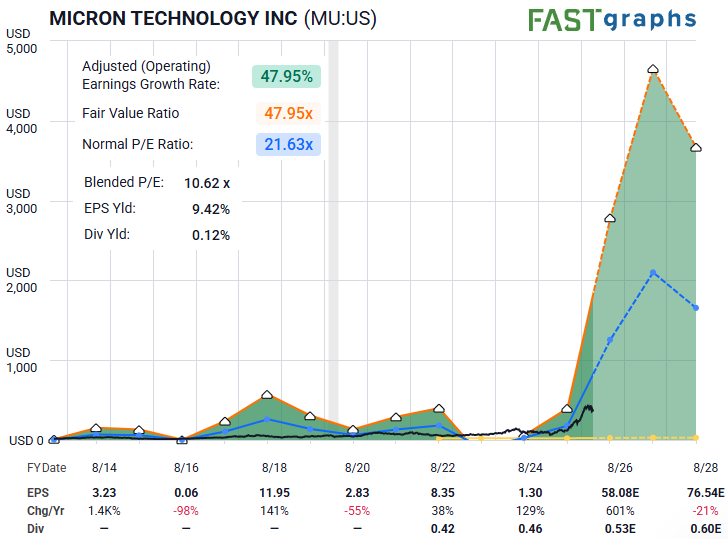
That distinction — persistence over processing — is the thesis in a single paragraph. Chatbots are trained in advance and then queried. Agents operate continuously, maintain context, track state, and act across extended interactions. The memory demands of that operational model are fundamentally different from anything the market has previously had to absorb at scale.
The Cycle Context
Micron has already reflected a significant portion of this enthusiasm. The stock is up more than 500 percent over the past year — a move that justifiably gives investors pause.
It has recently taken a breather.
RAM markets are cyclical by nature. Supply responds to demand, demand gets overestimated, and the cycle corrects. That pattern has repeated throughout the history of the semiconductor industry and will repeat again. Alden acknowledges this directly — overbuilding is coming. The question is timing, and her read is that the current cycle has further to run before that correction arrives.
What the Chart Is Showing
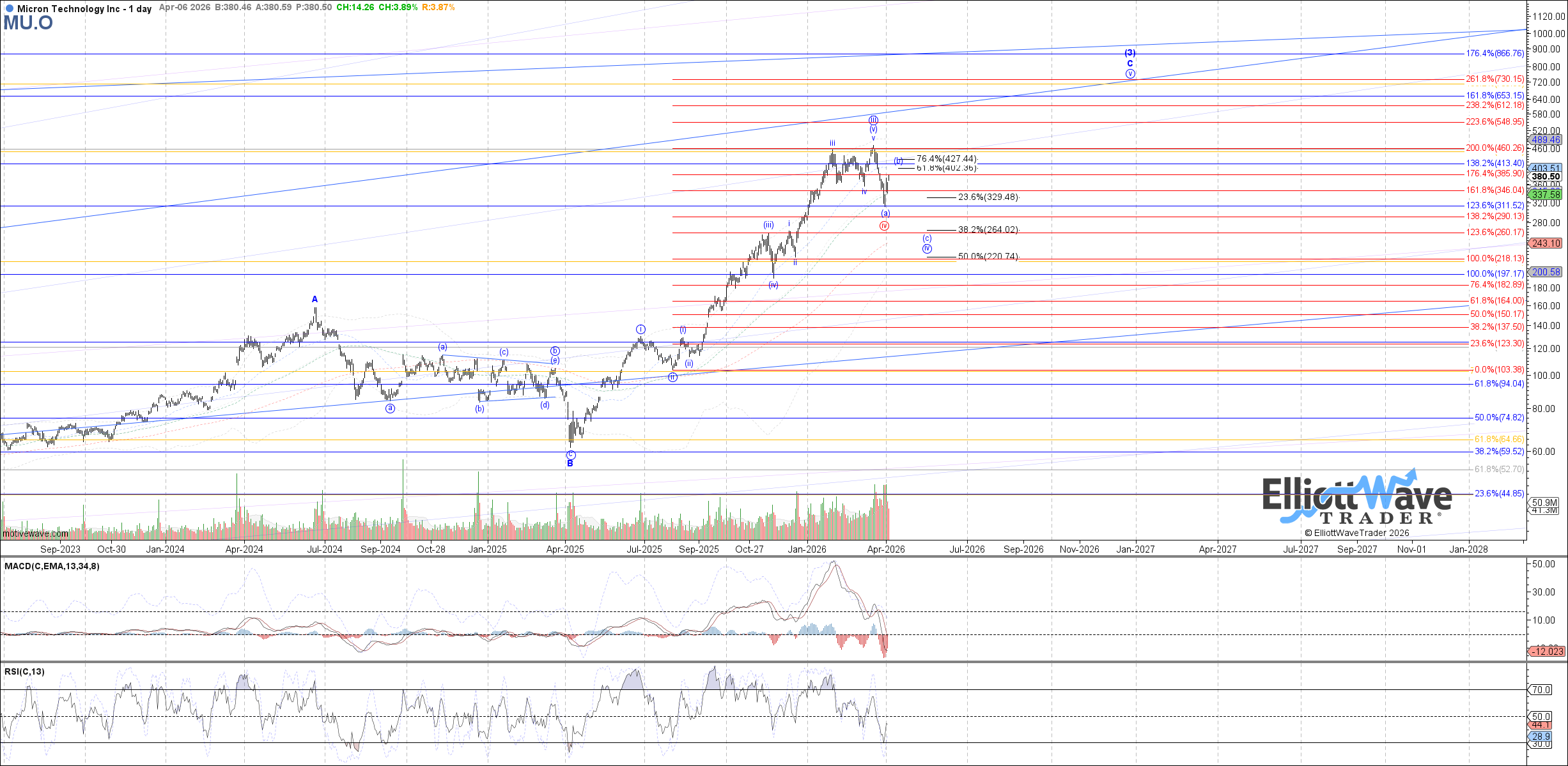
Note that the larger structure implies a move higher to complete the Intermediate Wave (3).
As Lyn notes: "Whenever technicals show signs of a bottom forming, I view the fundamentals as justifying another leg higher."
That is the convergence worth watching. Fundamentals that remain intact. A structure of price that may be setting up to reflect them again.
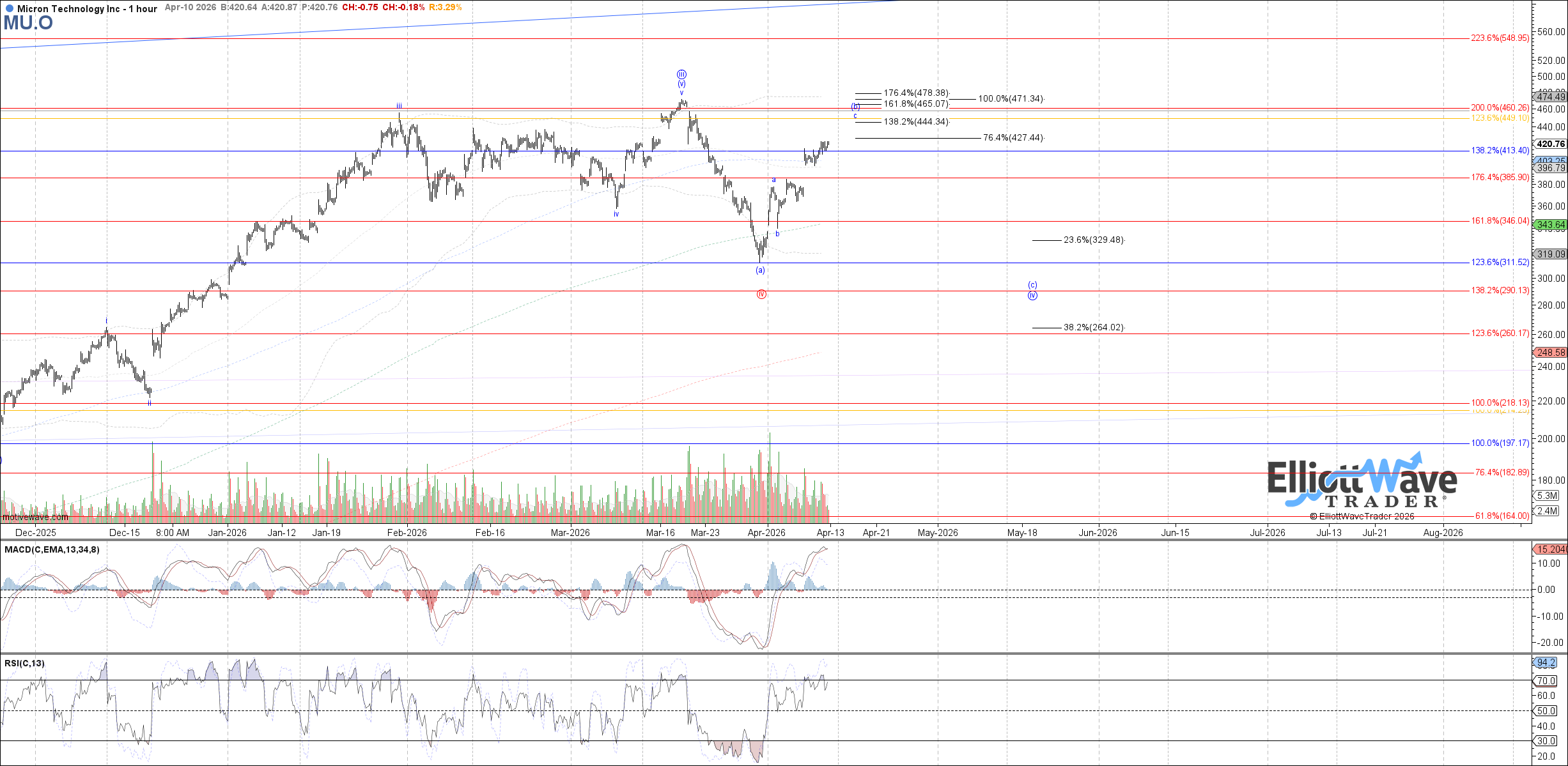
But we must pay heed to the two main possible paths currently ahead. One is the primary blue count Garrett is showing. This (b) wave of the circle ‘iv’ was anticipated and has thus played out as such. Could it be the alternate red circle ‘iv’ already in place at the low struck near the end of March?
Yes, it could. Standards suggest that the (c) of ‘iv’ will yet play out. How will we determine which path is in the lead and what is the best way to use this information?
The answer is straightforward. Should a lesser degree wave (i) of the (c) wave of ‘iv’ form from this area, then it would strongly lean towards the blue path. If there is only a corrective and overlapping pullback from the current area followed by price taking out this recent high, then the red ‘iv’ is already in place and price should climb to new highs in ‘v’ of C of (3).
The Geopolitical Dimension
One American company. Two South Korean competitors. In the current environment — where supply chain resilience and domestic semiconductor production have become policy priorities — that detail carries weight that extends beyond the balance sheet.
Micron is not simply a memory play. It is the memory play for investors seeking domestic exposure to one of the most structurally consequential components of the AI infrastructure buildout.
The Convergence Ahead
The AI infrastructure buildout is not a single trade. It is a sequence — and the market has not yet finished absorbing it. Compute captured the first chapter. Memory may be writing the next one.
Micron sits at the intersection of a structural demand shift, a favorable geopolitical position, and a price structure that may be setting up for its next leg higher. The cycle has further to run. The fundamentals remain intact. And the only American company that produces the memory the AI age increasingly depends on is now offering investors two clear near term scenarios worth examining.
The chart will confirm what the fundamentals are already suggesting. The structure of price does not argue. It concludes.
