The Unseen Layer Beneath the AI Infrastructure
 By
Levi
By
Levi
CoreWeave powers the GPU cloud that Meta, Microsoft, OpenAI, and Anthropic run on. The structure of price suggests the crowd is just beginning to notice.
The artificial intelligence race has produced a familiar cast of characters. Nvidia makes the chips. The hyperscalers build the models. The chatbots get the headlines.
But someone has to run the infrastructure that makes all of it work in real time.
That company is CoreWeave (CRWV).
What CoreWeave Does
Founded in 2017 as a cryptocurrency mining operation, CoreWeave pivoted to GPU cloud infrastructure when the crypto market collapsed — and shrewdly accumulated the Nvidia hardware that the AI boom would soon make impossible to source.
CoreWeave is a specialized GPU cloud provider — the critical link between Nvidia's hardware and the AI models that depend on it. Rather than building their own data centers from scratch, companies like Meta, Microsoft, OpenAI, and Anthropic rent CoreWeave's GPU capacity to train models and run inference at scale.
The business model is built on reservation contracts — multi-year agreements where customers pre-purchase blocks of GPU capacity. That structure gives CoreWeave something rare for a growth-stage company: visibility. Its current backlog exceeds $66 billion.
Nine of the ten largest AI model developers run on its infrastructure.
The Risks Worth Knowing
This is not a simple story. CoreWeave carries substantial debt — roughly $30 billion — and the company currently spends approximately $2.30 for every dollar of revenue it generates. That is not a typo. The business is in hyper-expansion mode, and the financial statements reflect it. For investors accustomed to evaluating companies on traditional profitability metrics, CoreWeave will not pass that screen.
Customer concentration adds another layer of risk. Microsoft represented nearly 67 percent of CoreWeave's 2025 revenue. The recent deals with Meta and Anthropic are diversifying that exposure, but the dependency on a small number of enormous customers means that a single contract renegotiation or relationship shift carries outsized consequences.
The competitive landscape is also evolving. Nebius, Lambda Labs, and the hyperscalers themselves are all building out GPU capacity. Amazon, Microsoft, and Google are simultaneously CoreWeave's customers and its most well-capitalized potential competitors. That tension does not resolve easily.
Longer term, GPU compute will face commoditization pressure as supply catches up with demand — and it always does eventually. CoreWeave's current advantage is positional: privileged access to Nvidia's best hardware before the broader market can secure it. That advantage is real. It is also temporary by nature.
These are risks the structure of price will ultimately arbitrate.
What the Chart Is Showing
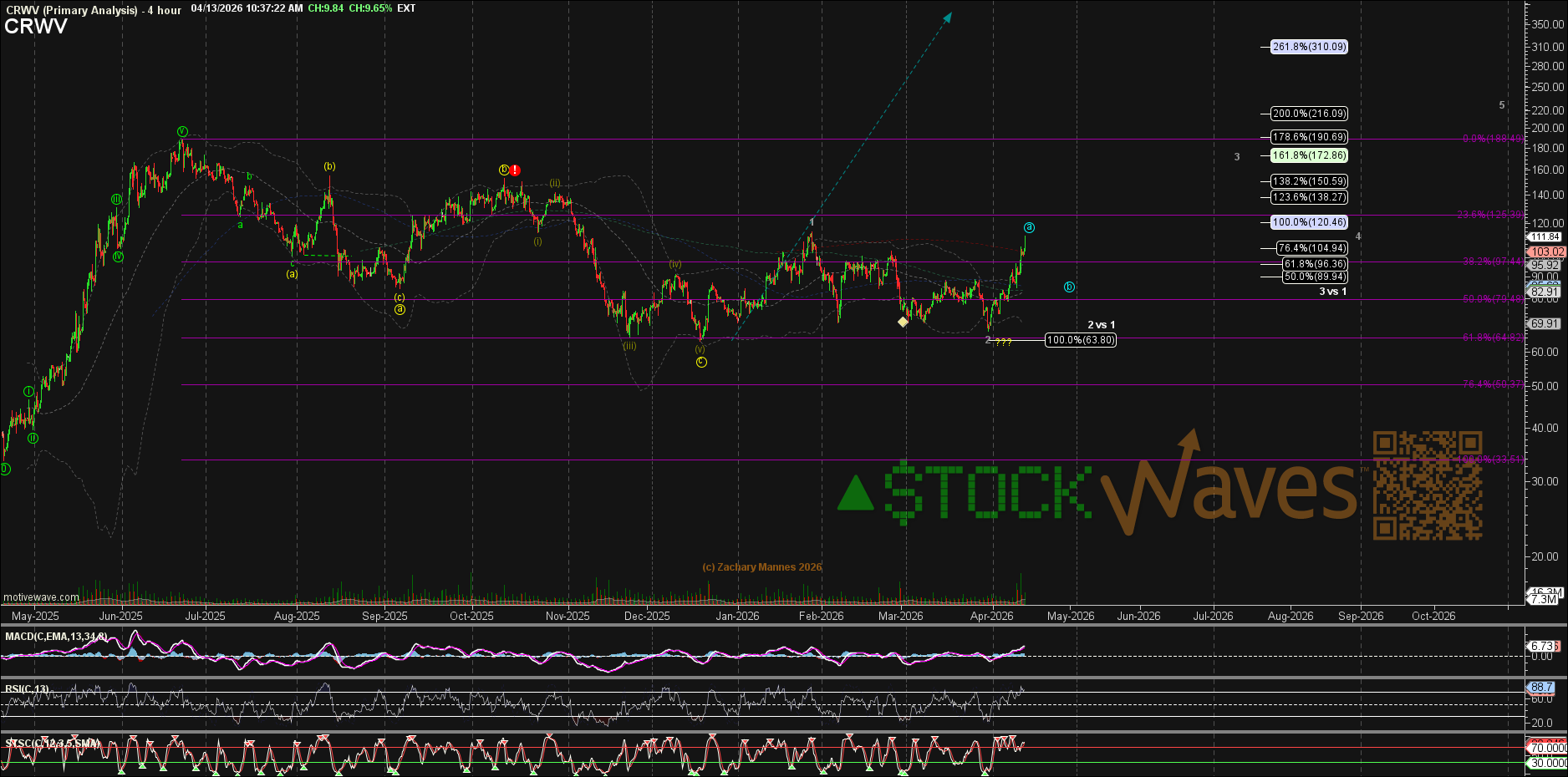
CoreWeave went public in March 2025 at $40 per share. From the post-IPO low, the structure of price has developed what appears to be a clear five-wave advance — the kind of organized, sentiment-driven progression that tends to resolve significantly higher before it exhausts itself.
The current wave structure suggests the stock may still be in the early stages of that larger advance, with Fibonacci targets pointing toward as high as the $172 range over the coming months.
The immediate test is the $120-$122 zone. A corrective pullback may be seen in the interim with support at $81 - $95.
Should price instead break directly above resistance, then it targets $138 - $150 next. Our purpose is not to predict the future — it is to identify the most probable path and the parameters that define it. That is the nature of crowd behavior.
The Unseen Becoming Visible
CoreWeave occupies a position that most investors have not yet fully examined — the foundation that the AI infrastructure depends on. The backlog is real. The customer relationships are institutional. The risks are substantial and worth taking seriously.
What the structure of price adds to that picture is timing. The five-wave advance from the IPO low suggests the crowd is in the early stages of recognizing what CoreWeave is and what it represents within the AI buildout. That recognition does not arrive all at once. It builds — wave by wave — until the unseen layer is no longer unseen.
The crowd has been watching the models. The chart suggests it may be time to watch what runs them.
