
Tempus AI: A Tale of Two Narratives — and One Set of Price Parameters
 By
Levi
By
Levi
Tempus AI has become less a stock and more a storyline.
On one side stands the vision: artificial intelligence transforming oncology, a vast clinical and molecular data library embedded into hospital workflows, and the possibility of building a durable, high-margin precision medicine platform. In this framing, Tempus is infrastructure — not discretionary software — and its long-term value lies in the depth of its data moat.
On the other side stands skepticism. More than $700 million in accumulated GAAP losses. Over $1.3 billion in debt. Aggressive acquisitions. Convertible notes that depend on materially higher equity prices to ease future obligations. For critics, the concern is not the science — it is the financial architecture.
Both narratives can be argued convincingly.
That is precisely the danger.
When a stock becomes narrative-driven, investors often stop asking the most important question: At what point am I wrong?
The bullish investor may view every pullback as opportunity, anchored to disruption and long-term transformation. The bearish investor may interpret every rally as temporary relief, anchored to balance sheet strain and dilution risk. In both cases, conviction quietly hardens. The story becomes the anchor. Price becomes secondary.
Markets do not reward attachment. They reward alignment.
Tempus currently trades roughly 50% below its 2025 highs. Short interest remains elevated. Insider selling has drawn attention. Earnings approach. The emotional temperature is high — which makes discipline even more essential.
This is where price parameters matter.
Parameters are not predictions. They are boundaries. Above certain levels, the technical backdrop begins to validate the bullish thesis. Below others, the bearish case gains material confirmation. Between them lies noise — and noise is where narrative thrives.
The objective is not to decide whether Tempus will revolutionize precision medicine or replay a familiar corporate arc.
The objective is to define, in advance, the specific levels that invalidate whichever thesis you are operating under.
Because once narrative replaces parameters, risk becomes elastic.
And elastic risk is how investors find themselves holding tightly to a story long after price has already delivered its verdict.
Price does not argue.
It confirms — or it does not.
And that confirmation begins with clearly defined parameters.
⸻
So, Narrative or Structure?
The market does not vote based on vision statements or skepticism. It votes through behavior — through where buyers step in, where sellers press, and where momentum either sustains or fractures. That behavior leaves a footprint.
And that footprint is measurable.
Rather than debate precision oncology or dissect convertible mechanics, we can ask a simpler question: What is price actually doing? Is participation expanding or contracting? Are advances impulsive or corrective? Are pullbacks being absorbed — or extended?
These are not philosophical questions. They are structural ones.
The chart does not care which side of the narrative you favor. It reflects positioning — nothing more.
So before taking a stance, we turn to the one arbiter that does not spin a story.
We turn to price behavior itself.
Let’s examine what it is communicating now.
⸻
The Chart — Where Parameters Take Over
From a structural standpoint, Tempus is attempting to build something constructive — but it has not yet confirmed it.
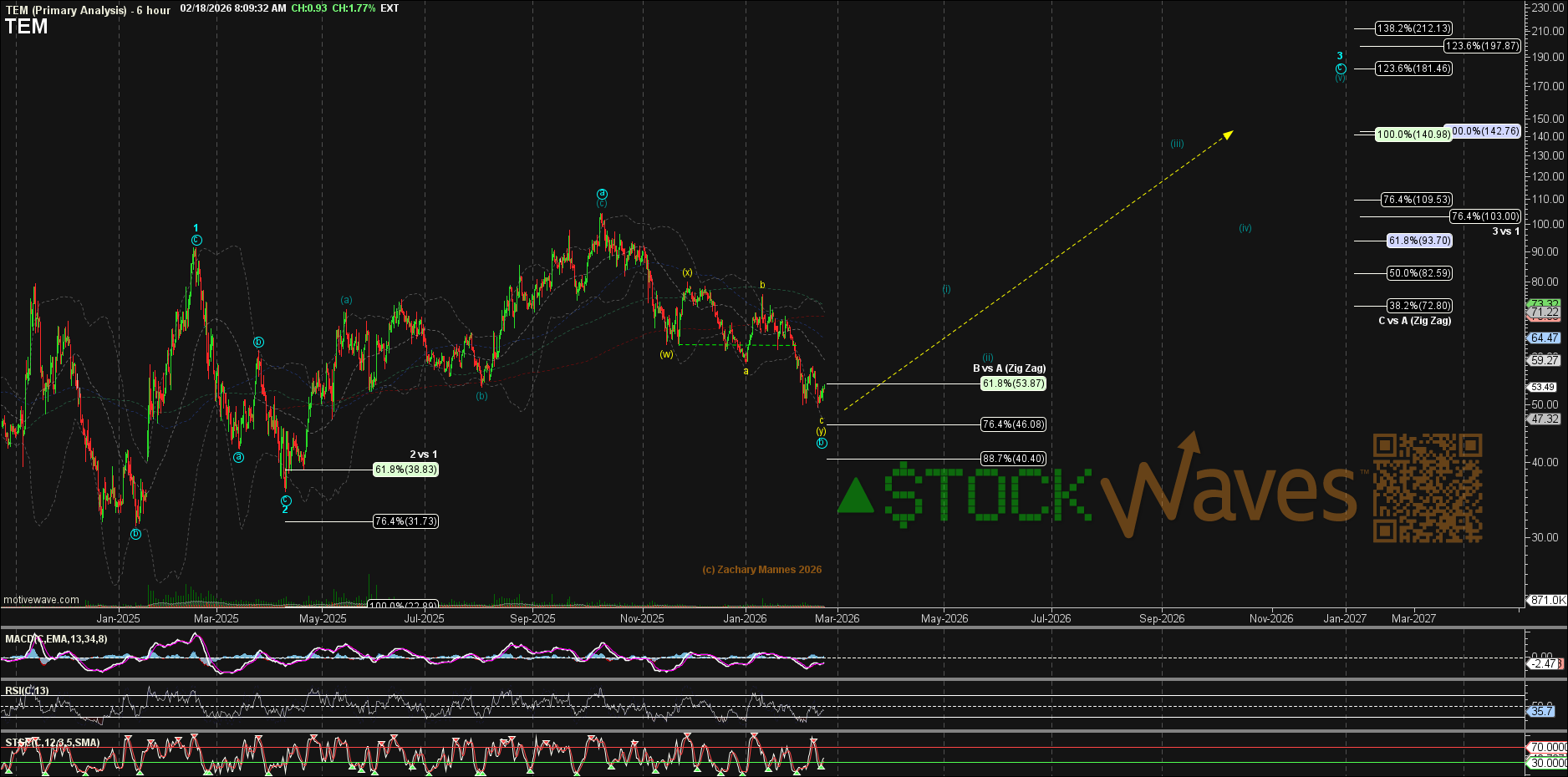
The broader pattern allows for a potential upswing extending into the latter part of 2026. However, that larger path remains conditional. The critical downside boundary currently sits near the $36 region. A sustained break below that level would materially damage the bullish framework and suggest something more defensive is unfolding.
In the near term, price has traced three waves up from its most recent low at the $49 area. That alone does not confirm a durable advance — three-wave moves can be corrective. What matters now is whether the next push resolves as a clean five-wave structure.
If price completes a five-wave advance into the $63–$65 region and subsequently pulls back in a controlled, corrective manner that holds above $49, the larger bullish pathway strengthens considerably. In that scenario, the stock would likely be transitioning into the next major advancing phase — a broader rally leg capable of carrying further into 2026.
Conversely, failure to extend impulsively — or a breakdown back beneath $36 — would shift probabilities sharply in favor of a more prolonged consolidation or deeper retracement.
These are not predictions.
They are parameters.
Above them, the upside thesis gains structural confirmation. Below them, it does not.
And that distinction outweighs either narrative currently competing for attention.
⸻
Conclusion
Tempus AI does not need investors to choose a narrative. It needs price to reveal which side is gaining traction.
The long-term opportunity remains viable as long as key downside parameters hold. The bullish pathway requires an impulsive extension higher, followed by a corrective retracement that respects prior support. If that sequence unfolds, the larger advance into 2026 becomes structurally consistent.
If it does not — if upside momentum stalls or deeper support gives way — then the market will have issued its verdict regardless of how compelling the underlying story may be.
This is the discipline that protects capital.
Narratives invite attachment. Parameters enforce accountability.
In a stock like TEM — where optimism and skepticism are equally persuasive — the only rational approach is to define invalidation before defining expectation.
Price will settle the debate.
Our responsibility is not to defend a thesis, but to respect the levels that confirm or contradict it.
