
TSLA: A Remarkably Slow Poison
 By
Levi
By
Levi
The Quote As Usually Told
There is a story famously repeated about the French writer and philosopher, Voltaire. He joked about his heavy caffeine habit when his doctor warned him that it was a slow poison, replying, “Yes, it is a remarkably slow poison; I’ve been drinking it for seventy-five years.”
When coffee first reached Western Europe, it was decried and branded as an outright poison. So much was this belief repeated that it became the crowd consensus. Even the doctor began to use the refrain as truth. But, why the worry? Legend has it that Voltaire drank 40 to 70 cups of coffee a day. Openly, nobody knows. Stories grow and embellishment increases as they are continually retold and augmented.
There have been modern-day scientific studies regarding coffee consumption and mortality. But it depends on how one interprets the data. The NIH-AARP study, which followed about 400,000 adults aged 50 to 71 and was published in the New England Journal of Medicine in 2012, found that adults who drank three or more cups of coffee a day carried roughly a 10% lower risk of death than non-drinkers. The raw numbers, though, first made coffee drinkers look more likely to die. Once smoking, alcohol, red meat and exercise were accounted for, the pattern flipped. At first glance the data read poison; with the fuller context, it read the other way.
Well, veracity and origin aside — which we’ll get to later — the substance of the quip has an interesting overlay with TSLA. Personally, I’m with Voltaire, or whoever is rightly credited with the quote. Three quad espressos per day is not beyond my reach, doctor’s advice or not. As for TSLA, the chart says this patient has plenty of life left in it yet.
The Diagnosis: Doctor’s Chart vs. Patient’s Record
In the stock world, the doctor’s test of choice is valuation. On TSLA, that test has come back “slow poison” for most of its public life. Yet, the patient keeps pouring cups.
The Doctor’s Chart
TSLA carries a trailing P/E of about 343 against a market average near 45. Its forward P/E estimates run well into triple digits.
However, the doctors don’t agree with each other: among 47 analysts the consensus is “Hold,” with price targets ranging anywhere from $25.28 to $840. A 33-fold gap between the lowest and highest diagnosis says the instruments aren’t reading this patient.
Updated lab results: Q3 deliveries of 486,532 beat consensus by about 25,000, but were down 2% year over year. The stock was up about 5% on October 2. Tesla’s last earnings, on July 23, missed expectations on EPS at $0.33 vs. $0.50.
TSLA stock is down roughly 18% for 2026 through October 2, the only Magnificent Seven name in the negative this year.
The Patient’s Record
Short sellers read the lab results and see a terminal case. By 2021, Tesla had been their biggest and most painful target since at least 2010, and S3 Partners’ Ihor Dusaniwsky called it “the worst-performing domestic short trade for the last decade or more.” In 2020 shorts lost $40.1 billion, nearly six times any other stock; Tesla rose about 700% that year.
Short interest has thinned from about 20% of float in 2020 to about 2.2% now. Most of the loudest doctors have packed their bags and gone home. The diagnosis stayed behind.
Data and Doubt
We have a great deal of data before us. But just as in the coffee study, the meaning hinges on the angle and interpretation of said data. It must be acknowledged that the poison did bite once. In 2022 the stock fell 65%. This was its worst year ever. Shorts cleaned up, making approximately $15 billion, according to Institutional Investor.
Then 2023 handed most of it back. The stock more than doubled, and shorts lost about $12.6 billion. We need a way to read this patient. The price swings are such that profit in both directions is available for those ready and equipped to harness it.
Lyn Alden: The Physician Who Declines to Prescribe
Lyn Alden is our lead fundamental analyst, world-class in her own right. The best fundamental physician in the room looks at this patient and sets her instruments down. That isn’t a bear or bull call; it’s her judgment about which tool fits, and it hands the case to sentiment and the structure of price on the chart.
When queried regarding TSLA, Lyn’s consistent diagnosis is:
Doctor’s orders, let’s turn to sentiment for our read.I don’t have fundamental coverage on Tesla, since it trades almost entirely on sentiment rather than fundamentals.
The Chart That Reads This Patient
If valuation isn’t the tool to read this patient, structure is. Crowd behavior is what structure records. Both Zac Mannes and Garrett Patten are showing a longer-term bullish setup.
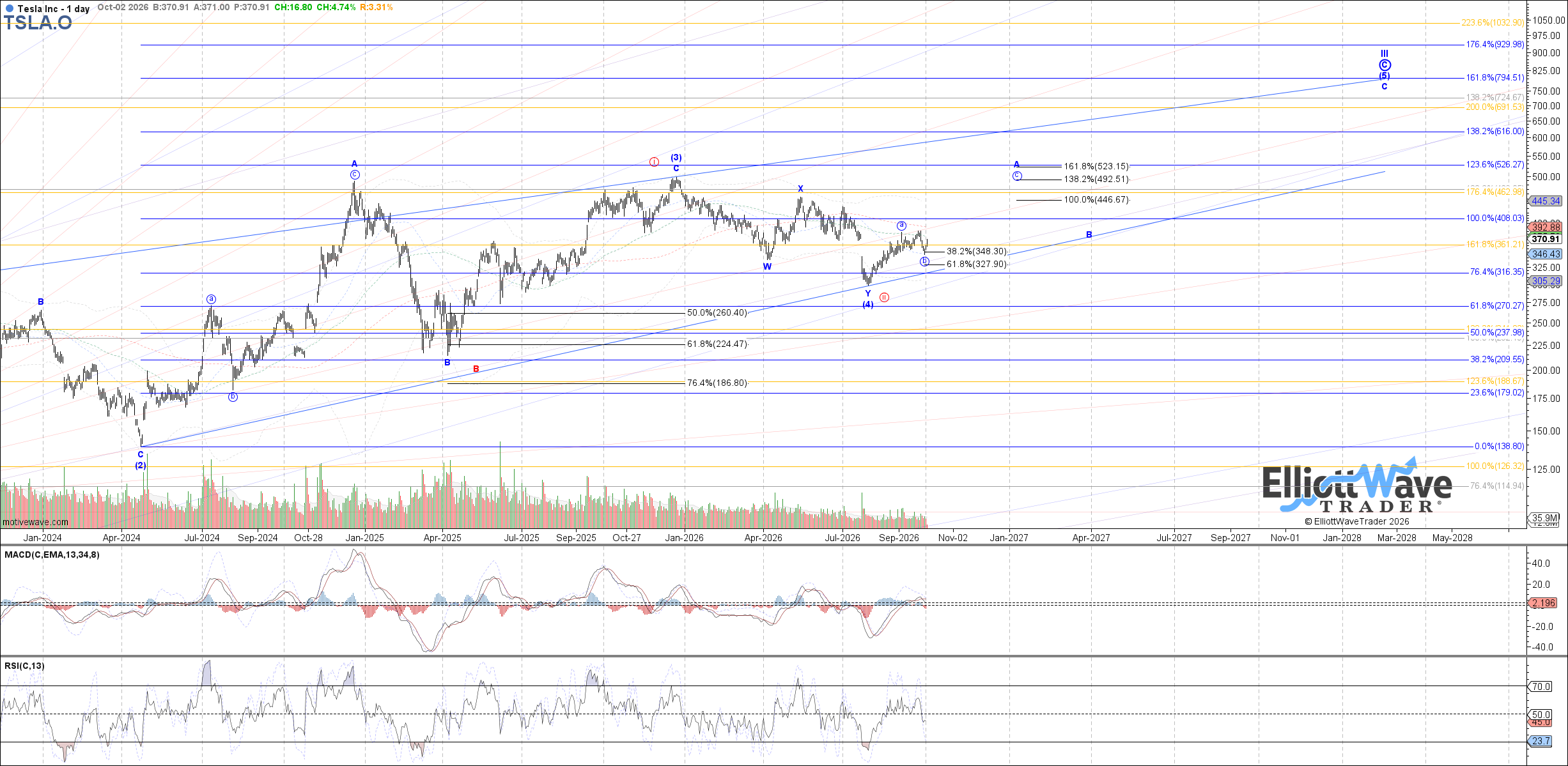
Garrett’s daily chart shows price as being in the A wave of an Intermediate Wave (5) higher. This is part of a larger rally structure that should extend over the next several months.
 Zac’s 6-hour interval chart shows a similar path.
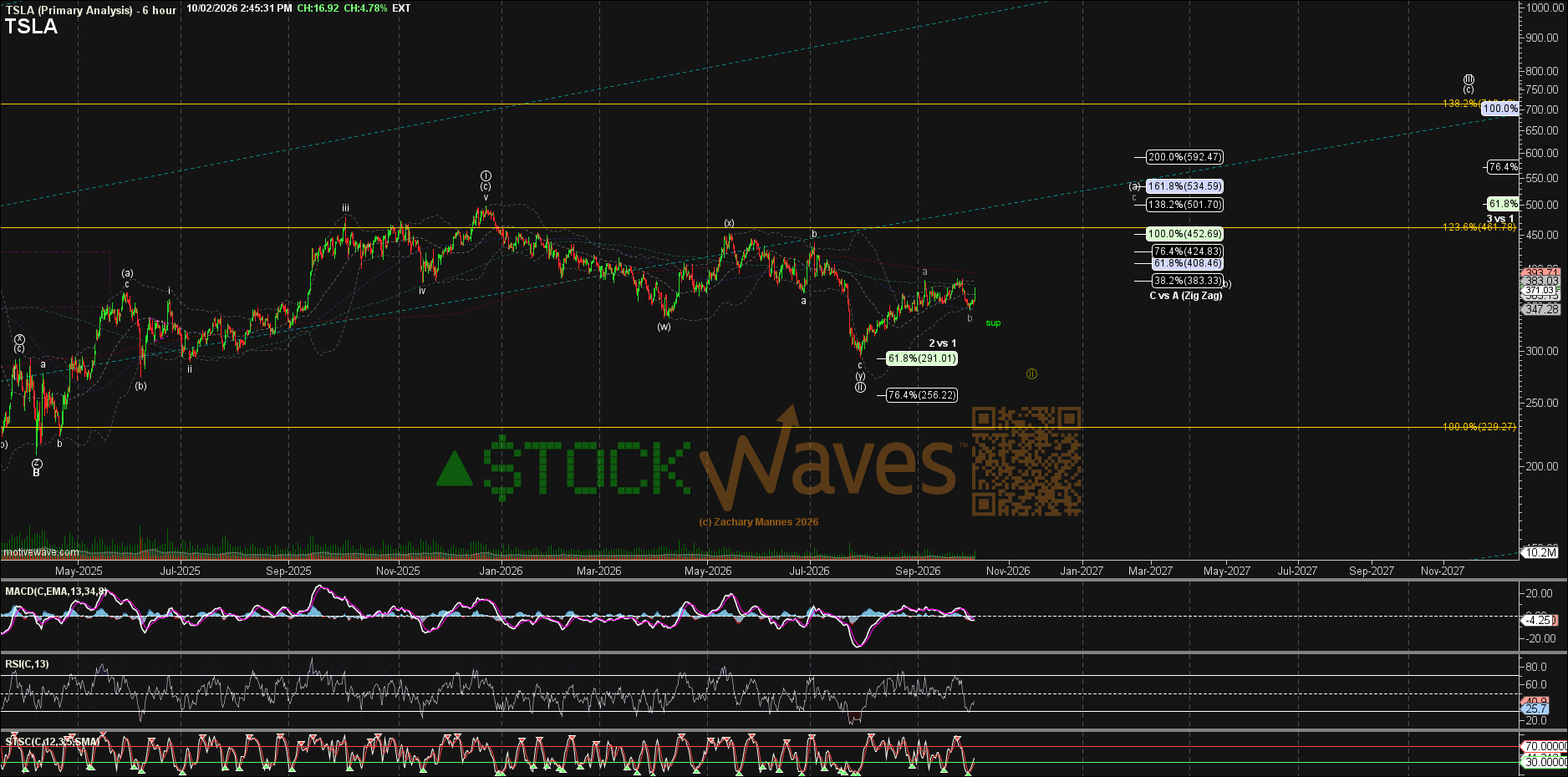 While the smaller subwaves may differ slightly, the overall prognosis for the patient is higher. This is by no means a guess. Zoom out to the larger structure on the chart, and the advance is the likely path forward given what came before.
Remember, the market is fractal in nature. Being variably self-similar at all degrees means that the smaller fractal patterns will repeat at the larger scale. So, for as long as this nature continues to replicate its structure, higher is expected.
With $345 as our key low in the immediate near term, price should extend to the $452 area or higher next. Back below $345 would be a caution flag, and a deeper pullback is plausible, just less likely at this time.
Keep in mind that earnings land on Wednesday, October 21, after the close. Consider it the patient’s next check-up: a test of sentiment, with the chart still doing the diagnosing.
Full Disclosure: The Line Wasn’t His
Voltaire’s quote about the “remarkably slow poison” almost certainly wasn’t his. The crowd handed it to the bigger name and kept repeating the embellishments until they grew implausible, even fantastical. A good yarn always outruns the facts.
The earliest known version of this quote is from a 1780 French almanac, two years after Voltaire died. It credits Bernard de Fontenelle, not Voltaire, with “more than eighty years” of daily coffee.
Fontenelle died in 1757, a month short of 100 years of age. Voltaire died in 1778 at 83, so seventy-five years of coffee would put his first cup at about age eight. The Voltaire version first appears in an 1807 English translation of August von Kotzebue’s anecdotes, with the years trimmed to seventy-five. The numbers kept drifting with each retelling: 40, 60, 80 and so on. What’s more, one long-lived coffee drinker proves nothing.
Tesla gets the same treatment every quarter. Its stories are retold, re-credited and embellished, while the chart keeps the one record the crowd can’t edit. By that record, this patient isn’t yet done drinking its coffee.
