
Starlink Owns the Sky — Verizon Owns Everything Under It
 By
Levi
By
Levi
Verizon's pullback from $52 looks like a casualty of the Starlink narrative. The structure of price suggests the market may be misreading the threat.
The headlines have not been kind to Verizon lately.
Satellite connectivity is expanding. SpaceX is eyeing spectrum that Verizon may have to bid against it to secure. The narrative forming around the major wireless carriers is one of disruption — a sky full of satellites slowly rendering ground-based infrastructure obsolete.
That narrative is compelling. It is also incomplete.
Here is what the Starlink threat actually looks like in practice: it works outdoors, in open areas, where traditional cell coverage is sparse or nonexistent. It works in rural dead zones, on remote hiking trails, and in the middle of the ocean. These are real capabilities, and they represent a genuine expansion of what wireless connectivity can do.
But walk inside a building and the equation changes.
Satellite signals have a physics problem that no amount of engineering ambition fully solves. They travel from low Earth orbit to your device — a journey that struggles with rooftops, walls, and the accumulated density of urban construction. The indoor coverage that most consumers depend on for most of their day remains the domain of terrestrial cell infrastructure. That infrastructure belongs to carriers like Verizon.
Verizon's own CEO acknowledged the dynamic plainly, telling Yahoo Finance that he views SpaceX as complementary rather than existential — adding that while competition in certain areas is inevitable, the two technologies serve fundamentally different use cases. That is not spin. It is an accurate description of where satellite-to-cell technology currently stands.
None of that means Starlink poses zero threat. SpaceX is applying to participate in the FCC's upcoming AWS-3 spectrum auction in June 2026 — which means Verizon may face higher costs to secure the spectrum it needs to remain competitive. That is a real headwind. It is also a known one, and known headwinds have a way of becoming absorbed into price before the crowd fully registers that the worst-case scenario is not the base case.
What Sentiment Does With a Good Story
Verizon ran from $38 to $52 in a sustained advance that reflected genuine improving sentiment around the stock. Dividend stability, broadband growth, and a more disciplined capital allocation story all contributed to a narrative that investors were increasingly willing to believe.
Then the Starlink headlines arrived. And sentiment, which had been expanding, began to rotate.
That rotation is what the current pullback reflects. Not a fundamental deterioration. Not a structural collapse in Verizon's competitive position. A shift in how the crowd is weighing a threat that is real in certain contexts and overstated in others.
Sentiment Speaks
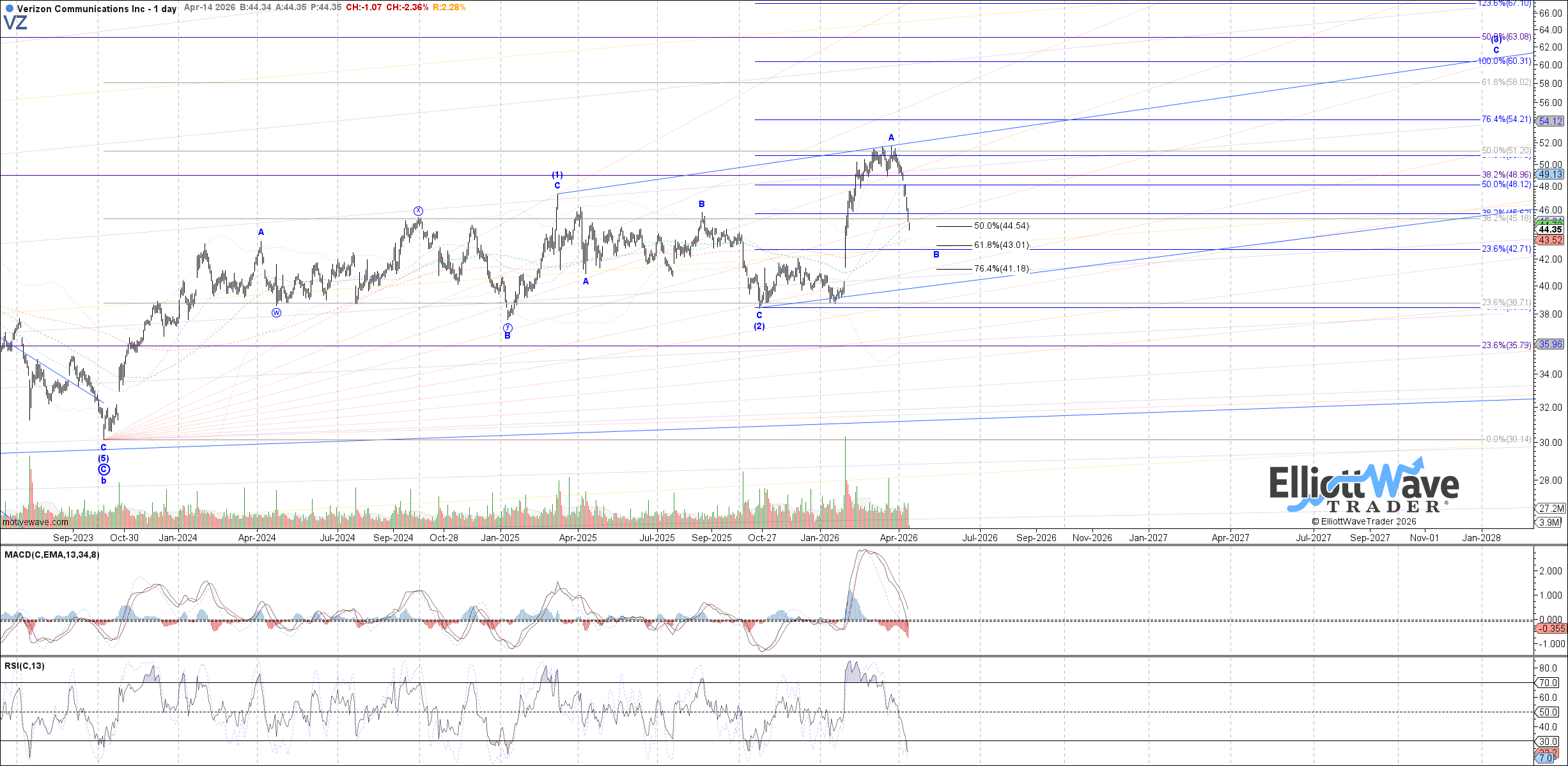
Back in the Fall of 2023 VZ found a key low near the $30 level. This is likely a durable nadir for some time ahead. Garrett Patten, senior analyst at Elliott Wave Trader, is counting this as a Cycle ‘b’ low meaning that a Cycle ‘c’ rally now unfolds over the next several months to years. This ‘c’ should form in five waves — the kind of organized, directional advance that, over time, tends to carry price significantly higher.
It would now appear that wave (1) of this advance shaped up as an A-B-C, thereby signaling a diagonal. Wave (2) formed its correction and completed at the $38 area. Wave A of (3) is now marked at the high struck a few weeks back.
Since then, price has pulled back sharply, as B waves in diagonal many times will do. What is anticipated next should be straightforward and clear to the observer.
A lesser degree five waves up should now form to suggest that the B of (3) has finished and that the C wave of (3) is underway. Note that this current B wave may just be a straight line down to support in the $42-44 area, or it may also be an a-b-c structure.
How will we know which is which? Should the bounce from these current levels be overlapping and corrective in nature, then it is more probable that it is a ‘b’ of B with a ‘c’ wave down to follow. If instead we see a clear 5 waves up from support and then a corrective decline, that is a signal that a more important low may already be in place.
Conclusion
The crowd found a story it liked — and then found a better one. That is how sentiment works at turning points. The Starlink narrative arrived at precisely the moment Verizon's advance needed a reason to pause, and the crowd obliged. But pauses are not reversals. The structure suggests this one is a setup rather than a conclusion. Starlink owns the sky. What happens under it — in the buildings, the basements, and the spaces where people actually live — still belongs to Verizon.
