
Sentiment Had Soured Before the Swoon
 By
Levi
By
Levi
Last week, shares of Super Micro Computer (SMCI) fell after news broke that a company co-founder had been indicted for allegedly diverting AI servers to China. This week, a new shareholder class action lawsuit filed in California sent investors bailing once again. The headlines were dramatic. The selling was swift.
But the chart had already seen this coming.
What the News Appeared to Explain
On the surface, the narrative writes itself. A co-founder indicted for allegedly rerouting AI hardware to China. A shareholder lawsuit following close behind. For investors watching from the outside, the cause of the decline seemed obvious — and the news cycle was happy to provide the explanation.
That explanation, however, arrives after the fact.
Sentiment analysis does not view markets as omniscient mechanisms that efficiently process information and reflect it in price. Markets are not calculators. They are crowds — emotional, fluid, and driven by the collective psychology of participants who are often responding to forces they cannot yet articulate.
The structure of price reflects that psychology before the headlines do.
A Company at the Center of the AI Buildout
For investors less familiar with the company, Super Micro Computer designs and manufactures high-performance server and storage solutions. It has become a central player in the AI infrastructure buildout, supplying the data center hardware that powers the rapid expansion of artificial intelligence across industries.
Its close relationship with Nvidia — SMCI integrates Nvidia GPUs into its server platforms — made it a favored proxy for AI infrastructure exposure during the height of the AI enthusiasm cycle. The stock reflected that enthusiasm dramatically, surging from the low single digits in 2023 to a peak above $120 in early 2024.
That peak, as it turned out, was the beginning of a different story.
SMCI had already been carrying the weight of accounting irregularities and auditor delays well before last week's indictment. A prior auditor resignation and Nasdaq compliance issues had kept a cloud over the company through much of 2024 and into 2025. The co-founder indictment and shareholder lawsuit are the latest chapters in a narrative that sentiment had already begun to reflect — not because the market knew what was coming, but because the crowd's confidence had already begun to erode.
What the Chart Showed in February
As of February 3rd, with SMCI trading near $28.88, the primary path on the chart was already pointing lower.
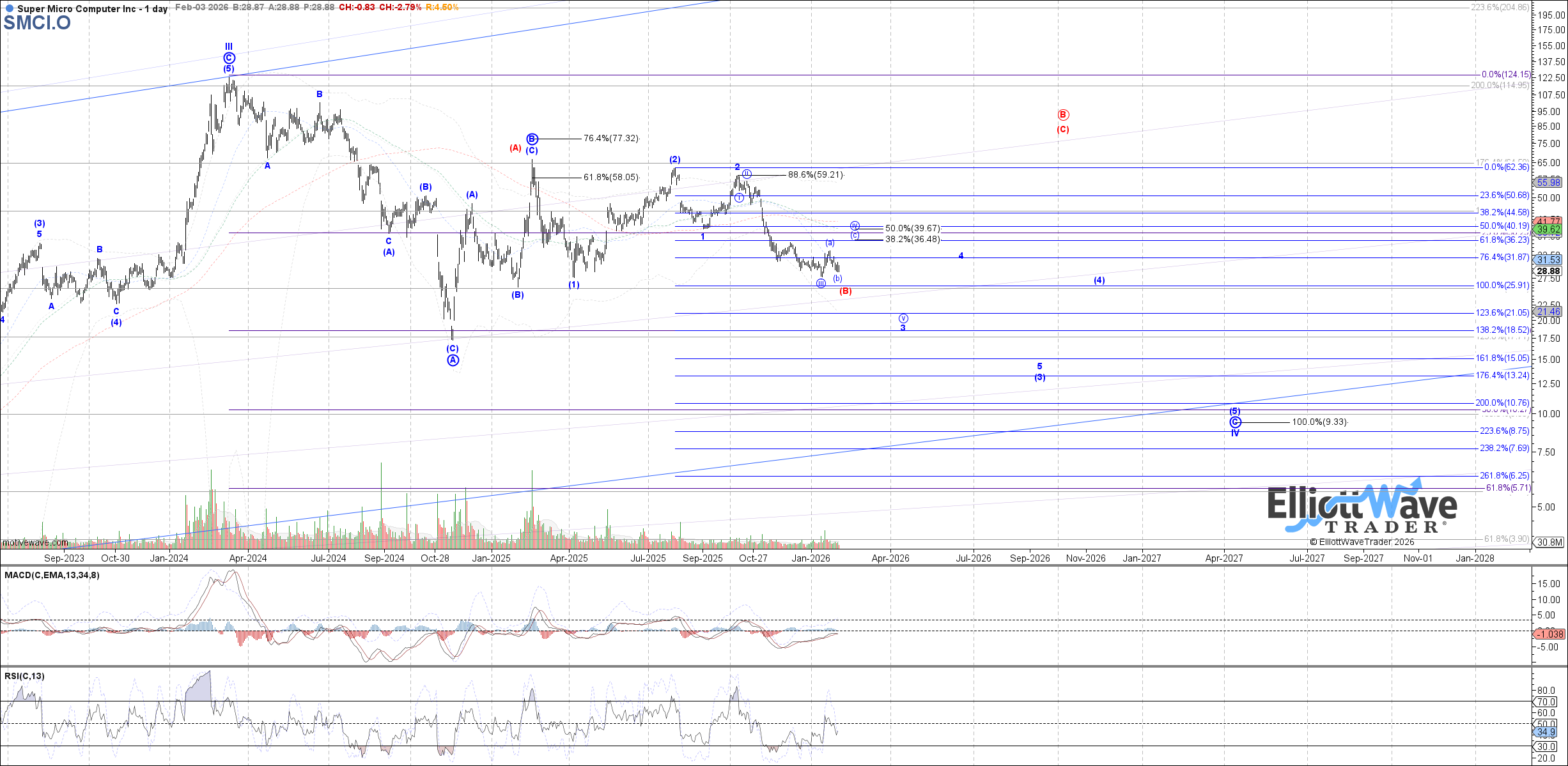
The structure of price at that point suggested the stock was developing within a larger bearish sequence — a multi-wave corrective pattern that implied not a temporary pullback but a sustained decline. The crowd had already begun withdrawing. The optimism that had carried the stock from single digits to triple digits had now shifted to something more cautious, more hesitant, more fragile.
No indictment had been announced. No lawsuit had been filed. The structure of sentiment had simply begun to speak.
Where Price Stands Now
The most current March chart tells the next part of the story.
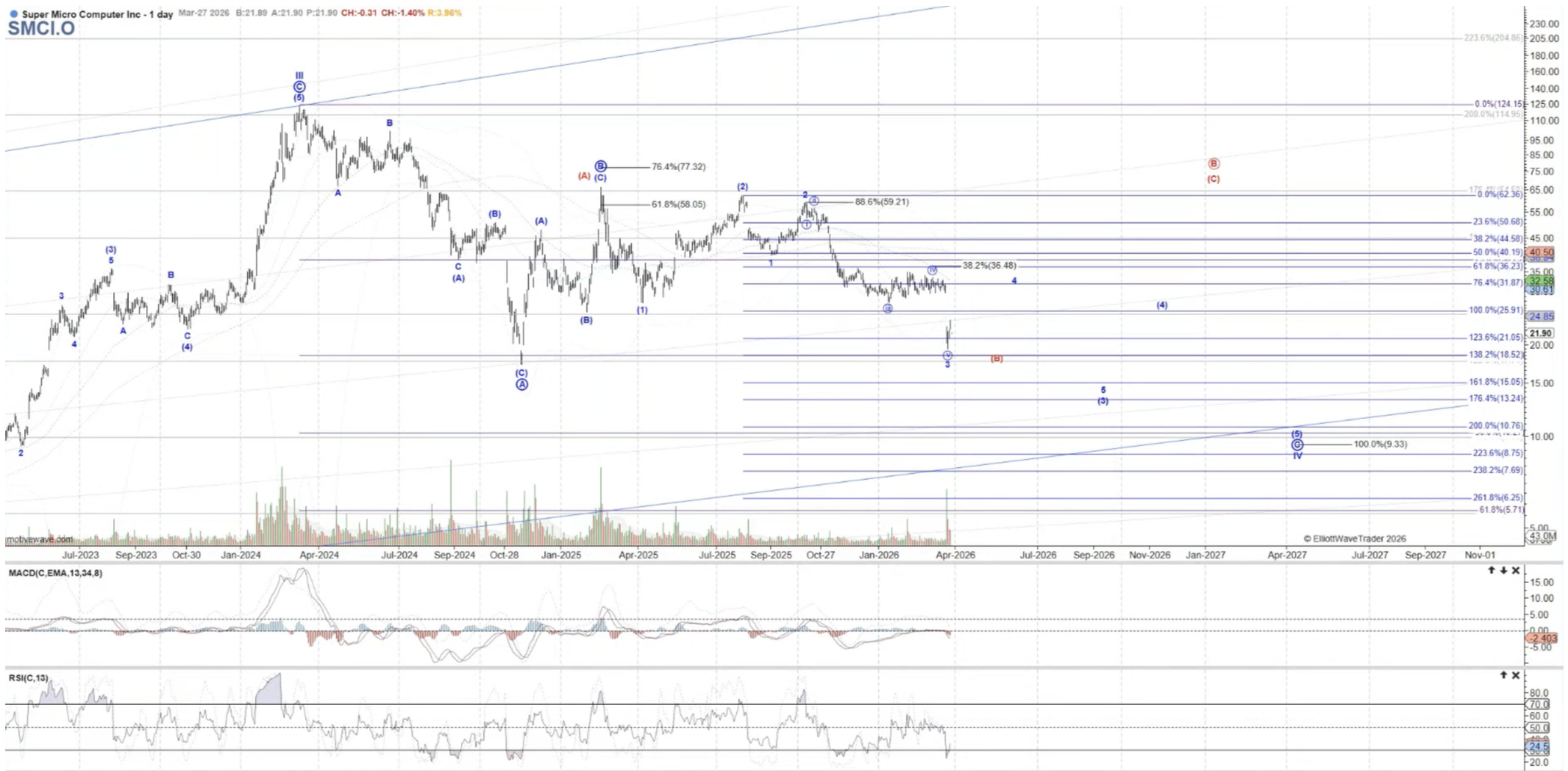
Price has followed the path already sketched in February with unsettling precision. The current structure suggests the stock is working through a continuation of that bearish sequence, with Fibonacci support levels visible on the chart at $21.05, $18.52, and $15.05 as successive downside waypoints.
This does not appear to be a bottoming process. The structure suggests there is more work to be done before a durable base is established.
What the Sequence Reveals
The lesson embedded in SMCI's chart is not about one company or one indictment. It is about the relationship between sentiment and news — and which one leads.
By the time a headline explains a decline, the decline is often already underway. The news does not create the trend. It confirms what the crowd had already begun expressing through price — before the story was written, before the filing was made, before the explanation arrived.
SMCI does likely find an important low at some point. For now, we retain a downside bias. Should, however, price form a clear 5 wave structure up from these levels, followed by a corrective 3 wave decline and then take out the high formed by the 5 waves, it would be considered constructive from a crowd behavior study standpoint.
This does not seem like the most probable scenario though.
There is a moment when the weight of evidence in the chart simply becomes the conclusion.
In SMCI's case, that conclusion was already visible via the structure of price in February. The co-founder indictment and the shareholder lawsuit did not change the story.
They just appear to have amplified it.
