
SPCX + TSLA: Same Building — Separate Invoices
 By
Levi
By
Levi
Terafab was reported as news about a factory. But it is really news about a stock price.
The building depends on the multiple that funds it. Which would mean the chart is not downstream of Terafab. It is upstream.
On August 6, Tesla and SpaceX confirmed the site for the largest fab ever attempted. They are building it together in Grimes County, under one roof. But they are not paying for it the same way, and that difference is the only thing that matters to either chart. SpaceX pays in stock the market values at a premium. Tesla pays in cash from a quarter that produced a 1.4% operating margin and negative free cash flow. Same building. Separate invoices.
Before this took place, much of the investing world was fixated on the SPCX IPO. Opinions abounded regarding the outcome. As the IPO was in the final stages of coming to market, we published a target for where the stock might initially reach.
Our work produced a zone of $225 - $240 for where the post-IPO advance would likely end. The high came in at $225.64 on June 16. The projection rested on assumptions based on the valuation points placed on the pre-IPO shares. It was aimed at where the crowd would run out of enthusiasm.
Crowd sentiment is the whole discipline, and it is worth sitting with for a moment, because the last two months have offered an unusually clean demonstration of it.
Consider what a reasoning individual would have done with the news flow since June. The largest IPO in world history. Starlink V3. A $60 billion acquisition. A terrestrial mobile network. Revenue growing 92% year over year. Now plans for the largest building on Earth by floor area, purpose-built to make chips nobody else can supply at the volume required. Every one of those headlines argues for a higher price. Every one of them is true.
The stock fell 53% anyway.
From $225.64 on June 16 down to $104.83 on August 3. Seven weeks. Below the IPO offer price. Everyone who bought the open was underwater. And none of the good news had gone away — it had gotten better.
So the story was not the judge. It never is. The story is what the crowd tells itself while it is doing something, and the something is the part we can measure. Price is the only arbiter we have of what people are actually feeling, as opposed to what they say they feel or what they will later claim they knew. A headline tells you what happened. The structure of price tells you what a few million people decided to do about it, in aggregate, with their own money on the line. Those are not the same information, and when they conflict, only one of them has ever paid anyone.
This brings us to the part that we find genuinely interesting, and may not have been widely noticed.
The low did not arrive on the bad news. It arrived three days before the first lockup expiration — the August 6 release of roughly 911.5 million shares, nearly $99 billion of newly saleable stock. The crowd sold the fear of that supply. Then the supply actually arrived, alongside the Terafab confirmation, and the stock rose almost 16% on the day.
Read that sequence again, because it is the entire lesson in miniature. The dread was worse than the event. That is not a fact about semiconductors. That is a fact about people, and it showed up in the chart before it showed up anywhere else.
Which is what we want to look at now, on both names.
One of them made its low into the supply. The other has not repaired anything, and is spending cash it does not have on a fab it does not own. What could we read via the structure of price?
Sentiment Speaks
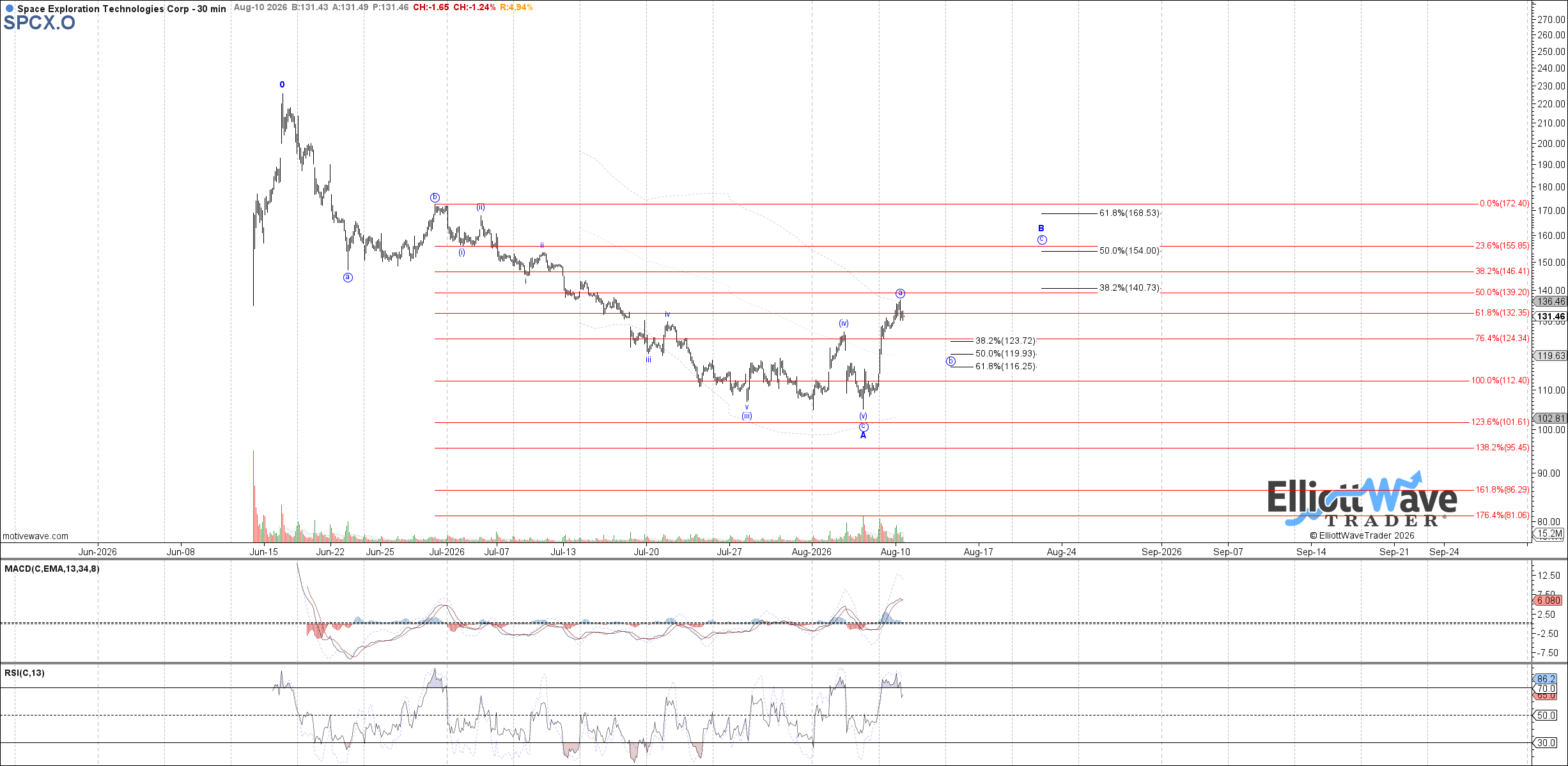
After striking the $225.64 high just after IPO liftoff, we began to share ideal pullback targets below. Some structure needed to form before properly projecting this area. Then, with a few weeks of price action, the $110 area appeared as a likely zone. The actual low has been $104.83 so far.
What is the probable path ahead? Given the proportions of this current bounce, a standard retrace would be to the $150 - $170 area. We will be tracking this closely in the days ahead.
Another possibility is that SPCX actually forms a small five waves up from the last low and then a corrective three wave retrace. That would tilt things more bullish rather than being just a bounce from the last low.
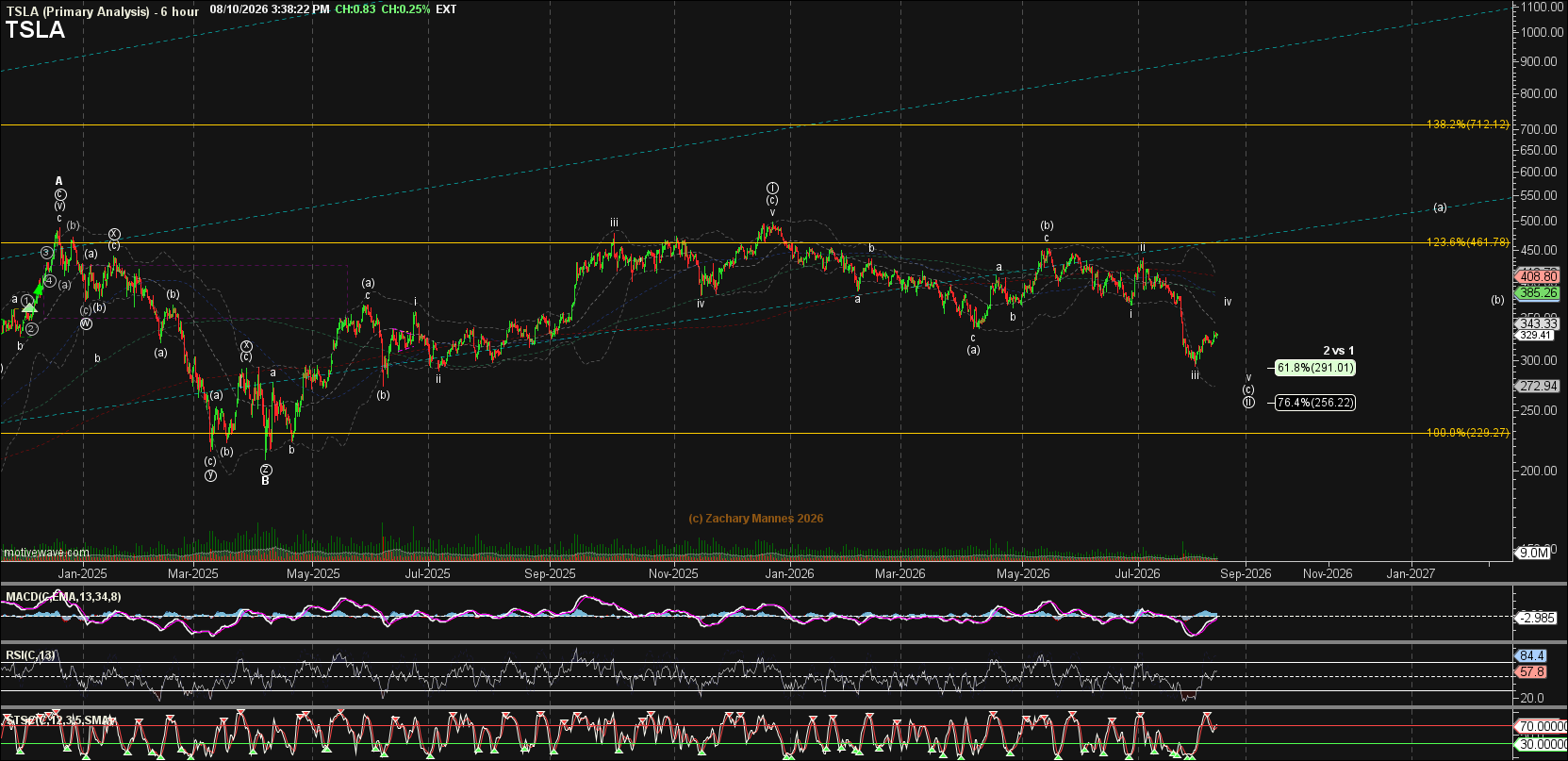
For those that follow our work on this one, you will know that there is a longer term bullish scenario that shows the $500 area as a possible target in the structure. But, from where? Senior analyst Zac Mannes is tracking the near-term action and it suggests that price is now in a wave ‘iv’ bounce. One more low would follow to complete wave ‘v’ of (c).
From the balance sheet angle, the cash side of the invoice perhaps coincides with that final low. Tesla is committing capital to a fab it does not own out of a quarter that produced 1.4% operating margin, and the market has not yet been asked to hold an opinion about that. Or, will this be yet another data point ignored by the crowd?
Either way, once this current corrective move is complete, the structure of the next rally will help us better determine the likely target overhead.
One more thing worth holding. The signed county agreement permits SpaceX to walk away with thirty days' notice and a maximum penalty of $60 million. The building is optional. The crowd's reaction to it was not.
Conclusion
The projections shared in this piece are not meant to sound like fanboy fare. There are strong, almost visceral reactions to the names of the players involved in these stories. And yet, it is the very sentiment on display that lights our way ahead. Sentiment is firmly in the pilot’s seat in both cases.
What’s more, sentiment allows us to track and then project what is likely next. Remember that these patterns formed by crowd behavior are variably self-similar at all degrees of the structure on the charts. The smaller degrees will help us identify what is probable at the larger degree.
While we cannot know the future with certainty, we do have parameters in place to guide our opinion — at least with two charts in this universe.
