
PLTR: The Bounce Both Bulls and Bears Agree On
 By
Levi
By
Levi
Palantir is a unique one, and it always has been.
Go back to its first days as a public company and try to find the stretch where fundamentals drove this stock. I will save you the time. It does not exist. The valuation arguments were discarded almost immediately — too expensive, the skeptics said, at every single price along the way — and the stock ran anyway. Then it fell, hard, and the believers said the story was intact, and it fell some more. Then it rose again and made the skeptics look foolish twice.
None of that was earnings. All of that was belief.
And I want to be clear about something: that is not a criticism. Some stocks simply trade this way. They become vessels for conviction — about AI, about defense, about the future itself — and once that happens, the analyst who keeps arguing with the multiple is bringing a calculator to an emotion.
Which is precisely why a stock like this belongs to sentiment analysis. When there is no fundamental anchor the crowd respects, the structure of price is not just one input among many. It is the only referee left standing.
So here is where it gets interesting.
Two of the analysts I work alongside — and two of the best wave readers I know — are looking at this same chart right now and seeing two slightly different stories.
Zac Mannes reads the more recent June high as a B-wave — the kind of rally that convinces the crowd the worst is over right before it is not. Under his primary count, the decline off that high has considerably further to travel, with downside targets that would surprise most holders of this stock.
Garrett Patten reads the same decline as a fourth-wave correction — painful, deep even, but a pause within a larger advance that has one more high left in it. Under his count, this pullback is the setup, not the sentence.
Same chart. Same squiggles. Opposite conclusions.
Now — here is the part that I find genuinely useful, and it is the reason this piece exists.
Both counts call for a continued bounce.
Zac's structure needs one: a wave 2 recovery rally within the larger decline. Garrett's structure asks for one too, but as a different segment of the correction yet underway. The bulls and the bears, for entirely different reasons, are waiting on the same rally.
Which means the bounce itself settles nothing. It is what the bounce is made of that settles everything.
Same rally. Two meanings. And the subwaves will tell us which one we are watching, likely within the next few weeks.
This is the part of the method I trust most — not the prediction, the arbitration.
Let’s delve deeper into the charts and set the parameters because there are a few more nuances to consider.
Sentiment Speaks
There will be moments when two analysts can study the same structure and yet produce distinct scenarios. This is not necessarily a bad thing. It has nothing to do with pitting one against the other.
Simply stated, we view the markets through a probabilistic lens. The individual’s weighting of probabilities is what can at times show up as variations in the output. However, what is key is that when further clarity does show up, via more subwaves filling in the chart, each analyst will immediately adjust accordingly. Soon, the charts come back into synch and we’re right as rain.
When I see two differing opinions of the same structure, it actually tells me to watch the near term closely. There is likely some sort of twist or turn incoming. Here are the two variations at the moment.
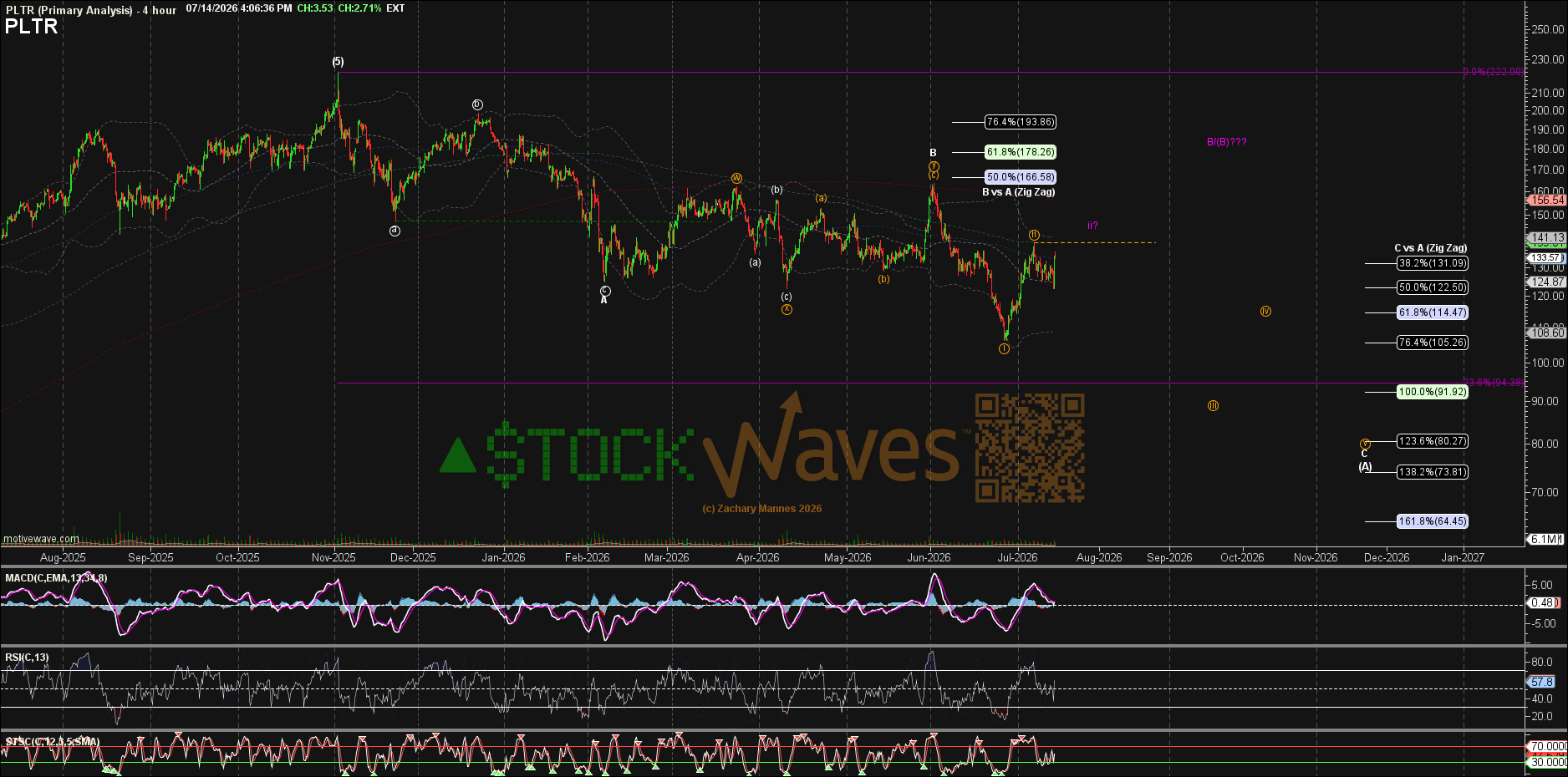
Note that Zac is counting the November 2025 peak as a fifth wave. Thereafter, in that scenario, an A-B-C corrective move should unfold. The A wave is in place. Now, the question surfaces: is B in place already? A bounce is likely next. Will that bounce be a wave ‘ii’ of the C wave? Or, will it unfold as a larger B wave?
In their beginnings, both could have the same appearance as they are corrective in nature. Let’s have a look at Garrett’s view.
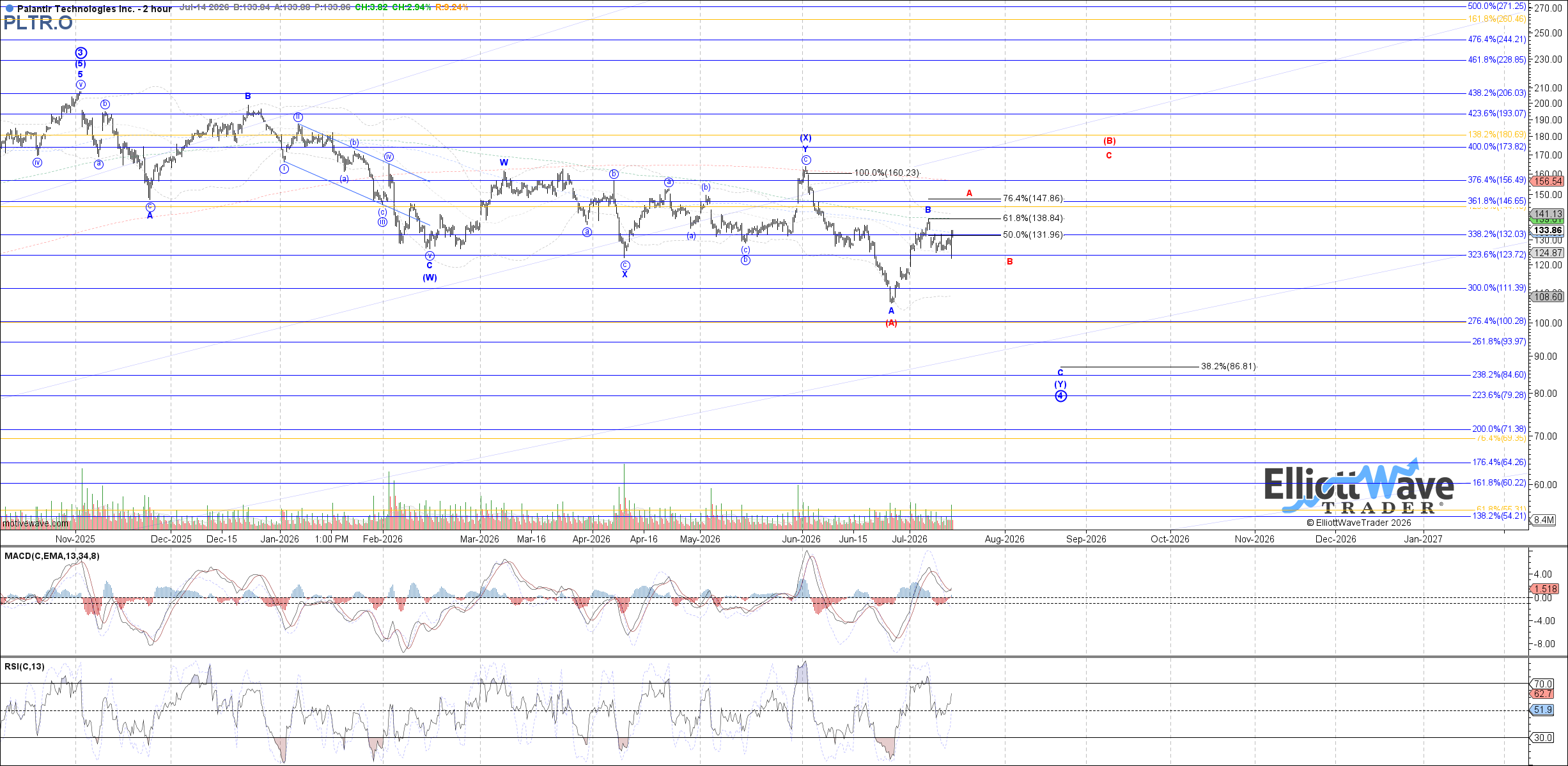
His chart also shows the possibility of a bounce higher in the near term. This as a (B) wave but of a larger fourth wave. What will help us have a high-probability setup in this one?
Both analysts have the higher ‘B’ wave as a potential path. In the near term, for as long as $122 area or higher holds, one might look higher for that corrective bounce to play out as illustrated. From there, if a clear 5 waves down followed by a corrective bounce forms, then it would actually provide a bearish setup for the ‘C’ wave down. In this type of setup, the invalidation point would be at the prior high where the ‘B’ wave completed.
Conclusion
So where does this leave us with Palantir?
In a better spot than the apparent disagreement might suggest.
The near-term path is actually the point of consensus: a bounce, likely from the $122 area or above, is the move both counts expect. Enjoy it if you are long. But do not confuse it with the verdict — because the verdict comes after.
It is the decline that follows this bounce, or the absence of one, that arbitrates everything. Five clean waves down off the bounce high, followed by a corrective recovery — that is the bearish setup asserting itself, and the C wave it implies would carry this stock far below where most holders might imagine it can go. An invalidation sits at the bounce high itself, which is what makes the setup definable rather than a guess.
But if that five-down never forms — if the pullbacks keep overlapping and the structure keeps refusing to impulse lower — then Garrett's fourth wave low may actually be asserting itself sooner rather than later. And, a final advance to a higher high remains on the table, perhaps as a diagonal.
Either way, the stock that has never once traded on its fundamentals is about to be decided, again, by the only thing that has ever governed it: the shape of the crowd's conviction, drawn on a chart.
Belief built Palantir. The structure of that belief will tell us, likely within weeks, whether it has one more act — or whether the crowd has finally begun to leave the theater.
Watch the bounce. Then watch what it is made of.
