
NVDA: Who Stops the Music?
 By
Levi
By
Levi
We all played it. Folding chairs in a circle, one fewer than the number of players, somebody’s mother working the stereo with her back turned so she couldn’t be accused of favoritism.
Nobody won that game by reacting. The kid who won had been shadowing one chair for two full laps — hands low, weight forward, committed to a spot long before the room went silent. The music stopping was the least interesting part of the game. It confirmed what the positioning had already decided.
That’s what most market analysis gets backwards when it reaches for this analogy. The question is not when the music stops. The question is where you are standing while it plays.
Semiconductors have been the loudest room in this market for three years running. And the music in that room is not the price. It’s the money — who is paying whom, and with what.
Lyn Alden laid out the chain, and I’m reproducing it here unedited, because its structure matters more than any summary I could provide:
“From a trading perspective, I would defer to sentiment on NVDA and other semiconductor stocks. Fundamentally, most of them are still supported by earnings. There's not yet a fundamental catalyst that should cause them to drop too sharply.
The challenge is that the source of their cash is somewhat wobbly when we look out years. The hyperscalers are paying them, but they've become free cash flow negative for the most part. The frontier AI labs are paying them, but they're running unprofitably on VC money, with the expectation that declining costs will fix their profitability issues in the future.
End-user consumers and businesses are paying the frontier labs and hyperscalers, and their AI-expenses per employee are sharply rising over time, but the durability of that trend is still unclear.
The blow-off top in June likely represented the end of easy gains for semiconductors. But there's still a case to be a selective buyer of dips for some of the strongest names going forward.” — Lyn Alden
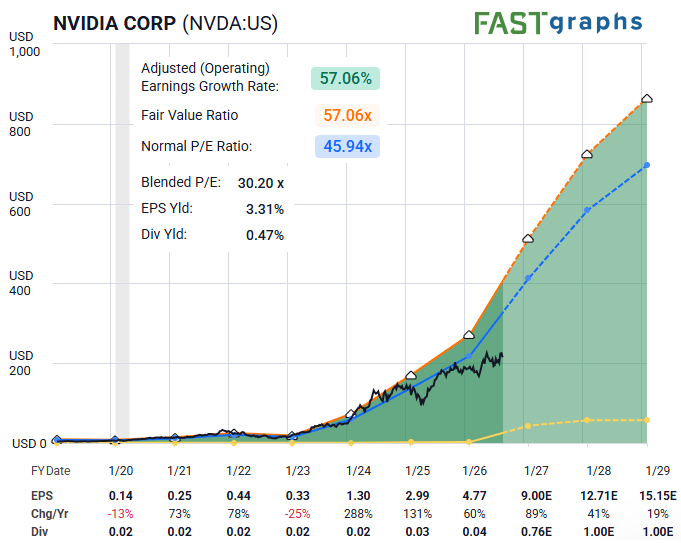
Now read that chain backwards.
Pay-when-paid. Every party stays solvent as long as the party above them keeps funding, and the invoices are legitimate the whole way down. The work is real. The chips ship. The revenue books. But the cash behind it originates somewhere farther up the chain than anyone standing in it can see.
A chain like that doesn’t require a failure to tighten. It just needs hesitation.
This is why I’m not waiting for a catalyst, and why Lyn’s first line is the one I’d underscore. Sentiment doesn’t wait for news to justify it. It turns first, and the headlines arrive afterward to forge an attempt at explaining what already happened. The June high in the SOXX was not made on bad news. It was made on the best news the sector has ever printed.
Then, on August 10, Nvidia brought six of the largest capital allocators on earth to the table and pointed them at its own customers. Apollo. BlackRock. Blackstone. Brookfield. Goldman Sachs. KKR. The target is more than $500 billion of third-party money to finance further buildout, with Nvidia holding an option to backstop about a quarter of it.
Read that as management telling you what it sees. If the customer base could fund the next leg out of earnings, none of this would be necessary. This is the contractor walking the owner into the bank, sitting through the loan committee, and then signing a residual guarantee on the finished building.
There’s nothing improper about it. Contractors do it when they want the job and the owner is short. It works exactly as long as the appraised value holds. Here’s what nobody has signed yet. These are memoranda of understanding. No firm has disclosed a commitment. No project has been named. Whether the backstop sits in first position, and who values a used GPU cluster three years from now, are open questions.
So the funnel got wider, and it now runs through pension money and insurance float instead of Microsoft’s cash flow. That is a longer chain, not a sturdier one. And it means the first crack, when it comes, may not show up in an earnings release at all. It shows up in a spread.
In the summer of 2007, the head of Citigroup was asked about leveraged lending and answered with a dance metaphor — while the music played, you got up and danced. He wasn’t being flip. He was describing a constraint he couldn’t escape. He was out four months later.
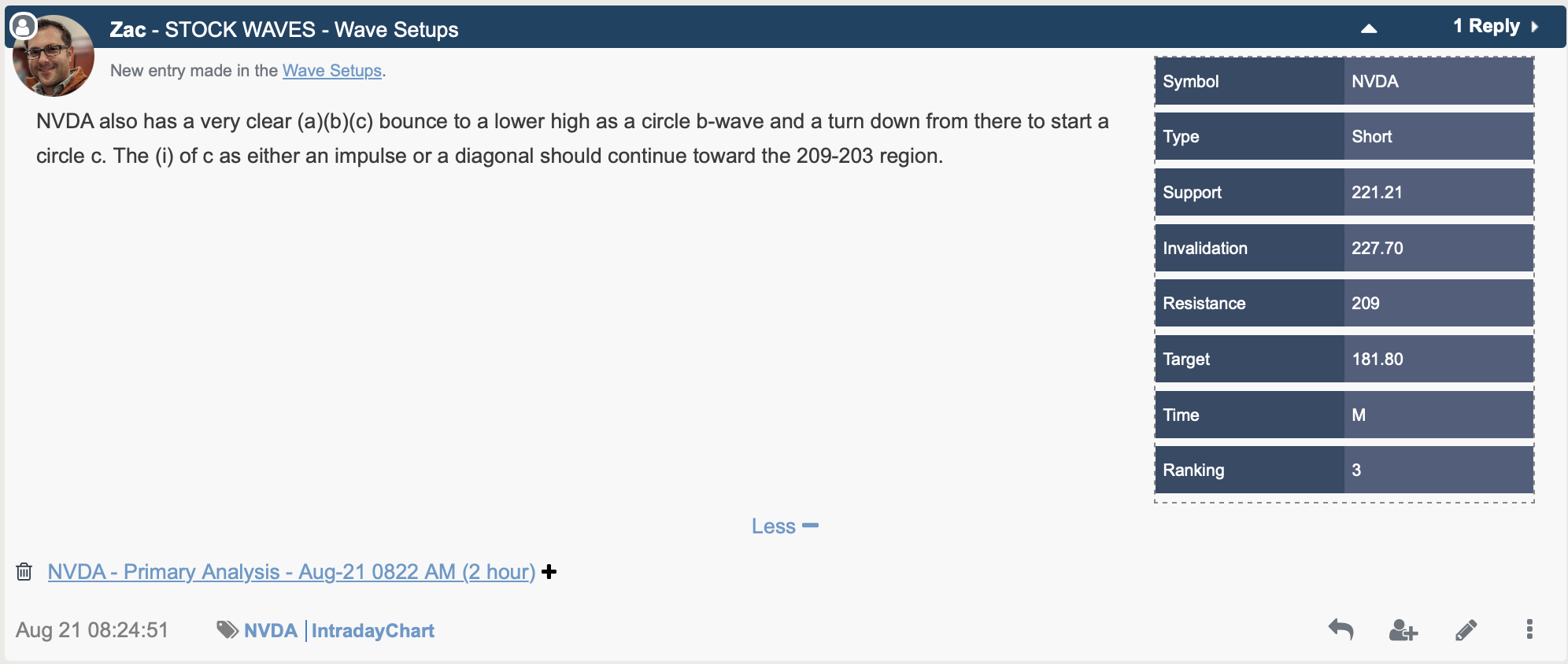
Now, on to our count for NVDA — it is a bearish setup, and it carries an invalidation level at the $227.70 prior swing high. Above that level and the scenario needs revision.
Nvidia reports Wednesday, August 26. The print doesn’t decide this.
It reveals where everyone was standing.
So where do we look for parameters — first the sector, then NVDA itself? Zac Mannes has done some fascinating work on this via studies of human behavior as it manifests itself on the charts, and by means of ratios. Follow along as we discuss how this may lend us a hand in the near-term.
Sentiment Speaks
And it speaks to us even in the comparison of performance between two indices. Allow me to share the following side-by-side showing of the SOXX index versus the QQQ. The comparison is revealing.
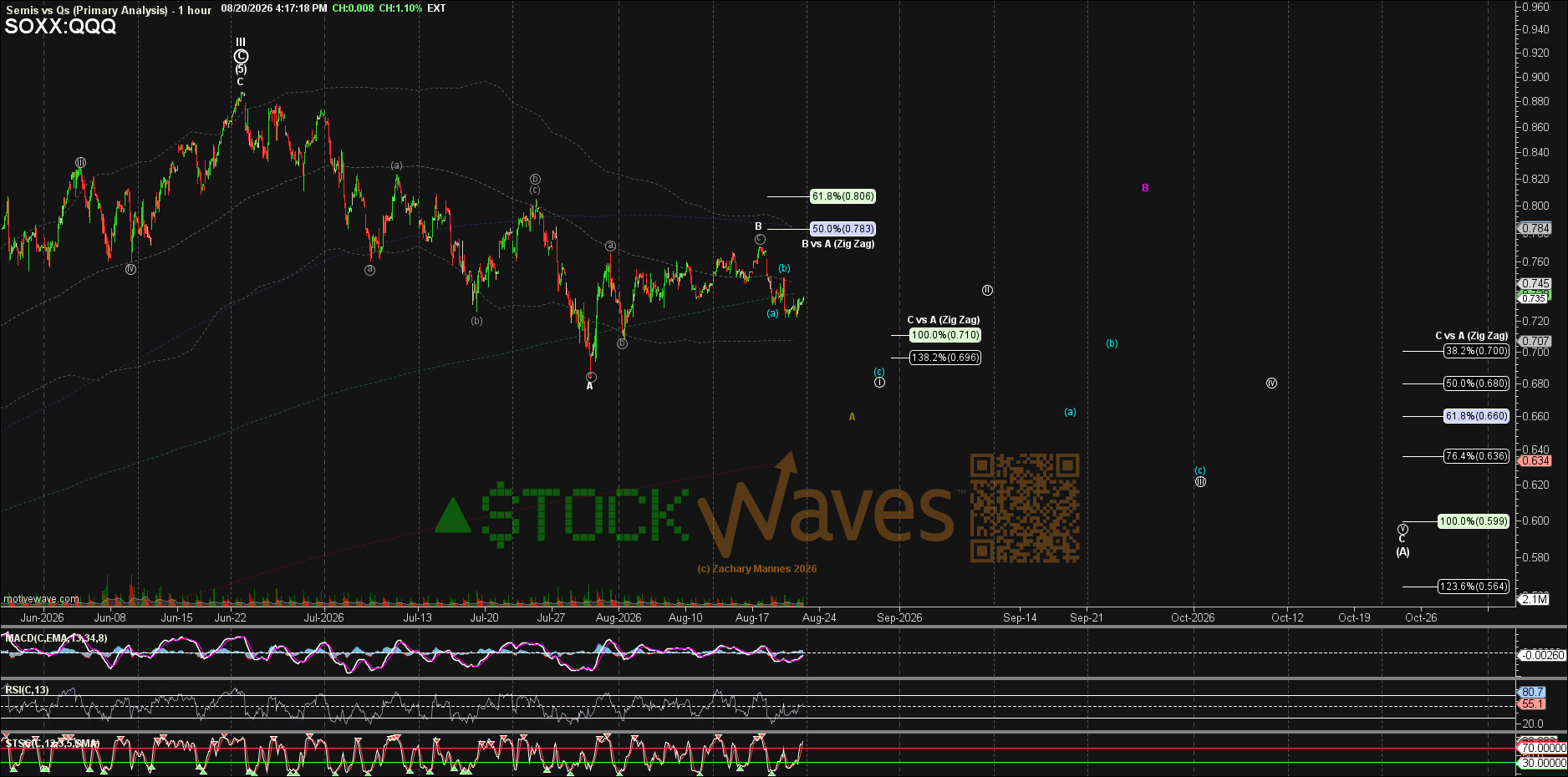
What does this chart tell us? That since the June high was struck a few months back, the semis have been underperforming the Q’s. Now, what’s so interesting here is that this performance comparison follows a structure that can be tracked and projected. Note that Zac is showing a continued underperformance of the semis versus the Q’s for the next few months.
This would lend further credence to the next chart. NVDA.
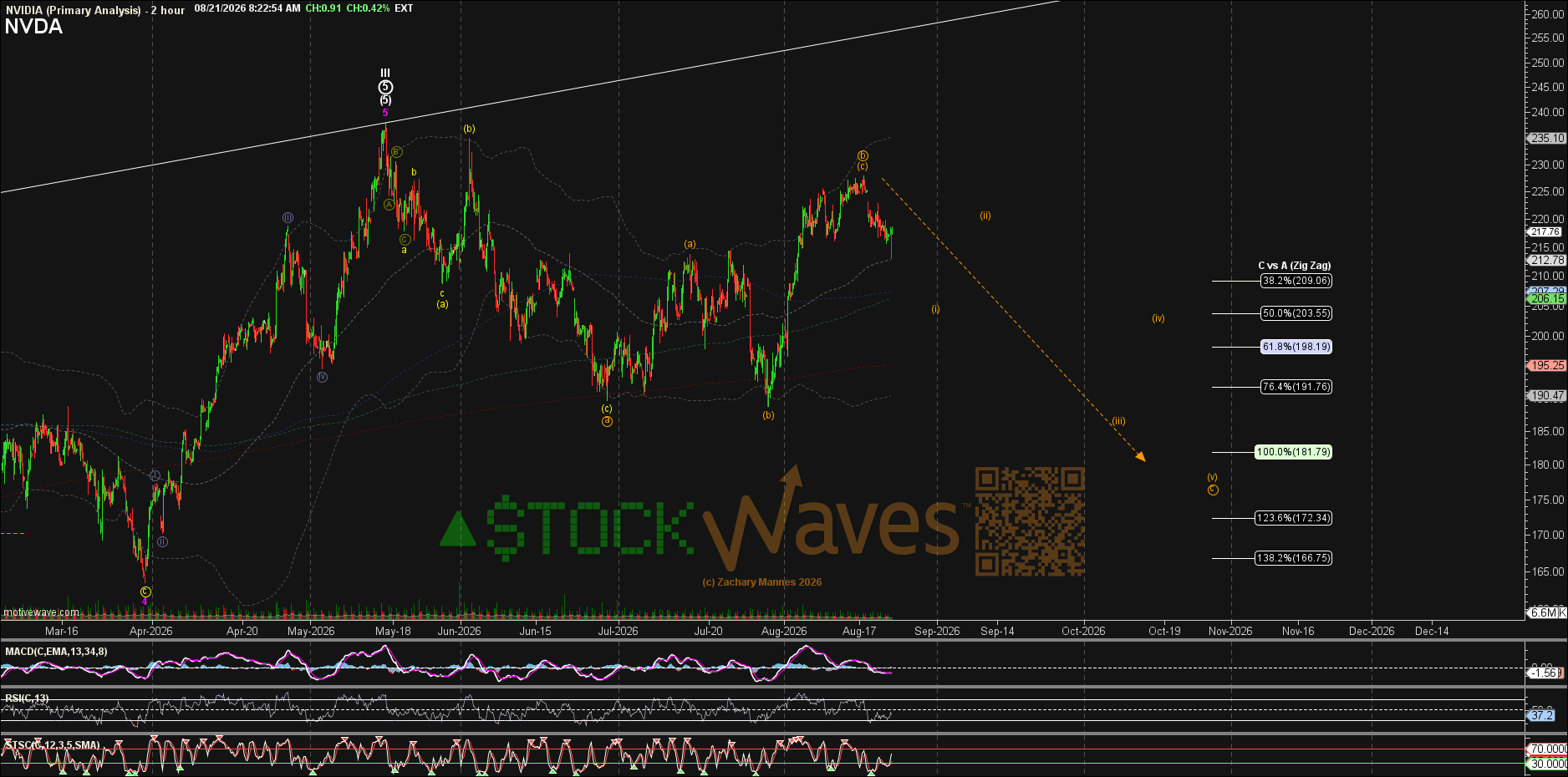
None of this is a knock against Nvidia. It is the crowd ebbing and flowing with the waves of sentiment. And should this current structure continue to play out as illustrated then price should correct into the fall of this year. Here are the specific parameters shared in a current bearish Wave Setup for NVDA.
Conclusion
So — who stops the music?
Nobody does. That’s the answer, and it’s the part that makes this game different from the one we played as children. There is no mother at the stereo. No regulator, no earnings miss, no downgrade decides the moment. The music doesn’t get stopped. It gets stopped being listened to. One player looks at the chair instead of the circle, and then another, and the room turns before the song ends.
That’s what sentiment is. Not a reaction to news, but the thing news gets written to explain.
None of this makes Nvidia a flawed company. Lyn’s read stands: the earnings are real, no fundamental catalyst is sitting there waiting, and there remains a case for buying dips selectively in the strongest names. The wave structure isn’t an argument against the business. It’s a map of the crowd around it.
And the map is falsifiable, which is the whole point. Below $227.70, the bearish path stays primary and we expect price to correct over the next few months while the semis continue to lag the Q’s. Above it, the near-term bearish scenario invalidates and the count gets revised. That’s not hedging. That’s how you define risk and stay in the game for the next setup.
Wednesday’s print will move the stock. It will not tell you anything about the chain, or about who is funding whom, or about whether a used GPU cluster appraises in 2029.
The kid who wins isn’t listening for the song to end.
He’s already standing where he means to sit.
