
Intel: When Price Floats Above Fundamentals
 By
Levi
By
Levi
Intel’s story today is less about growth and more about gravity.
Once the unquestioned titan of semiconductor manufacturing, Intel now finds itself rebuilding under pressure. Earnings have contracted sharply from prior cycles. Free cash flow — historically a defining strength — has thinned to the point of strategic vulnerability. Massive capital expenditures aimed at regaining process leadership and expanding foundry capacity have turned the balance sheet into a staging ground rather than a fortress.
The numbers are not ambiguous. Profitability has compressed. Competitive positioning has eroded. The turnaround remains aspirational rather than demonstrable.
And then there is Washington.
The CHIPS Act and broader national security considerations have positioned Intel as more than a public company. It has become a strategic domestic asset. Subsidies, incentives, and political alignment have extended runway and restored optionality. In practical terms, government involvement has reduced the probability of catastrophic failure.
But stabilization is not revival.
This is where the paradox emerges.
Despite deteriorating earnings power and fragile free cash flow, the stock has not mirrored that weakness proportionally. Price has at times appeared resilient — even detached — from the underlying income statement. Investors are being asked to underwrite a recovery that has yet to manifest in operating metrics.
Lyn Alden summarized the imbalance succinctly:
“They basically collapsed and the US Gov’t got involved. I lean bearish because earnings and free cash flow have dried up while the price levitates.”
That word — levitates — carries weight.
When price rises or holds firm in the face of shrinking cash generation, it is either believing in a credible turnaround ahead of the data, or reflecting optimism that has yet to earn validation. Markets are capable of both.
Intel’s valuation today is not anchored in current earnings strength. It is anchored in forward belief — belief that foundry ambitions will bear fruit, that process competitiveness will return, and that domestic semiconductor policy will translate into durable profitability.
This can propel a stock for longer than many expect.
But belief without confirmation eventually encounters resistance.
So the question is not whether Intel is important or strategically supported. It is whether price is aligned with what the business is producing — or merely the anticipation of what it hopes to produce.
To answer that, we move from commentary to structure.
Let’s look at the chart.
⸻
Sentiment Speaks
If price were fully aligned with the optimism implied by policy support and long-term recovery hopes, the chart would reflect expanding strength. It does not.
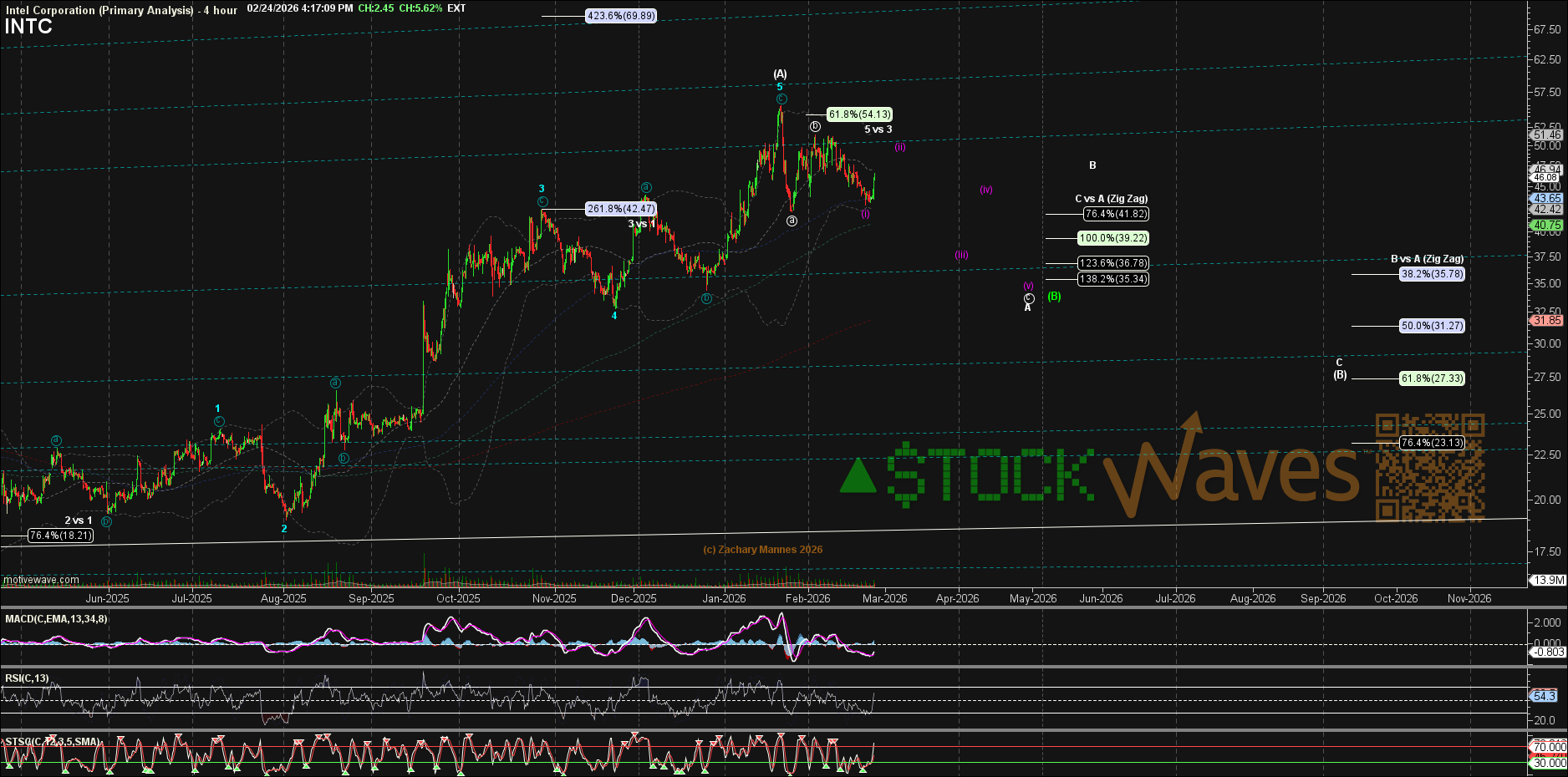
What we see instead is a completed five-wave advance into the mid-$50s — followed by fading momentum and the development of a retracement. The rally into the January highs counts best as a finished (A) wave. Since then, price has struggled to extend impulsively, and the current decline appears to represent the early stages of a broader corrective phase.
The key region now rests in the low-$40s. A sustained break beneath that zone would materially increase the probability of a deeper unwind, with the mid-$30s retracement cluster emerging as the next logical destination.
This is where levitation becomes instructive.
When fundamentals weaken but price holds, it often does so on expectation. But expectation must transition into participation. Thus far, the structure does not reflect expanding demand. It reflects hesitation following completion.
For the bullish case to regain traction, price would need to reclaim the $51–$54 region with authority, neutralizing the developing corrective posture. Until that occurs, the weight of evidence favors a near-term downside resolution.
This does not preclude future stabilization.
It simply suggests that the immediate path of least resistance remains lower.
And when price floats above fundamentals, gravity tends to assert itself before lift returns.
⸻
Conclusion
Intel does not lack relevance. It lacks confirmation.
Government support may extend its runway, and long-term domestic manufacturing ambitions remain strategically significant. But earnings power and free cash flow have yet to reestablish themselves in a manner that supports sustained optimism.
For now, price is attempting to hold above meaningful retracement levels — but without decisive impulsive strength. Until that changes, the burden of proof remains with the bulls.
A reclaim of recent highs would necessitate reassessment. Failure to stabilize above key support, however, would suggest the prior advance has completed — not that a durable upside expansion has begun.
This is not a judgment on Intel’s long-term viability.
It is an evaluation of present alignment.
And at present, price appears to be negotiating gravity — not overcoming it.
