
IONQ: A Random Walk With a Memory
 By
Levi
By
Levi
There is a certain irony in writing about IonQ. The company builds machines that work in probabilities, where nothing is settled until it is measured. Yet its stock trades in a market that, according to the most influential theory in academic finance, carries no useful information in its own price history.
We see it differently. And IONQ happens to be a good place to show why.
First, a brief word on the company, in its own terms. IonQ now calls itself the "world's leading full-stack quantum platform and foundry," with trapped-ion systems spanning computing, networking, sensing and security. That word foundry is new. On July 31, IonQ completed its acquisition of SkyWater Technology, a U.S.-based semiconductor foundry, and on September 8 it raised its full-year 2026 revenue outlook to between $450 million and $460 million for the combined company.
The same day, IonQ launched its Superion 256 platform, with customer deliveries planned for 2027 and a larger Superion 10K generation to follow. Management describes the destination as commercial-scale, fault-tolerant quantum computing. Then on September 22, the company announced what it calls the industry's first end-to-end, real-time quantum error-correction decoder running on a single off-the-shelf CPU. (In fairness, the work was tested on simulated workloads, and the paper has not yet been peer reviewed.)
That is the company's story. The stock has been telling a different one.
A Walk Without Memory
The efficient market hypothesis comes in three strengths, and the weakest one is what matters here. Weak-form efficiency holds that everything past prices could tell us is already reflected in today's price. Burton Malkiel brought the idea to Main Street in 1973 with A Random Walk Down Wall Street, and the logic is tidy. If yesterday's price already contains all it knows, the next step is a coin flip. Charts become decoration.
It is an elegant idea. It is also a claim about how people behave, and that is where it runs into trouble.
The academic world has never fully settled this argument. In 2013, the Nobel committee split its economics prize between Eugene Fama, the father of efficient markets, and Robert Shiller, who built a career documenting how emotion pushes prices far from anything resembling rational value. (Lars Peter Hansen shared it as well.) The committee honored both sides of the same debate in the same year. That alone tells us the question is still open.
Then there is momentum. In 1993, Narasimhan Jegadeesh and Sheridan Titman showed that stocks with strong recent returns tended to keep outperforming for months, while weak ones kept lagging. A walk with no memory should not do that. Fama and Kenneth French later called momentum "the premier anomaly," an interesting choice of words from the man who built the theory. Andrew Lo and Craig MacKinlay went further, rejecting the random walk in weekly stock returns and eventually titling a book A Non-Random Walk Down Wall Street.
Prices remember. More precisely, people do.
Four Weeks in Plain Sight
Now look at IONQ's last twelve months through that lens. On October 13, 2025, the stock struck $84.64 at the height of the quantum enthusiasm, and the crowd was never more sanguine. By March 30 of this year, it had fallen to $25.89, a decline of roughly 69%. It closed Friday at $45.48, about 76% off that low. It is hard to argue the business was worth 69% less in March than in October, and then 76% more by September. The crowd's mood, on the other hand, can swing that far and often does.
And then there is the decoder. IonQ's researchers posted their paper to arXiv on August 25, where anyone could read it. Four weeks later, on September 22, the company announced the result in a press release after the close, and shares jumped more than 12% after hours, from $40.74 to $45.74. Same research. Same public access. What changed was the telling, not the information.
Even the stronger form of the theory, the one that says public information is absorbed as it arrives, has trouble with that. So, let's turn to the chart, where this kind of behavior leaves its fingerprints.
What the Crowd Is Saying Now
If we use the past as prologue, then price should be in the C wave of a larger (A) wave rally structure.
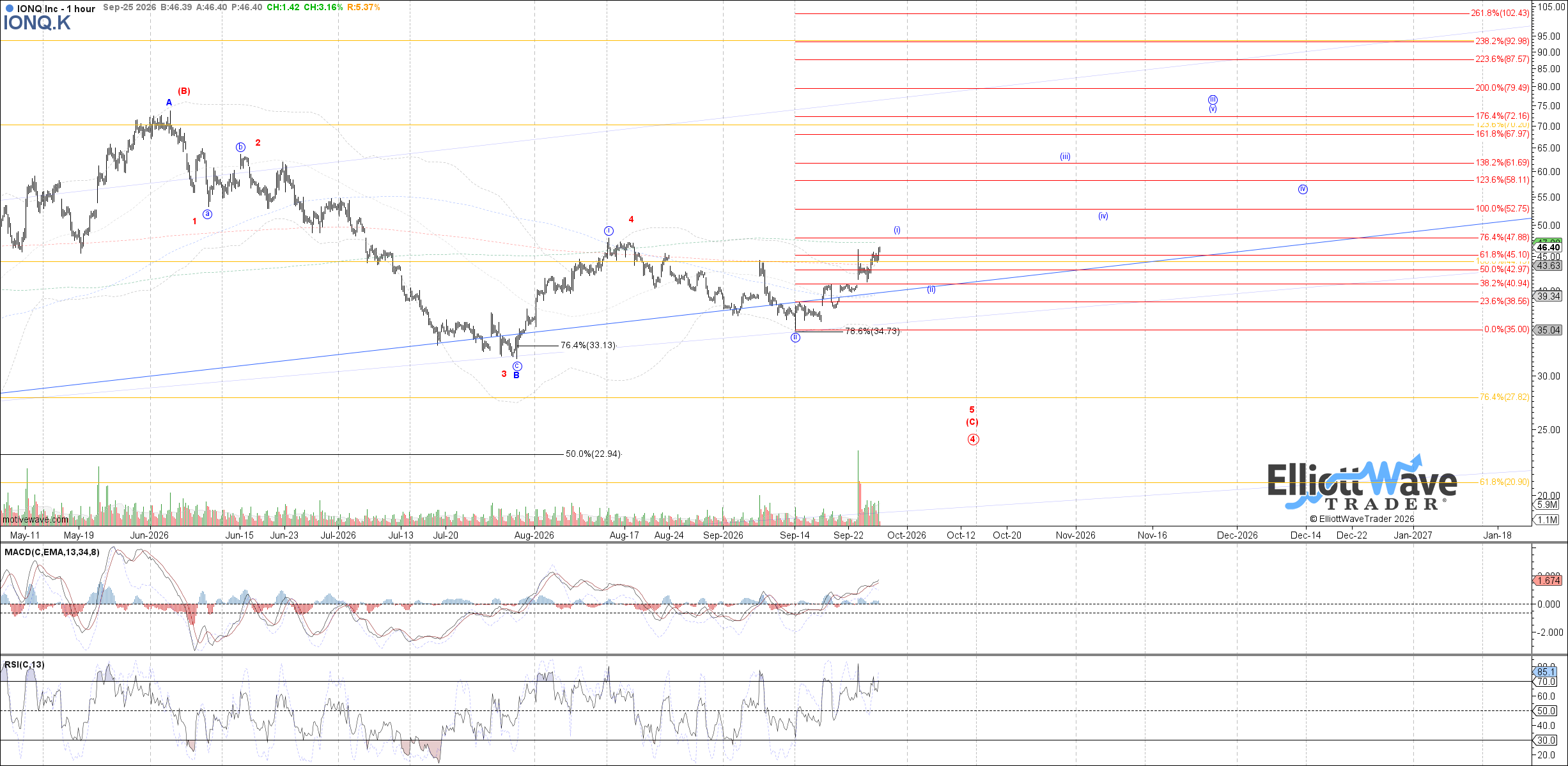
This means that the C wave should take shape as five waves up with corrective moves along the path. A caution flag would go up should we see a clear five waves down form from this current region. However, the typical outcome for a chart with this structure is higher, as shown. And this remains valid for as long as price is above the $35 area.
Why do we make this projection with such seeming confidence? Doesn’t it fly in the face of modern economic theory? Yes, it does. But there is solid basis for such an assertion.
Conclusion
That basis goes back to 1938. Ralph Nelson Elliott observed, thirty-five years before Malkiel's random walk arrived, that markets move in recurring patterns because the people inside them do, cycling between hope and fear in ways that repeat at every degree of trend. Here is where Elliott Wave draws its strength. It does not try to predict the news. It maps the crowd that will react to it.
None of this means the future is known. It means the future can be weighed. A random walk offers no odds at all, while a crowd with a memory hands us probabilities, and probabilities are something we can work with. Right now, IONQ's near-term setup leans higher.
The theory says the walk has no memory. The crowd walking it has nothing but.
