
Hims & Hers: Reinvention — or Regulatory Repricing?
 By
Levi
By
Levi
Hims & Hers Health is no longer simply a telehealth platform. It is a company in transition — and the crowd is trying to decide whether that transition represents reinvention or repricing.
On paper, the growth story remains compelling. Q4 2025 delivered an earnings beat. Subscriber counts climbed to 2.5 million. The company continues expanding beyond its original direct-to-consumer roots into diagnostics, international markets, and a broader preventative health model.
The acquisition of Eucalyptus positions HIMS as an emerging global platform rather than a U.S.-centric compounder. The launch of Hims & Hers Labs shifts the model from episodic prescriptions toward recurring diagnostic engagement.
But none of those initiatives exist in isolation.
They are unfolding against intensifying regulatory scrutiny of the company’s most profitable category: compounded GLP-1 weight-loss treatments. Lawsuits from Novo Nordisk, DOJ and SEC inquiries, and FDA declarations regarding certain compounded products have introduced material uncertainty. Management has already guided to a near-term $65 million revenue impact as shipping cadences adjust to regulatory pressure.
This is not merely volatility.
It is a repricing event in motion — and a meaningful shift in previously bullish sentiment. Momentum is no longer accelerating. It is being tested.
Investors are not debating whether HIMS has growth avenues. It clearly does. The real issue is whether those engines can scale quickly enough to offset legal constraints before market confidence deteriorates further.
In moments like this, narrative becomes seductive. Bulls see platform evolution. Bears see structural impairment.
But markets do not resolve these debates through rhetoric.
They resolve them through price behavior.
That is the story worth following.
And it begins with the structure unfolding on the chart.
⸻
Sentiment Speaks
Let’s look at what price is actually telling us.
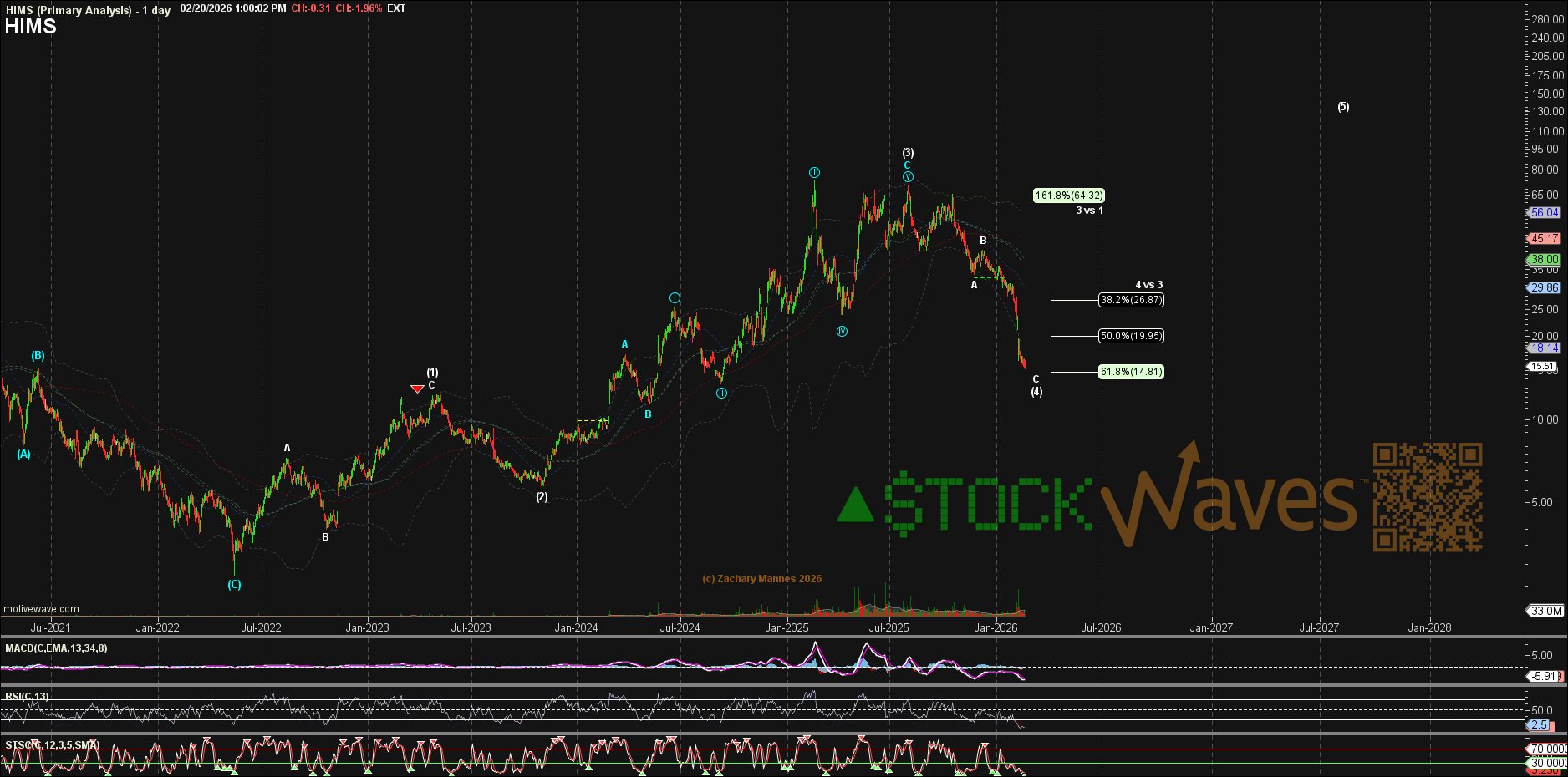
On the daily timeframe, HIMS appears to be working through a larger corrective phase following what counts best as a completed wave (3) into the mid-$60s. The current decline is viewed as wave (4) of that broader advance — but that interpretation remains conditional.
Importantly, price has retraced into the 50%–61.8% region of the prior impulse, with the 61.8% retracement near the $14–$15 zone. That area is structurally significant. A sustained breakdown beneath it would materially weaken the larger bullish framework and suggest that something more than a standard wave (4) correction is unfolding.
Conversely, stabilization in this region — followed by a constructive advance off the lows — would materially improve the probability that this is indeed a fourth wave setting up a future wave (5). Given that the pattern appears to be a non-overlapping diagonal, the subdivisions of a potential wave (5) would likely unfold as an A-B-C structure. That means the initial advance of wave (5) does not need to begin with a traditional five-wave impulse.
It is also important to stress: we are not projecting an aggressive wave (5) target at this stage. While a move to new highs remains plausible within the broader count, the chart has work to do. Momentum must rotate. Subdivisions must clarify. Participation must broaden.
At present, HIMS sits at an inflection point.
The regulatory narrative may dominate headlines, but structure is defining risk. If support holds and an impulsive advance develops, the repricing may already be behind us. If it fails, the larger bullish thesis requires reassessment.
For now, the parameters are clear.
Above the key retracement zone, opportunity remains viable.
Below it, the market is likely communicating something far more defensive.
⸻
Conclusion
Hims & Hers is operating under pressure — not only from regulators, but from the market’s reassessment of risk.
The legal backdrop is serious. The strategic pivot is ambitious. The financial stakes are meaningful. But headlines do not determine durability. What matters now is whether participation begins to stabilize and rebuild — or continues to contract.
The broader bullish interpretation remains possible, but it is not automatic. Support must hold. Momentum must turn. Buyers must demonstrate follow-through rather than hesitation. Until those elements appear, projecting a sustained advance into new highs would be premature.
This is not a debate about vision. It is a test of structural integrity.
If price begins to organize constructively from current levels, the recent decline may ultimately register as recalibration rather than impairment. If it does not, the market will be signaling that the transition requires more time — or more repair — than anticipated.
In situations like this, clarity does not come from confidence in a story. It comes from observing how capital behaves when challenged.
And capital leaves footprints.
That is what we will continue to evaluate.
