
Ford (F): A Trading Sardine, Not An Eating Sardine
 By
Levi
By
Levi
There is an old Wall Street story Seth Klarman retold in Margin of Safety. Sardines had vanished from the waters off Monterey, but the cans kept trading, bid higher by people with no intention of eating them. One buyer finally opened a can and made a meal of it. He got sick. The seller explained that he had misunderstood the product. These were not eating sardines. They were trading sardines.
Anyone who grew up near the California coast knows the part that is not a joke. The fishery collapsed, Cannery Row emptied one building at a time, and the last cannery closed in 1973.
Lyn Alden used the phrase recently when the subject turned to Ford:
"I treat Ford like a trading sardine, and it trades significantly on sentiment."
Her use is narrower than Klarman's, and the difference matters. Klarman's can was spoiled. Ford's is not. There are fish in it: $2.5 billion of adjusted EBIT last quarter, free cash flow guided to $6 to $7 billion, a dividend that keeps arriving, smaller since the supplemental ended. What Ford lacks is a moat that makes those contents worth more each year. Without one, the price of the can gets set somewhere else. By mood.
The chart has been making the same argument.
Ford topped in the first days of June. The structure pointed toward consolidation and pullback, and that read was on the table before any of what followed. Before the Washington-Ottawa talks collapsed in late August. Before the criticism of Ford's CATL and Geely partnerships this month. The news came afterward and supplied the narrative.
One turn proves nothing by itself, and hindsight flatters everyone. But it matches what Lyn describes from the fundamental side. Sentiment moves first. The explanation catches up later.
What Is In The Can
"Fundamentally, it's a value stock, and like most car companies, it forever remains a value stock rather than being a long-term compounder.
It's a company that could just as easily trade at 6x earnings or 10x earnings, and right now is near the middle. The balance sheet is a hair above junk grade. They've had poor success breaking into the EV market, and various future successes or fumbles there can give an investor a doubling or a halving of the share price.
And that's mainly the challenge with a narrow-moat car company. It requires being exceptionally correct to generate superior returns from it, compared to buying a company with a wider economic moat and letting it compound." — Lyn Alden
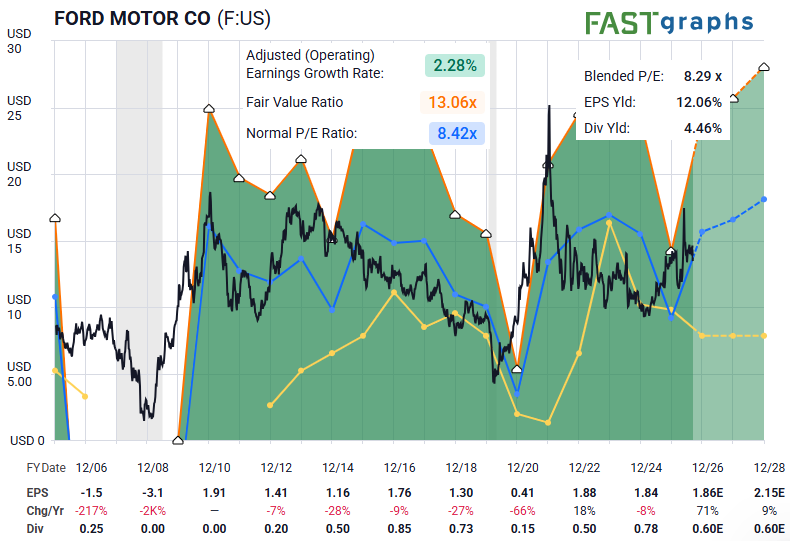
The history below shows the shape of it. Adjusted earnings have grown 2.28% a year across two decades, $1.91 in 2010 against $1.86 estimated for this year. The price has traveled a great deal further than that, in both directions.
Ford Blue earned $1.1 billion last quarter, up 72%. Ford Pro earned $1.7 billion, down 26%. Ford Credit added $757 million pre-tax. Trucks, vans, and a finance arm fund everything else in the building. Everything else is the part that subtracts.
Check the 6x-to-10x range against the history. There is no usable trailing GAAP multiple on Ford. The quarter carried a $1.3 billion GAAP net loss on $4.2 billion of special charges, most of it non-cash and tied to unwinding the BlueOval SK battery venture.
With shares near $14, the multiple in play runs against adjusted earnings rather than reported ones: a blended 8.29 times, against a normal multiple of 8.42 across this history. Near the middle holds, and it has held for most of two decades. The market is showing an estimate of the contents rather than a count of them, and that estimate rose in July to $10 to $11 billion of adjusted EBIT.
A hair above junk grade holds at two agencies and misses by a notch at a third. S&P and Fitch have Ford at BBB-, with a negative outlook at S&P. Moody's has it at Ba1, one step below investment grade.
The EV line is where doubling-or-halving earns its keep. Model e lost $919 million against $1.329 billion a year earlier, a third straight quarter of improvement, with full-year losses near $4 billion and segment profitability not promised until 2029. August EV sales fell almost 80%.
Ford's 2026 high printed after the May announcement of Ford Energy, a pivot repurposing EV assets toward storage demand. Nothing had been built yet. Since then the stock has fallen roughly 20% while those EV losses narrowed. Contents improving, price falling.
The rest is a queue of things that move the can without changing the fish. China scrutiny. Edges under federal investigation. A threatened 50% tariff on Canadian vehicles in January. Ford answers with capital, including $1 billion for a paint shop in Kentucky this week. Being exceptionally correct about this company means being correct about all of it.
That is a tall order. The chart asks for less.
Sentiment Speaks
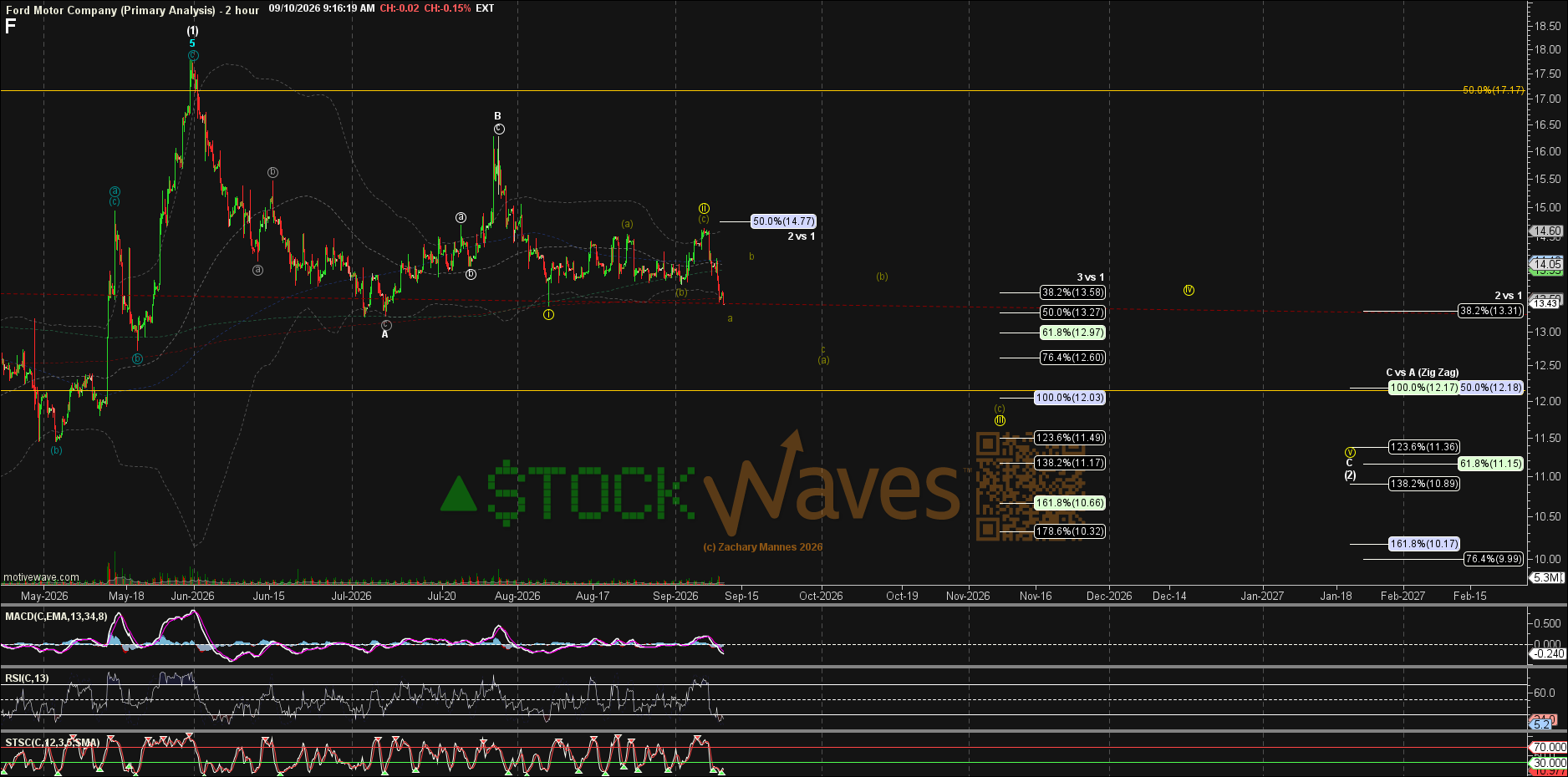
Zac Mannes, Senior Analyst at Elliott Wave Trader, recently shared a bearish setup, and his count calls for the pullback to extend over the next several weeks. The parameters came with it.
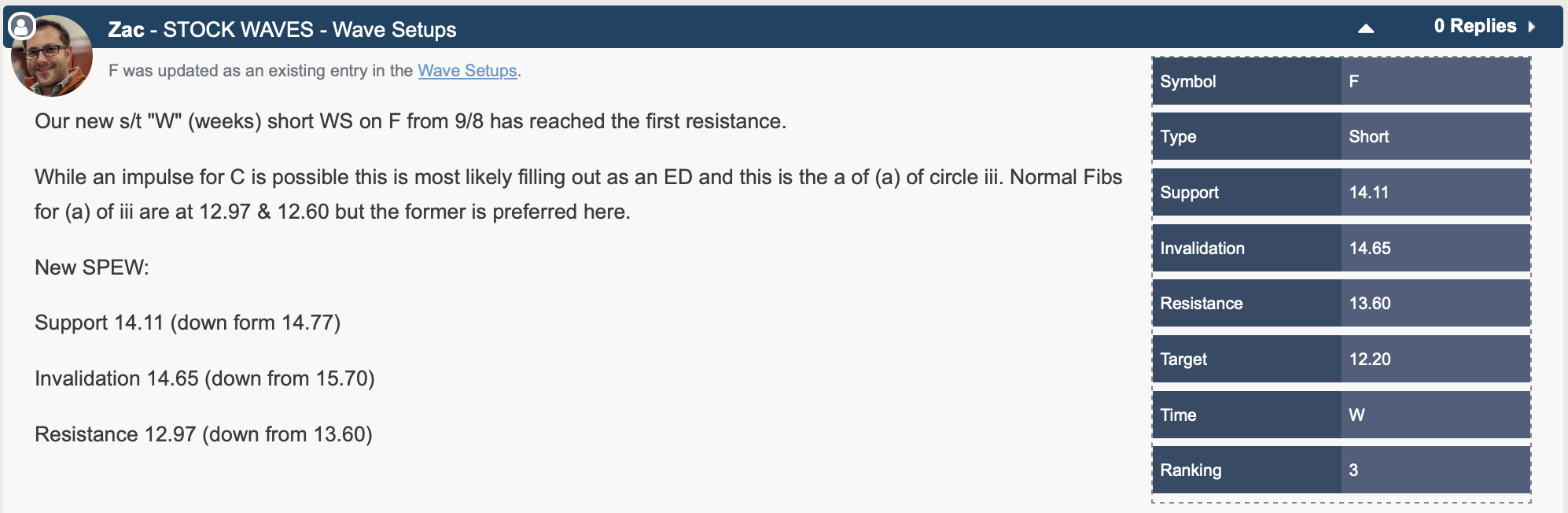
What a table like that offers is a boundary. Levels to work from, and a level that ends the discussion. (F) trades actively every session, which keeps spreads tight in both the shares and the options. The next target sits near the $12 area, for wave (iii) of circle 'c' of 2 within this correction.
Conclusion
Nothing in the fundamentals settles where Ford goes next. They set a range and leave it there. Value at one end, a narrow moat at the other, with the space between filled in by how people feel about trucks, batteries, and Washington in a given month.
If price works down toward the $12 region, there will be a reason attached to it by the time it arrives. A tariff headline. Another investigation. A sales month nobody likes. The reason will read as the cause, and it will have followed the turn rather than started it.
So the levels are what we watch. The setup marks where the bearish read holds and where it stops being worth holding, which is a question that can be answered. The next headline is not.
The fish in this can are real. It is the label that keeps getting repriced.
