
FIVN: The Floors the Crowd Poured
 By
Levi
By
Levi
If you've ever seen a building going up, then you well know that it's the site work and foundation first. The slab has to cure and pass inspection before anyone frames the first story on it. In a way, that is very similar to what has happened to FIVN in the past few months.
Due to several different situations plaguing the stock, no floor was found for months. The negative headlines just continued to flow. A 2024 guidance cut on weak bookings, then layoffs: the first in company history in August 2024 and another round in May 2025. The CEO, Mike Burkland, retired for health reasons in July 2025. There were exits by the CMO, the head of corporate strategy and the head of HR. A shareholder class action over the 2024 guidance that partly survived a motion to dismiss on February 23, 2026. Confidence had eroded, and by April of this year, the crowd had pressed the stock to the $13 level, down from a peak in August 2021 at over $211. What’s almost paradoxical about that high is that it arrived shortly after Zoom's $14.7 billion all-stock bid, which Five9 shareholders voted down. By spring of 2026, near disaster was being presumed.
But then, the stock found a base, a foundation as it were. We began to watch this one closely for a further turn higher. Would the crowd continue to build or was it just a dead cat bounce? We will examine what's ahead for FIVN and what the structure of price on the chart is telling us going forward. The concrete has been poured and has had the time to cure. How high will the building rise?
The Company in Its Own Words
Five9 describes itself as a cloud contact-center platform that is turning into an AI-agent platform, and its filings name both the opportunity and the risk in the same breath. Here is their base blueprint.
What they do: The 2025 10-K calls Five9 a leading provider of an intelligent CX platform for enterprise contact centers, powered by its Genius AI suite. The stated design goal is human agents and AI agents working together, with each interaction improving the next. The Q2 2026 release counts more than 3,000 customer organizations and more than 1,450 partners.
Their path forward: The Q2 release cites a third straight quarter of accelerating subscription growth, a nine-figure contract signed through the Google Marketplace, the launch of Voice AI Agents, and new executive appointments in June. Full-year 2026 revenue guidance is $1.260 to $1.272 billion. On the Q2 call, management put AI revenue at about $39 million, up 78% and roughly 15% of subscription revenue.
The strategy: On the first-quarter call, CEO Amit Mathradas said the role of human agents is “elevated, not eliminated.” Five9 calls this approach “Humantic CX.” Its design is AI agents and people on one platform. AI takes routine contacts and humans keep the calls that involve complexity, value or vulnerability. Human agents get real-time guidance from AI tools. Then how they resolve the hard cases feeds back into training the AI. Commercially, management is moving new and renewing customers off per-seat pricing toward fixed commitments. The AI is sold on consumption.
The filings name the risk plainly: if AI shrinks seat counts faster than AI sales replace that revenue, results would suffer. They also warn that the stock has been volatile and may stay that way.
Who Pours the Floors
The filings describe the building, but the crowd decides when each floor gets poured. News will act as a catalyst for a small cap such as this, as will earnings releases and company announcements.
Why size matters: FIVN joined the S&P SmallCap 600 on August 3. The great majority of its shares, almost 97%, are held by institutions. The stock had 40 moves larger than 5% in a year. Concentrated holders make for sharp turns.
Reactions to earnings: In Q1, shares slipped after hours to $16.74 from a $17.05 close, then rose 18.6% the next session. In Q2, shares traded at $27.84 after hours, down another 1.89%, then closed the next day at $33.98, up 19.8%. The numbers didn't change overnight. The crowd was pouring a floor.
Taking into consideration the concentration of holders and the nature of the crowd's emotions, the volatility arose from sentiment shifting under the pressure of fear and greed in motion. If the crowd sets the schedule, we need a way to know when a floor has cured. Please allow us to share a method to help in this process.
The Setup — Floor by Floor
Builders use a blueprint. It's their go-to framework to guide the project. In a way, you can do the same, albeit in simpler form, with a stock chart. The Wave Setups feature is specifically designed as such a tool for the user.
Let's take a look at what the FIVN chart looked like pre-setup, then at the time of initiation, and finally where we find ourselves now.
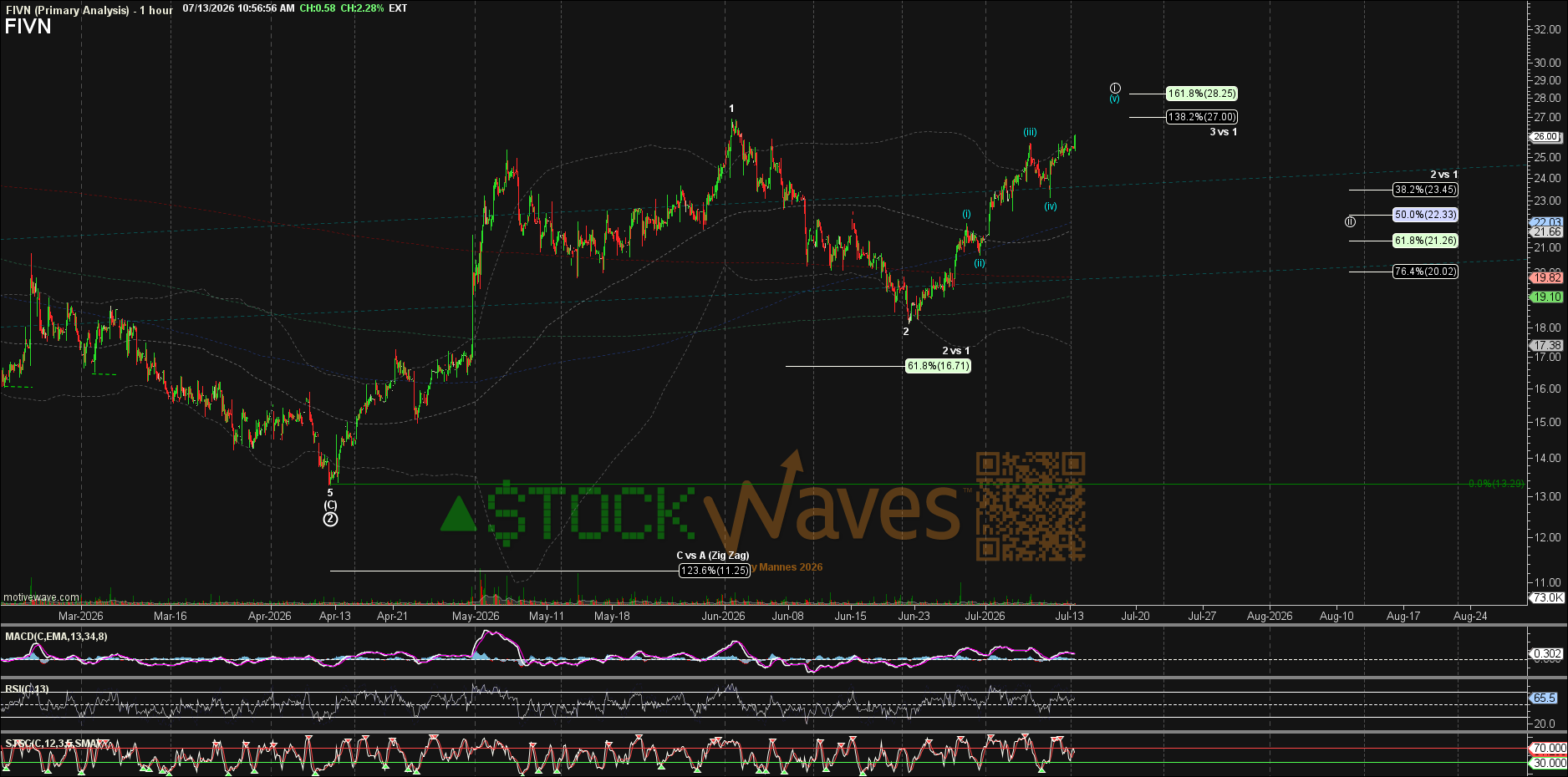
Our ideal Wave Setups show a stock in a 1-2, i-ii structure. These types of setups tend to provide all of the key factors looked for that will give us specific parameters going forward. Here, on the 1-hour chart from July 13, Zac Mannes shares how FIVN has formed the initial 1-2 and the next lesser degree wave 'i' underway. A corrective wave 'ii' thereafter would be the setup we are looking for. That's exactly what transpired.
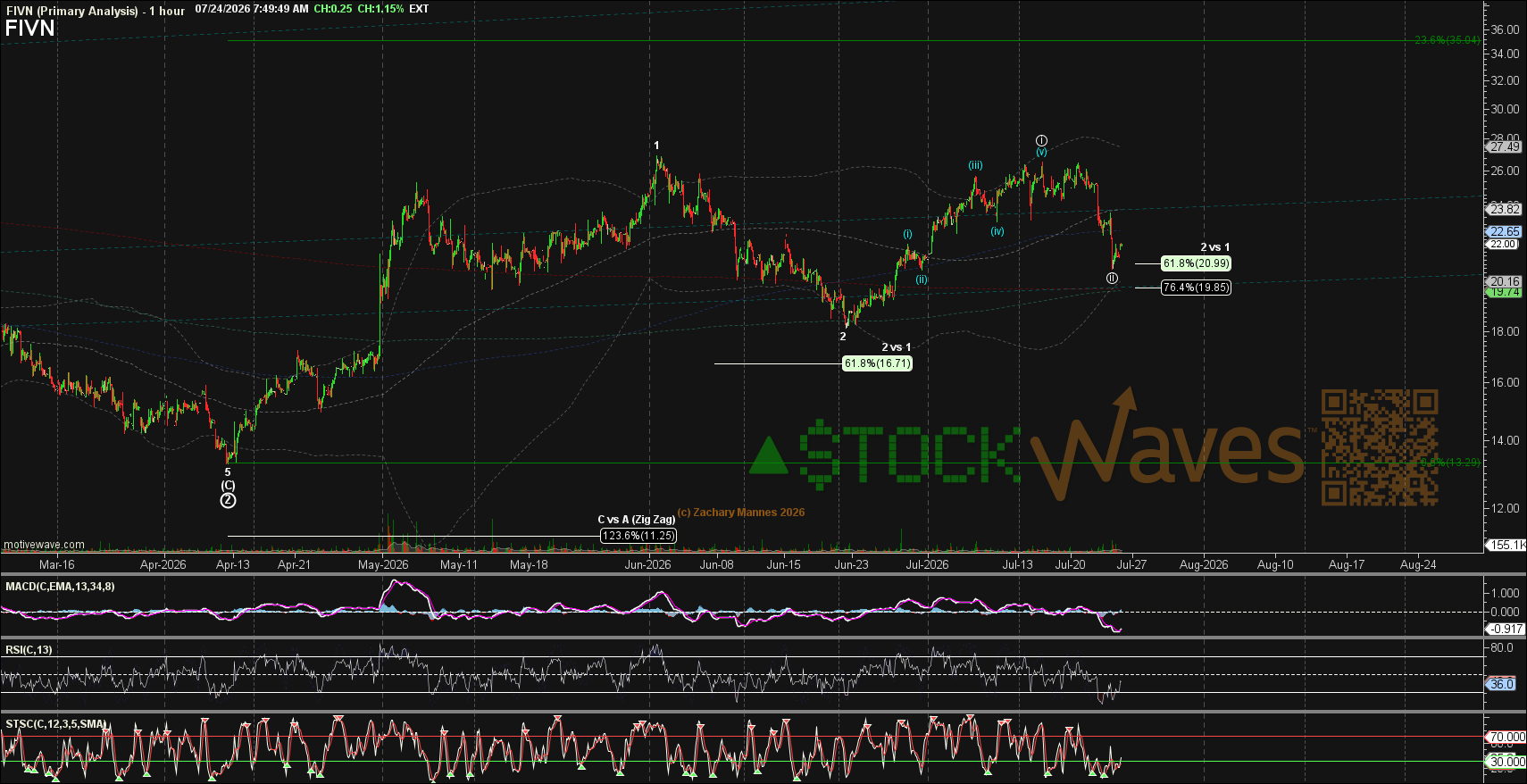 Why would you want a stock to go down? Well, stated plainly, when you are awaiting the ideal 1-2, i-ii setup! Many times a stock will retrace anywhere from 38% to 62% of a wave 1 rally. Zac had been waiting for FIVN to oblige. Here's the setup posted on the morning of July 24 before the market open.
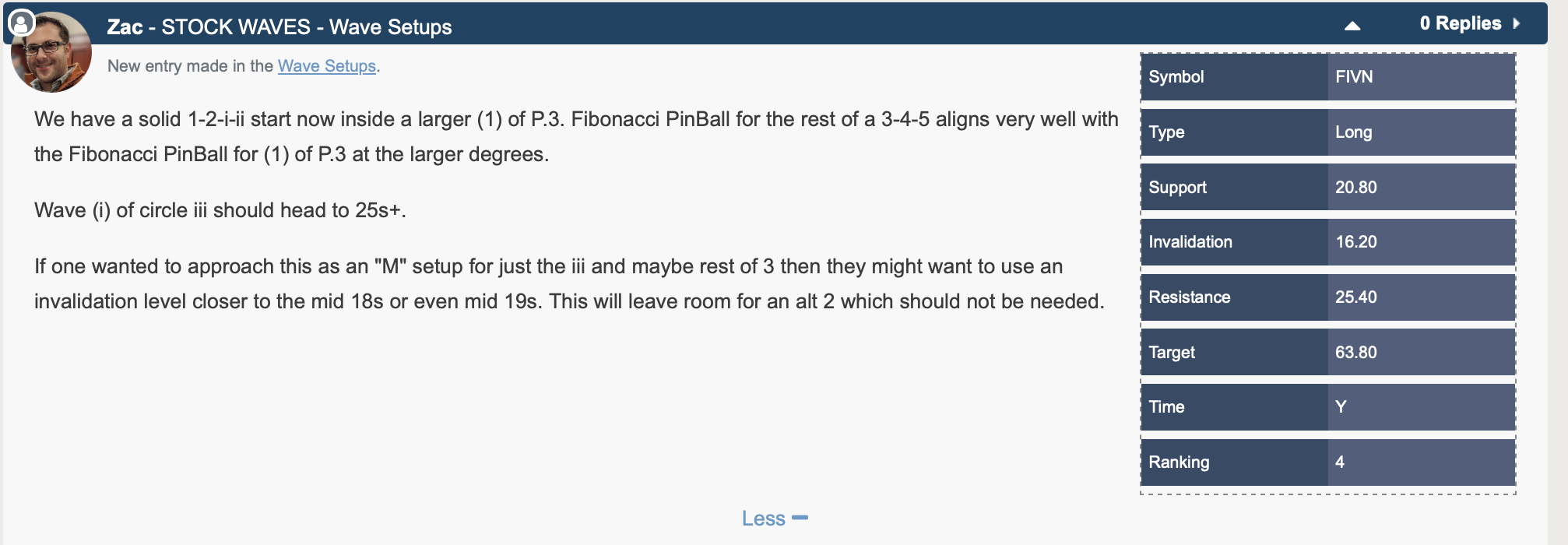
For this setup the entry was at the $22 area, the invalidation was initially placed at $16.20, and the long-term target was $63.80. That calculates to about $42 of upside against $6 of risk, or roughly 7 to 1.
Note the clean parameters, no ambiguity. As a side point, had the setup busted, it would not necessarily mean that there are no other bullish alternatives for the stock. Just that our parameters as stated at the outset did not hold. But, in this case, they did.
In two months' time, the stock rose roughly 80% from the $22 entry to $40.00 on September 23. When a stock moves like this, an update to risk versus reward is required. Zac posted this on September 24.
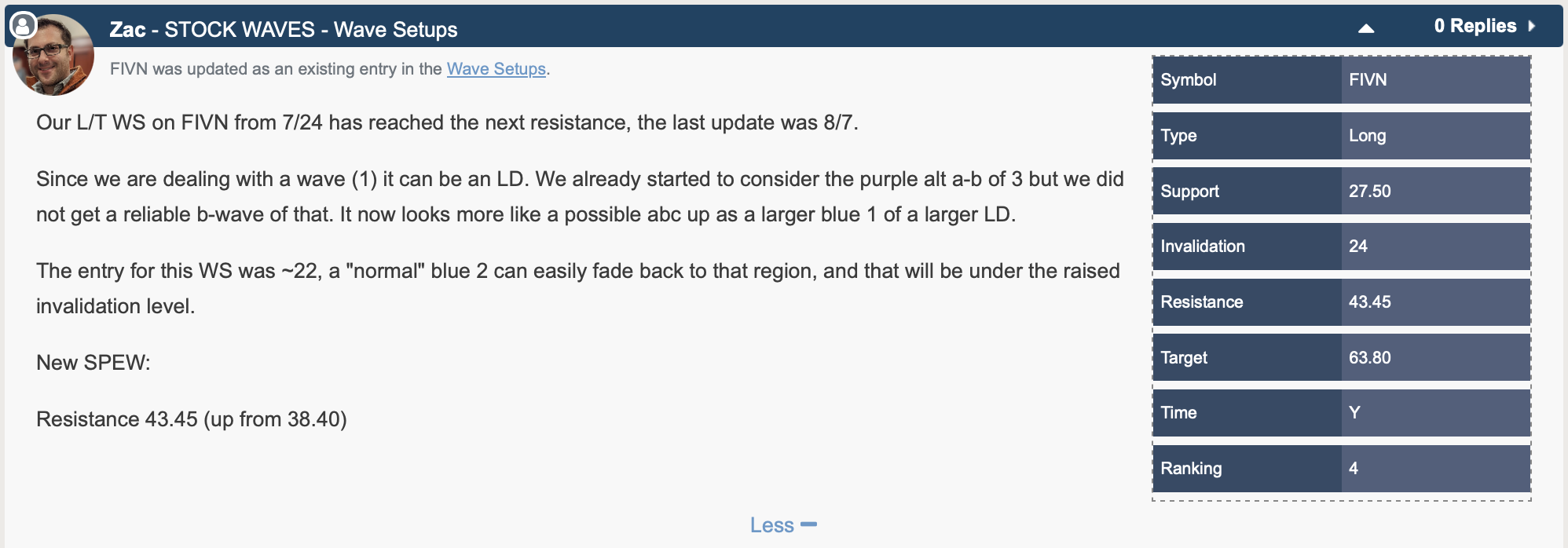
$22 to $40 necessitated the following revisions to the setup table: Support $20.80 to $27.50; invalidation $16.20 to $24, now above the $22 entry; resistance from $25.40 to $38.40 in August, then $43.45 in September; target unchanged at $63.80. 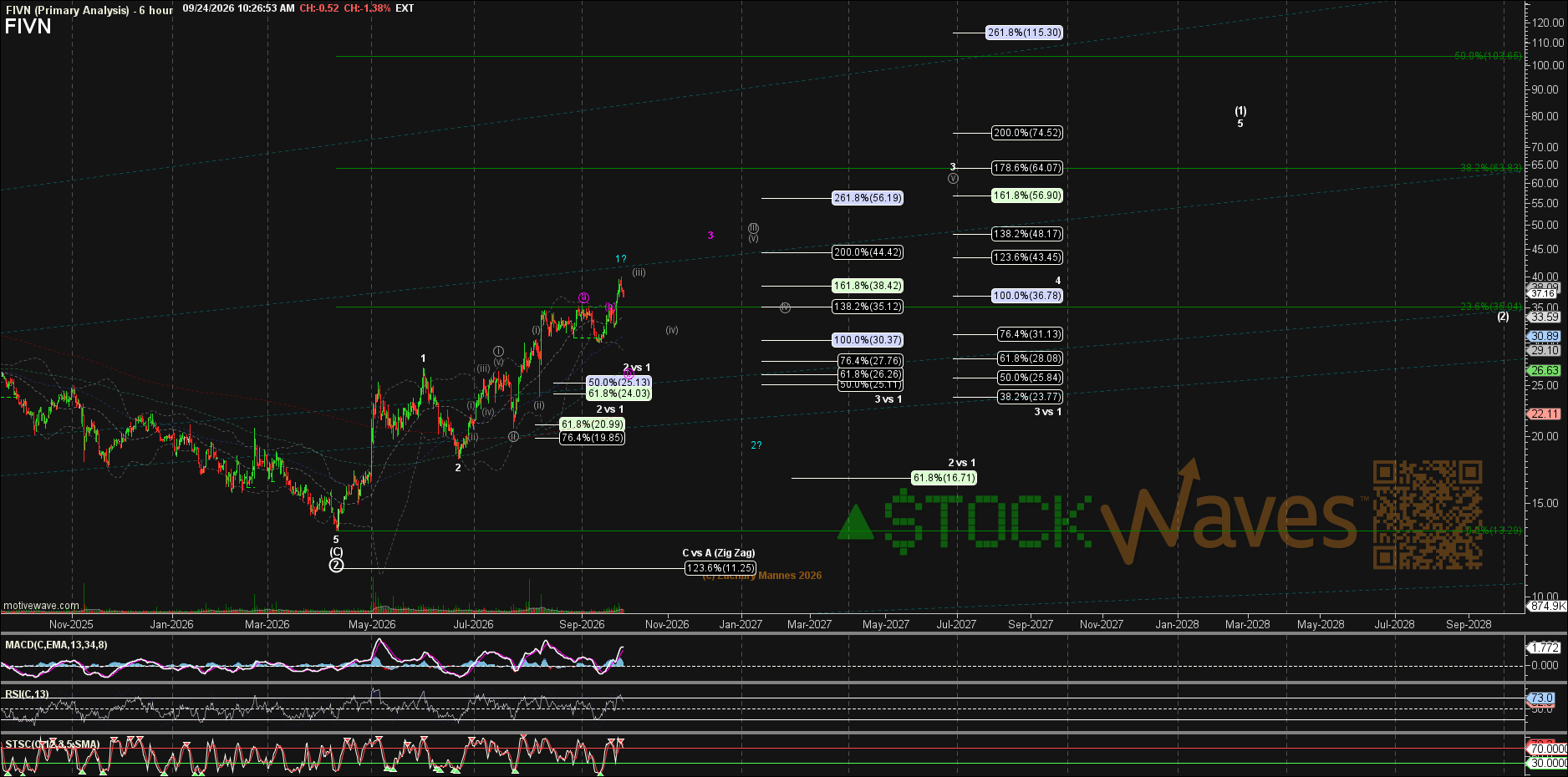
A few points to keep in mind. Individual traders will use this information in various ways. Some will have already taken profits. Others have a longer time horizon. Understanding how stocks like this can ebb and flow, Zac has also commented that a normal wave two pullback could even fade toward $22 yet again, below the new $24 invalidation. Should that happen, it would likely generate a different setup with new parameters.
Note the big-picture view next.
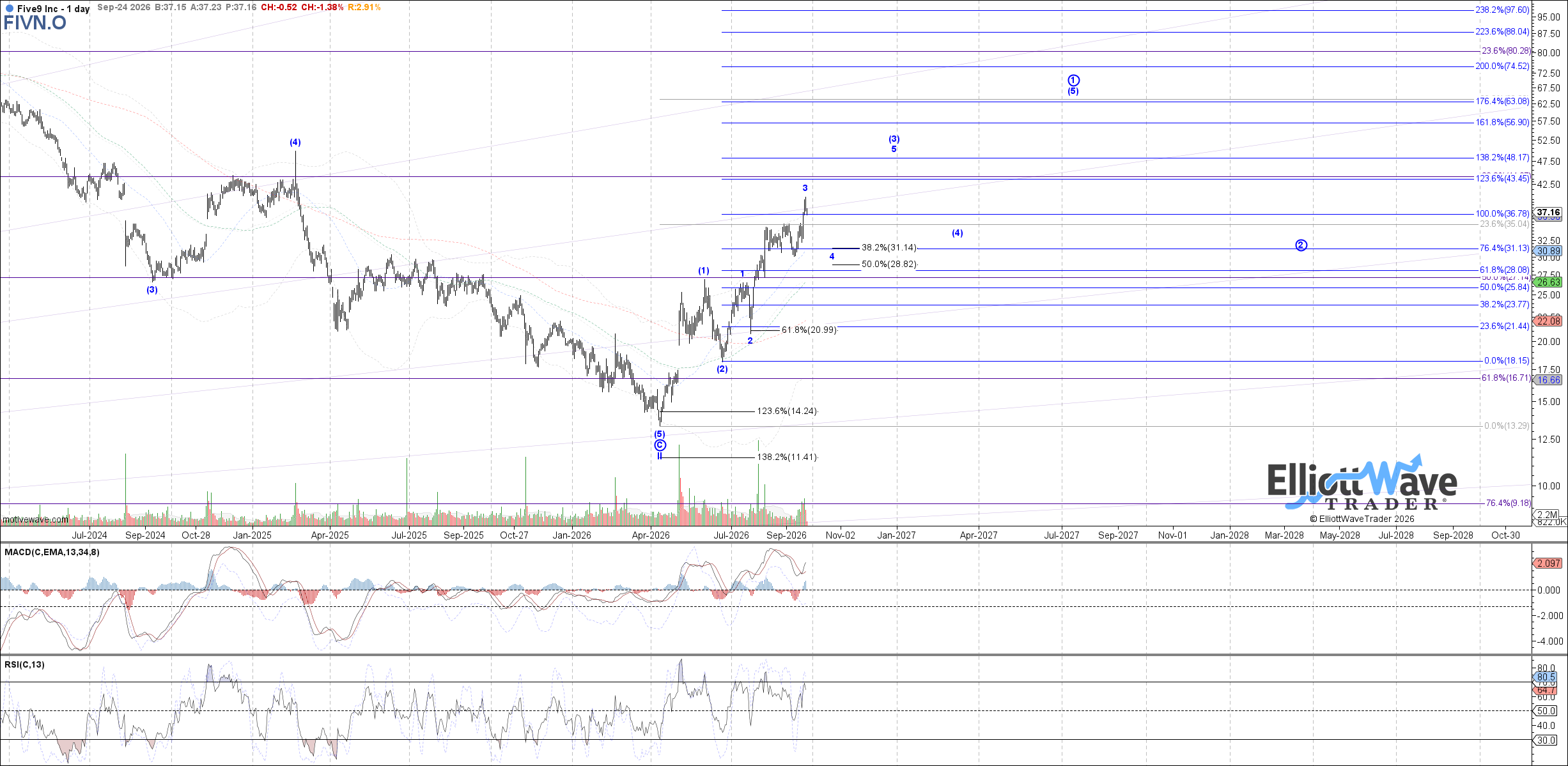
For as long as support holds, the stock appears to be in an uptrend and on its way to filling in a larger Primary Wave 1. Both Zac and Garrett show the structure suggesting higher. We will continue to track the price action and follow the parameters as set forth in the setup.
Conclusion
Let's return to our blueprint. The plans still call for a top floor at $63.80, but no one frames the next story until the crowd shows that this one will bear weight. Holding $27.50 keeps the next story toward $43.45 on the schedule. A break of $24 means the setup steps aside, and a pullback toward the low $20s becomes a new footing to inspect, not a failed building.
