
Demand Was Never IREN’s Problem — Delivery Is
 By
Levi
By
Levi
IREN spent years mining bitcoin. Now it sells compute.
That part of the story is complete. Microsoft signed on, and in size. Others have followed. Customers are even paying up front — recent contracts came with prepayments covering close to half the cost of the chips, and this before a single one was delivered.
Nobody prepays for something they can get elsewhere. Demand is not in doubt, and it has not been for some time.
The funding question was answered too, and better than the sector usually manages to do so. IREN funded the MSFT buildout with investment-grade debt and customer cash instead of minting new shares. That is the inverse of the old bitcoin miner playbook, where every buildout arrived with a secondary attached.
So what’s left to worry about?
Two things, and they are the same thing.
The first is the clock. Prepayments are not gifts. They are advances against delivery. Megawatts have to come online via a schedule that customers agreed to in contracts, and lenders test the coverage every quarter. The buildout does not get to run late in exchange for running well.
The second is the stock itself. IREN carries billions in convertible notes. The most recent tranche converts near $73 a share. Above that line, the notes turn into stock and the problem is solved. Below it, they stay debt — cash owed, and owed behind the lenders who already hold first claim on the chips.
Read that again, because it’s the whole setup.
The share price is not a scoreboard here. It is a financing input. If the crowd believes and drives the stock to new highs, the debt dissolves into equity and the cost of the next buildout falls.
If the crowd instead stops believing, the same paper hardens into an obligation and the next spend gets more costly. Belief funds the buildout. The buildout feeds the belief. The loop runs in whichever direction it has already started turning.
That is the part that gets passed over. The analysts modeling megawatts and run-rate revenue are doing honest work. But a model of the business is not a map of the stock. A company can execute a plan and still hand shareholders a two-year drawdown. It happens constantly.
Which brings us to the only thing that resolves it.
Sentiment moves first and price records it. Every contract, every financing, every delivery milestone arrives inside a structure that was already in motion before the news printed. The chart does not care what IREN is building. It tracks what the crowd is willing to pay while they wait.
So we are going to set the fundamentals aside for a moment. Yes, they are compelling. If IREN executes their plan, it should be a great success for the company and for the stock. These figures are telling us what is at stake. They do not tell us specific risk versus reward levels from this point in time forward.
Here is what the structure of price on the chart is communicating.
Sentiment Speaks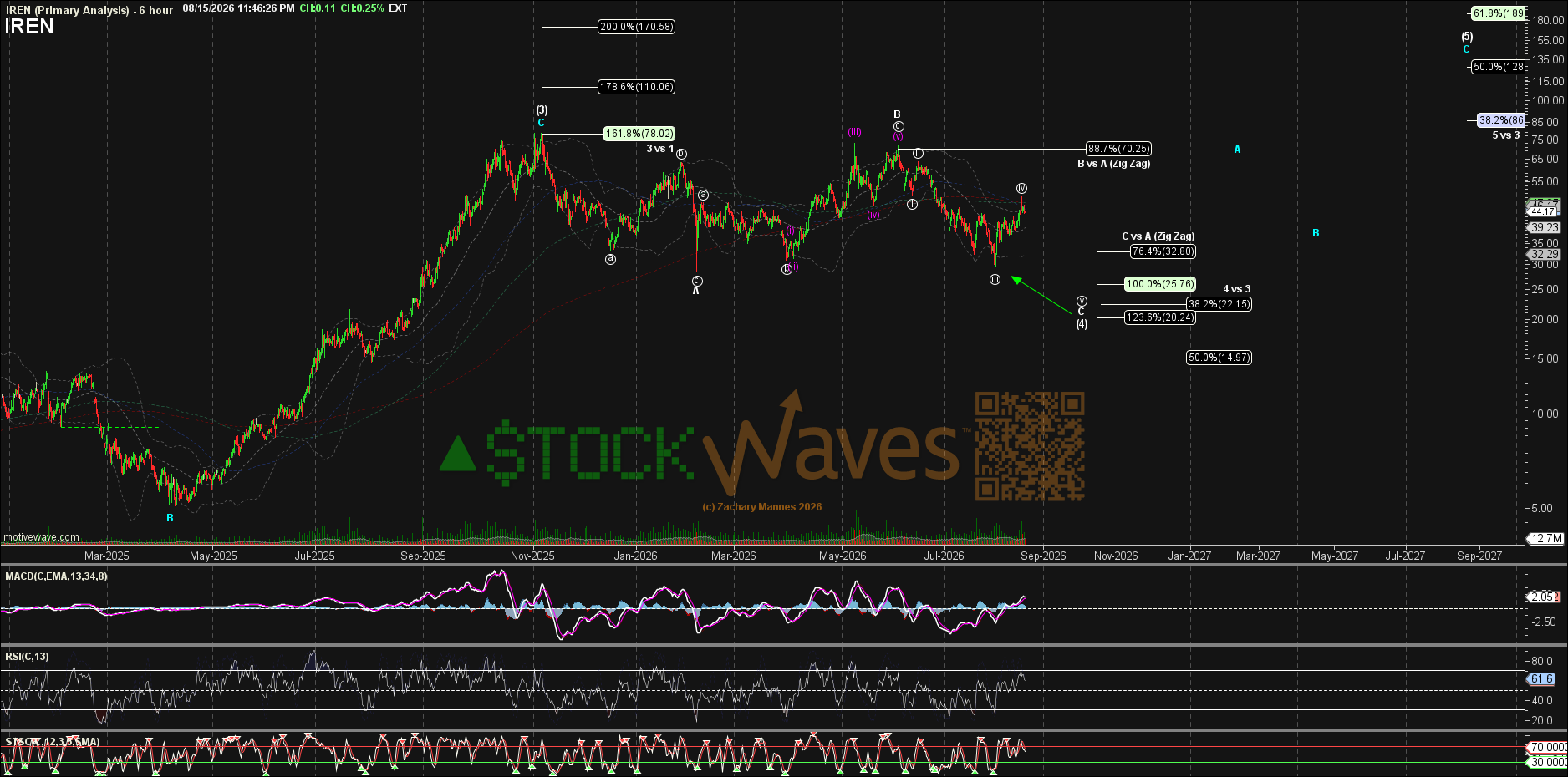
Right away you can see that IREN has just been biding its time for nearly the past year. Senior analyst Zac Mannes is showing the fourth wave correction as either completed already or nearly so. An argument could be made for it to have filled in all the way as wave ‘v’ of C of (4).
We can identify five waves down from the B wave high that was struck in late Spring 2026. Now, a key point to keep in mind is that the larger structure has shaped up as a non-overlapping diagonal. This means that the subwaves inside the advances will form as A-B-C. You can see this as a B wave low formed in April 2025 and then the C wave of (3) topped in the Fall of 2025.
The next rally for wave (5) should also form an A-B-C. If price has indeed already found a low in (4), then it is in wave ‘a’ of the A of (5). A ‘b’ wave pullback should now form and retrace from 38% - 62% of the ‘a’ wave rally.
Current resistance is at $50 and near-term support is $36-$40.
Conclusion
IREN has the contracts signed. It has the funding in place. What it does not have is unlimited time — and the chart is where that clock gets read.
The structure of price on the chart says wave (4) is complete or close to it. If that holds, the first leg of (5) is already underway, which means the next move of consequence is a ‘b’ wave pullback rather than a breakout.
We are watching the next retracement of this ‘a’ wave rally. Support at $36-$40 is where this either holds or tells us the fourth wave still needs time.
Overhead, $50 is the main hurdle. Beyond it sits a number the market has not talked about much: $73. That is where the most recent convertible tranche turns into stock instead of debt. The crowd does not know it is voting on the balance sheet. It votes anyway.
That is the setup in full. Delivery is IREN’s job. Reading the crowd is what we do. The company will either energize those megawatts on schedule or it will not. And we will learn which is which long after the chart has already told us how the crowd feels about the odds.
Price is the arbiter of opinion. Watch $36-$40. Then watch $73.
