
DXYZ: Anthropic on the Cover — Treasuries in the Book
 By
Levi
By
Levi
Most funds don't tell you what the crowd is feeling. You have to work it out from how price moves.
Destiny Tech100 is different. Four times a year it publishes what its holdings are worth. The stock trades against that number every day. The gap between the two is a sentiment reading you can put on a chart, and for most of this fund's life the gap has been enormous.
In April 2024, the stock closed at $99.79 against a book value of $4.84. Buyers were paying roughly twenty times what the assets were worth. That's not a valuation. That's a crowd.
What happened since is the part worth contemplating further.
Two years, opposite directions
The fund's own semi-annual report, for the twelve months ended June 30, puts it plainly. Net asset value rose 395.66%. The market price fell 32.37%.
Same period. Same fund. Both numbers printed in the same table.
Book value went from $6.44 at the end of 2024 to $34.30. The holdings did well. The stock went from near $100 to the low $30s anyway.
Whatever was being traded in 2024, it wasn't the portfolio. It was access — the feeling of owning something you weren't supposed to be able to own. That feeling had a price, and it has been deflating out of the stock ever since.
Sometime this summer it finished its deflation. DXYZ now trades below what the fund says its holdings are worth, the first sustained discount in its history.
That crossing is the story. Above the line, this was a scarcity trade. Below it, it's a fund, and funds get judged on what they hold and what they charge.
What it actually holds
The June 30 filing lays it out. The largest single position is a money market fund — $939.7 million, or 57.5% of net assets. Anthropic, held through a vehicle called Magnitude ANC III, is $235.7 million. The SpaceX exposure, spread across three separate vehicles, comes to $173.1 million.
Across 47,657,338 shares, that works out to about $4.94 of Anthropic per share. So a dollar put into this stock at $32 buys roughly fifteen cents of Anthropic.
That isn't a scandal. A fund that just raised money has to park it somewhere, and Destiny raised a great deal — 25.7 million new shares in six months at an average of $37.57, nearly a billion dollars. Some has gone to work, including $150 million into an OpenAI vehicle in August. Most is still waiting.
But it changes what you own. And it changes how the fee lands. The management fee is 2.50% of gross assets, so the Treasuries pay it too. In the first half of the year the fund earned $6.9 million in income and paid $11.2 million in management fees. Expenses ran $13.2 million against that $6.9 million. The fund lost money on operations before a single holding moved.
Both sides of the same trade
Two things the fund has done deserve to sit next to each other.
It sold 25.7 million shares at an average of $37.57 while the crowd was paying a premium. And in August, the board approved a program to buy shares back at prices below book value.
Sell high, buy low, on its own stock. Both add to book value per share. Whatever you make of it, the adviser has been reading the same gap we are, and now has the authority to act on it in either direction.
That second piece matters for anyone watching the downside. A buyer with a mandate to step in below book changes what a decline looks like.
What the chart says
Price has been building a structure off the July low, and there are two ways to label it. Either a third wave just finished and a fourth is completing near $30, or the first micro 5 wave sequence is done and a second wave is working toward $28 to $30.
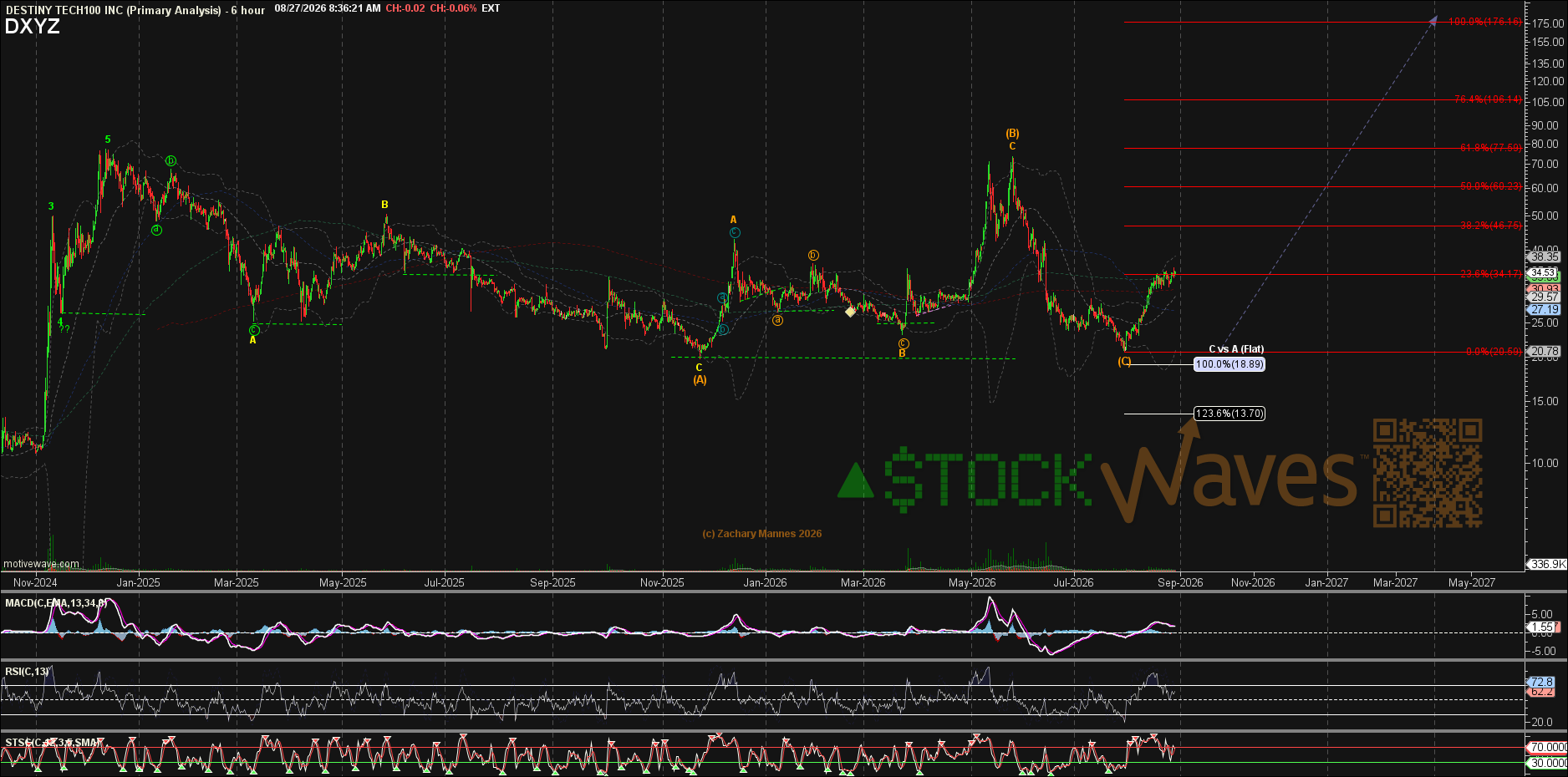
The labels differ. The trade doesn't. Both point to the same area, and both point next toward $40.
What makes $40 interesting isn't the number — it's what it means against the book. At $34.30, a move to $40 puts the stock back at a premium of about 17%. Not a recovery to fair value. A return to paying up for access, roughly two-thirds of the way back to where the adviser was issuing.
The $28 to $30 area is the mirror. That's a discount of 12% to 18%, wider than this fund has printed, and now squarely inside the range where the buyback could show up.
Below $24 is where the read changes. That's a discount near 30%, and discounts that wide don't come from sentiment drifting. Something else would likely be going on.
The part price can't tell you
Here's what keeps this honest.
The next book value lands in late November, for September 30. The SpaceX position is marked almost straight off the public price — the filing shows only about a 1.9% structural adjustment, no discount for the shares being locked. SpaceX closed at $170.86 on June 30 and trades near $150 now. That's roughly $21 million, about 44 cents a share. Real, but small.
Anthropic is the swing. It's marked off observed secondary transactions, and a listing is reportedly being targeted for October. A step-up there flows straight into that $235.7 million.
Which means $40 could arrive two completely different ways. Sentiment expanding again, with the crowd paying a premium the way it always has. Or book rising to meet the price.
Same number. Opposite meaning. The chart can't separate them. Only the filing can.
That isn't a hedge. It's the shape of the thing, and pretending otherwise would be inventing certainty that isn't on the chart.
The structure says $30, then $40. Below $24 says the read was wrong. Everything in between is the crowd deciding, once again, what access is worth — and doing it in public this time, against a number anyone can look up.
