
DLR: Quiet Separation in a Noisy Market
 By
Levi
By
Levi
In a market where real estate and REITs are often treated as a single macro trade, nuance tends to get lost. Rising rates, falling rates, growth scares, and inflation narratives frequently sweep entire sectors into broad, undifferentiated moves. And yet, markets rarely behave that cleanly beneath the surface. Over time, they separate — quietly at first — rewarding some structures while leaving others behind.
Digital Realty Trust appears to be entering one of those moments.
What’s notable is not that this separation is new — it isn’t — but that it may be re-emerging at a time when the market is becoming increasingly selective. While much of the REIT and real estate space continues to trade as a broad macro proxy, DLR has begun to show signs of carving out an identity of its own. This is not about chasing yield or leaning on conventional valuation narratives. It’s about recognizing when price behavior starts to reflect a different participation profile — one that suggests relative strength may be forming even as the broader group remains uneven.
That subtle shift matters. Markets rarely rotate all at once; they differentiate first. Leadership often emerges quietly, long before it becomes obvious in headlines or consensus positioning. DLR’s role in digital infrastructure provides a distinct operating backdrop, but it is the way price is behaving — not the story — that hints at a potential edge.
If that edge is real, it won’t announce itself through guidance, commentary, or forecasts. It will express itself through structure.
That is why we turn to sentiment analysis here — not to make claims about certainty, but to define probability, risk, and the conditions under which this emerging separation either confirms — or fails.
⸻
Sentiment Speaks
Fundamentals may explain what a company does, but sentiment reveals when the market is willing to reward it. That dynamic becomes especially important when a stock begins to separate from its peers, because leadership does not emerge through headlines — it emerges through behavior. Price records that behavior with remarkable honesty. By studying its structure, we can assess whether participation is expanding, stabilizing, or subtly exhausting.
In DLR’s case, the chart now offers a framework to evaluate whether this recent divergence is the beginning of a broader advance — or simply a temporary reprieve within a larger range. To answer that, we turn to the structure itself and let price define the probabilities.
DLR has been a stock we have been following closely. Just a month ago, Zac Mannes shared a Wave Setup with specific parameters outlining a bullish scenario. That setup remains intact and continues to respect its structural boundaries. Let’s review where it stands now — and what the probabilities suggest going forward.
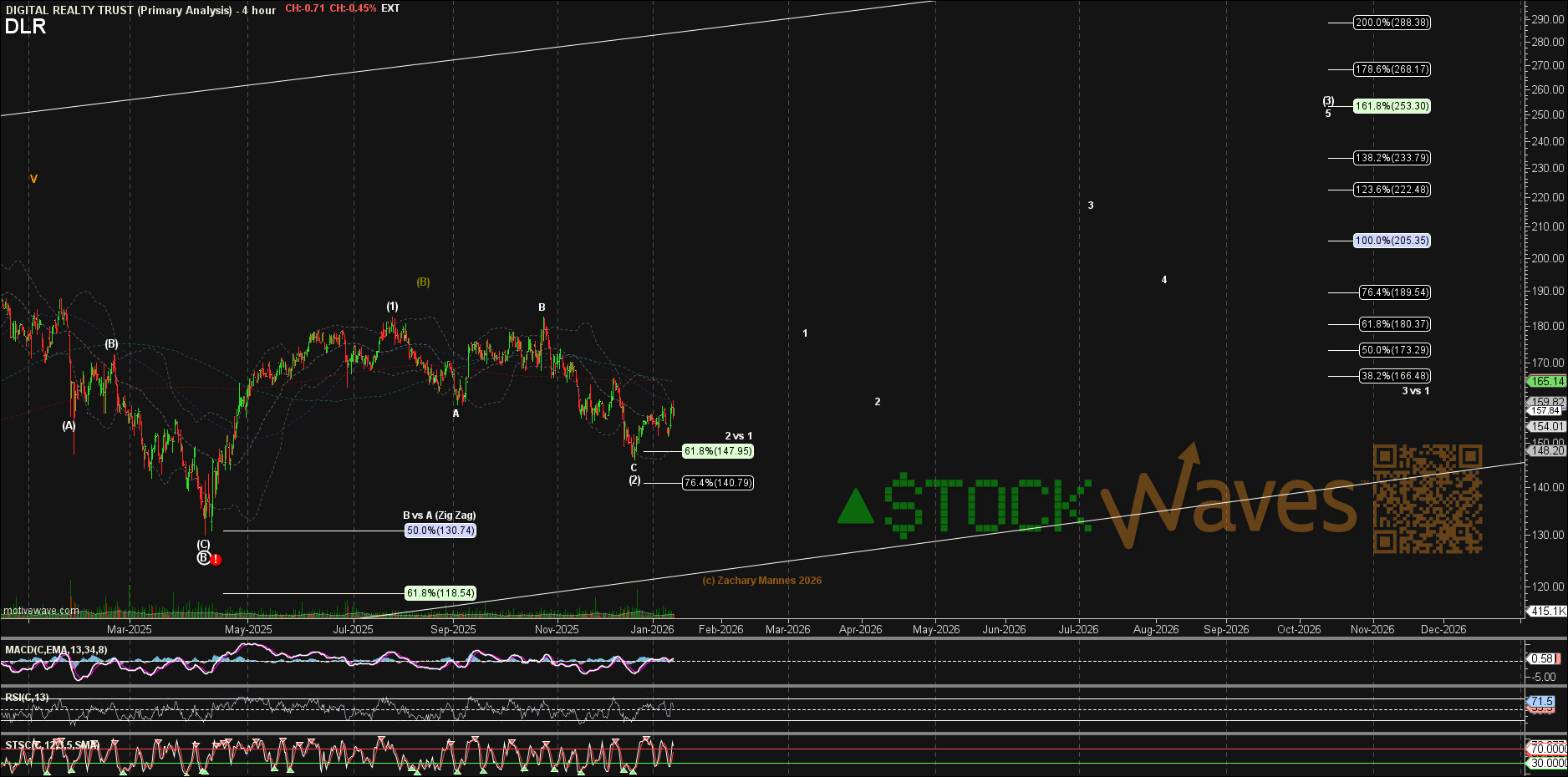
We are likely dealing with a standard Fibonacci Pinball structure here. Zac is showing price unfolding within a Primary C-wave advance, which by definition subdivides into five waves. Waves (1) and (2) have already formed.
Given the fractal nature of markets, those five waves are themselves composed of smaller, similar structures. This places DLR within a lesser-degree wave 1 of the larger wave (3) of Primary C.
Put simply, price appears to be entering the heart of a third-wave advance — typically the strongest and most persistent portion of a bullish structure. This alignment allows for unusually clean risk definition against a clearly identifiable upside target.
Zac is projecting the standard 1.618 extension of waves (1) and (2), placing the primary target zone near $250. This bullish scenario remains valid so long as the wave (2) low near $146 holds.
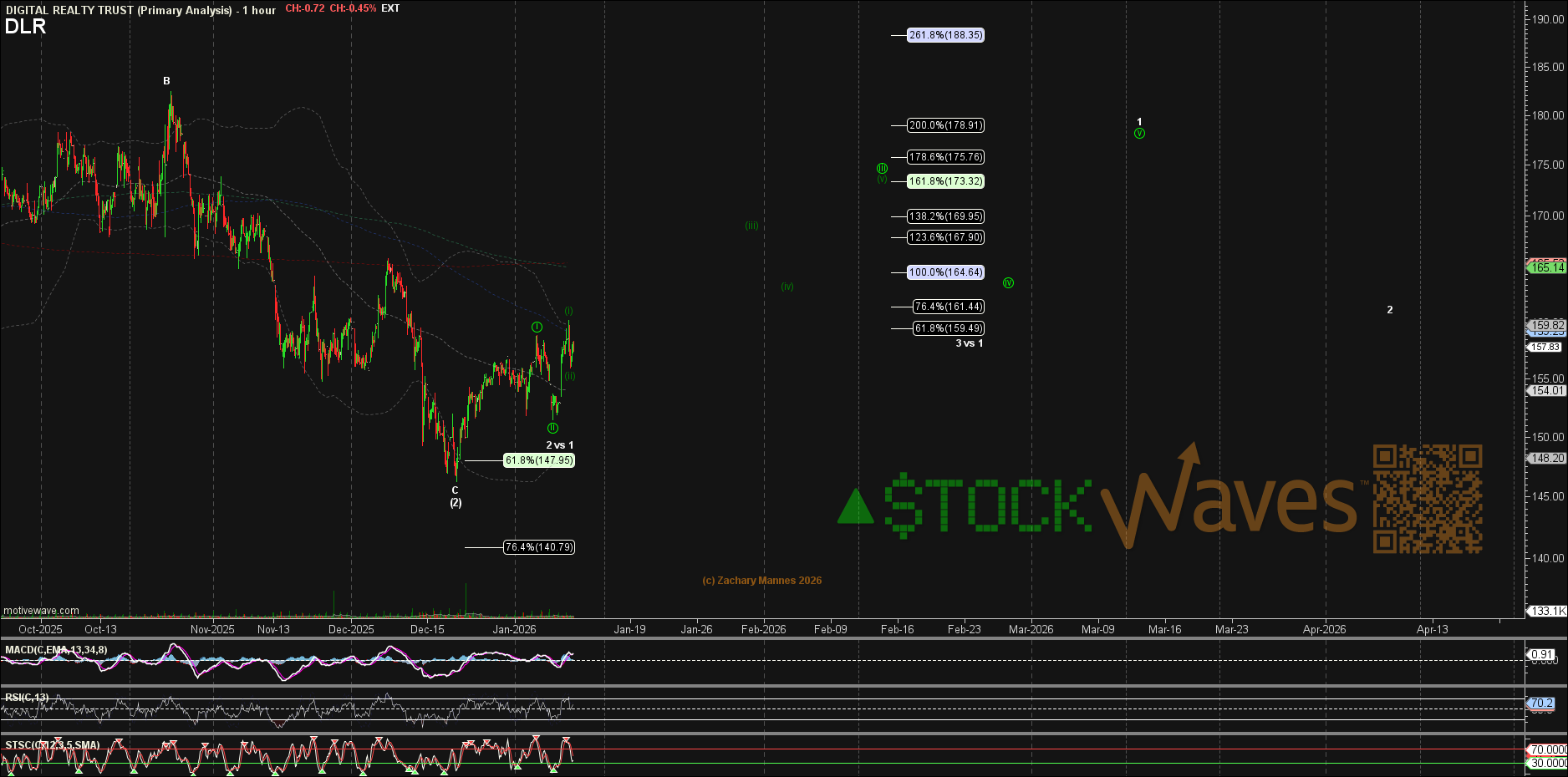
Zooming in further reinforces this view. Wave 1 of (3) should subdivide into five smaller waves, providing additional checkpoints as structure unfolds.
When the market presents a structure this well-defined, the advantage is not certainty — it is clarity. Risk and reward are measurable, and invalidation is explicit. Viewed through a probabilistic lens, this setup does not promise outcomes — it illuminates behavior patterns that repeat with consistency.
⸻
Concluding Perspective
Quiet leadership is often the most durable kind. DLR does not need to outperform loudly, nor does it require a wholesale rotation across real estate to validate its structure. It simply needs to continue doing what price is already suggesting — attracting participation in a measured, persistent way.
This is how leadership forms before it is recognized.
The opportunity here is not about prediction; it is about alignment. As long as structure holds, probabilities favor continuation. If structure fails, risk is clearly defined and contained. That is the power of approaching markets through sentiment and structure rather than narrative and assumption.
In a noisy market, separation rarely announces itself. It reveals itself methodically — one wave at a time, within the larger structure of price.
