
DDOG: History Is the Herald
 By
Levi
By
Levi
November 17, 2021, Datadog traded just under $200 a share. But the crowd soured soon after. Within a year the stock had given back nearly 70%. Four Novembers later, it touched just above the $200 level. And the crowd soured again.
Two peaks, four years apart, about two dollars from each other. The reasons behind each selloff had nothing in common. It's hard to see that and not wonder what else repeats.
What Datadog Does
Datadog makes software that watches other software. When an app slows down or a server goes dark at 3 a.m., its platform is often what tells engineers where to look. In its August 6 earnings release, the company calls itself "the leading AI-powered observability and security platform."
The path forward, as management tells it, runs through AI. Customers are building with it, and CEO Olivier Pomel says they use Datadog to "observe, secure, and act on" what they build. The next step is autonomy. This ultimately means that AI agents find, investigate and fix problems on their own. Second-quarter revenue grew 36% to $1.12 billion, and the company expects $4.45 billion to $4.47 billion for the full year.
The numbers do tell a tale. However, the more telling story is how the crowd has felt about them.
Sour, Then Sweet
Between mid-November and early February, the stock fell 32%. Along the way, Datadog reported fourth-quarter revenue up 29%. So the business didn't regress or shrink. The price people would pay for it did.
There was a palpable fear in the sector: autonomous AI agents would make companies like Datadog unnecessary, and by winter the crowd had grown wary of software as a whole. At the low, shares touched $98, roughly half the November high.
Then, as if it had never happened, the story flipped. Datadog's argument all along was that AI makes systems more complex, and complex systems need more watching. After a beat-and-raise first quarter in May, analysts rushed to lift their targets. By August, the stock had nearly tripled off the low. The same technology that was supposed to make the company unnecessary became the reason to own it.
Sour Again, Then Sweetening
On August 6, Datadog reported 36% growth and raised its full-year outlook. The reasoning trader would expect a rally. Instead, the stock fell in spite of the growth. Management said one very large AI customer would use less going forward and built that into guidance, which implied third-quarter growth slowing to 28% to 29%. By early September, shares were back in the low $200s.
This month, the tone shifted once more. Datadog rose five straight sessions through Friday, gaining 16.6% to close at $268.13. The narrative needed reason. A fresh Outperform from Wedbush and easing Treasury yields drew most of the credit.
Look at what drove each turn. AI would replace Datadog. AI would feed Datadog. An AI customer was pulling back. AI demand is the story again. AI was the story each time, with four different verdicts in less than a year. The subject never changed. The crowd's interpretation of it did.
What History Announces
This is where the past earns its place as prologue. The 2022 selloff came as rising interest rates pushed growth stocks out of favor. The 2026 selloff came on fears about AI. Different stories, right? But, in the end, the same behavior. In both instances the business kept growing while the price collapsed. And in both, the stock eventually climbed back above where the fear began.
What has changed is the intensity. Each washout has been shallower than the one before: nearly 70% in 2022, about half this past winter, and about 30% this summer. The rebounds have arrived faster, too. After the 2022 low, it took more than three years to get back above the old high. After this winter's low, it took a few months.
We don't have any special insight into what Datadog's customers will spend next quarter. What we can track is how the crowd responds when the news arrives, and that response thus far has been consistent. Whether the shallower dips reflect a crowd growing more confident with the story, or a little too comfortable, is a fair question. Price is our arbiter and will answer it before anyone else does.
The Setup
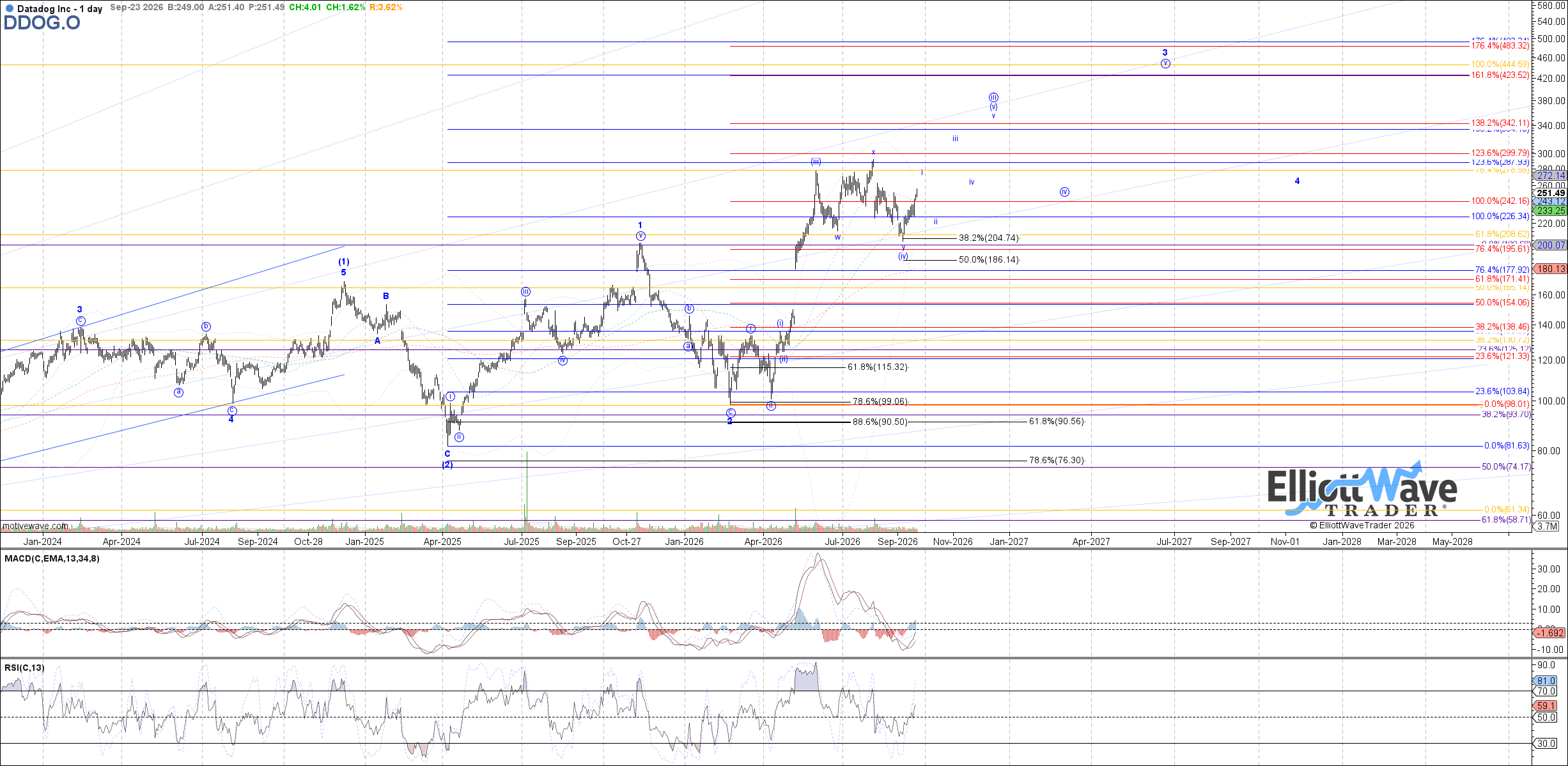
Garrett Patten frames the larger context for DDOG as a (1)-(2), 1-2 wave setup. This is one of the higher probability scenarios we come across in our analysis. Its standout advantage is practical in nature: it gives us standard target zones overhead and clear invalidation points below.
As the structure continues along its probable path, we can raise our support and invalidation levels. So with this framework, price is now likely forming the lesser degree i-ii of wave (v) of the larger circle 'iii'. That places our near-term invalidation of the bullish scenario at the last low struck, $203.24.
That low sits within a few dollars of the two November peaks that opened this piece. The ceiling that turned the crowd away twice is where price has now found support.
The typical target zone overhead for all of wave 3 sits between $423 and $483. From Friday's close, that's roughly 24% of risk against 58% to 80% of potential reward.
Conclusion
The next scare around this stock will come with a new headline. If history is any herald, it will leave the way the others did. For now, the structure favors the sweet side.
The headlines keep changing. The crowd keeps answering them the same way.
