
Bank of America: Structural Risk Beneath a Strong Surface
 By
Levi
By
Levi
Bank of America does not look distressed.
Its stock has held firm despite the aftershocks still rippling through pockets of regional banking. Its brand remains a default choice for institutions and consumers alike. Its size conveys durability. And the market generally assumes that support mechanisms—both explicit and implicit—remain far more available for the largest banks than for those on the margins.
On the surface, stability prevails.
But stability and strength are not the same thing.
A stock can look calm while vulnerabilities compound quietly underneath it. In banking, that distinction matters because the market’s perception of safety often rests on what is most visible—scale, franchise, and headline profitability—while the risks that shape outcomes tend to reside in places that are harder to see: duration, capital sensitivity, loan mix, and the second-order effects of credit and liquidity stress.
Two weeks ago, Avi Gilburt published a detailed analysis of Bank of America’s financial condition. The conclusion was direct:
“There are issues sitting within BAC’s balance sheets that could lead to worse consequences than what they experienced during the Great Financial Crisis.” (source: SaferBankingResearch.com)
The thrust of the argument is not that Bank of America is about to fail.
It is that the bank’s exposures create a form of fragility that can remain dormant—until it doesn’t. And when confidence is the product being sold, fragility does not need to become catastrophe to matter. It simply needs to become visible.
A central focal point is the bank’s held-to-maturity bond portfolio. As Avi noted:
“These deeply underwater HTM bonds cannot be sold or even repositioned without realizing a loss equal to roughly 40% of the bank’s capital. As such, they cannot be called ‘liquidity sources.’”
Layered on top of that is a credit book whose weight leans heavily toward commercial lending—nearly 60% of total credit exposure—at a time when corporate default probabilities have risen. Commercial real estate exposure remains significant at roughly $67 billion. Unsecured consumer exposure is not trivial. Deposit costs are no longer the near-zero advantage they once were. Each of those items can be manageable on its own. The concern is correlation—how quickly separate strains converge during late-cycle conditions.
None of this requires a doomsday narrative.
It requires only a shift in confidence.
And confidence is exactly what price reflects.
Which is what makes this moment interesting: while the financial debate deepens, the stock has remained constructive enough to suggest investors are still granting BAC the benefit of the doubt.
That disconnect—strong surface, structural fragility—is where sentiment becomes decisive.
The structure of price often resolves tension long before narratives catch up.
⸻
Sentiment Speaks — Structural Risk Beneath Strength
While discussion emphasizes franchise scale and “too-big-to-fail” assumptions, price is approaching a far more consequential test.
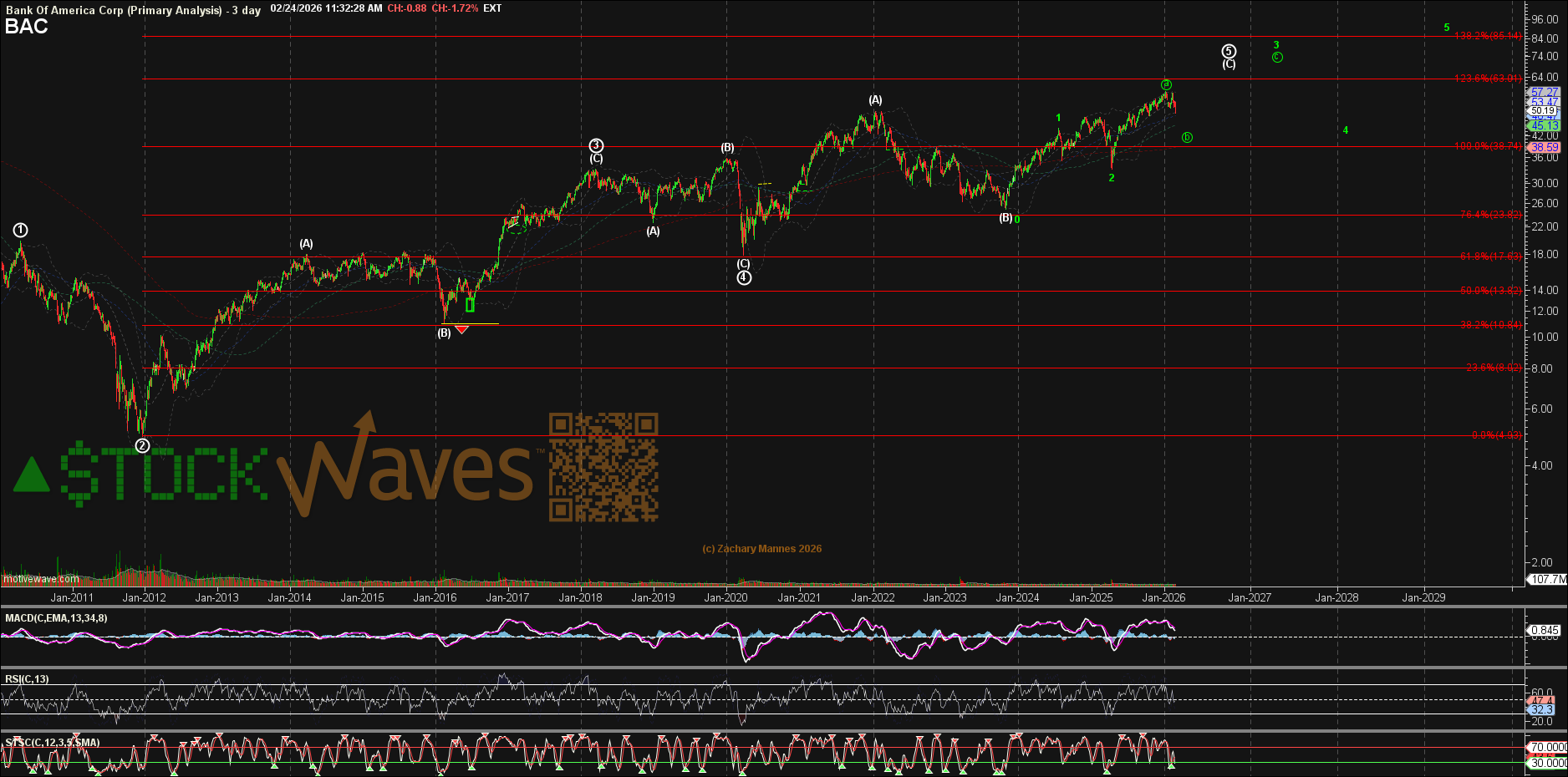
On the longer-term chart, BAC’s advance from the 2009 lows appears mature. The rally into the mid-$50s region is either the circle ‘a’ wave of a larger wave 3 in the green count, or it is nearing a much more poignant top at the completion of all of a Primary Wave 5 in the white count. That does not mean the advance is finished. In fact, one more higher high into the low-$60s—and even the upper-$60s—remains structurally viable.
But mature advances are not judged by how far they have traveled.
They are judged by how they behave near the end.
Late-stage structures often continue higher—but with diminishing quality beneath the surface: shallower follow-through, more overlap, sharper reversals, and increasingly important reactions around prior support. Price can still climb, but the character changes. And when character changes, it often foreshadows a larger turn even if the final high has not yet printed.
On the intermediate timeframe, the stock has begun to retreat from recent highs. That pullback is not inherently bearish.
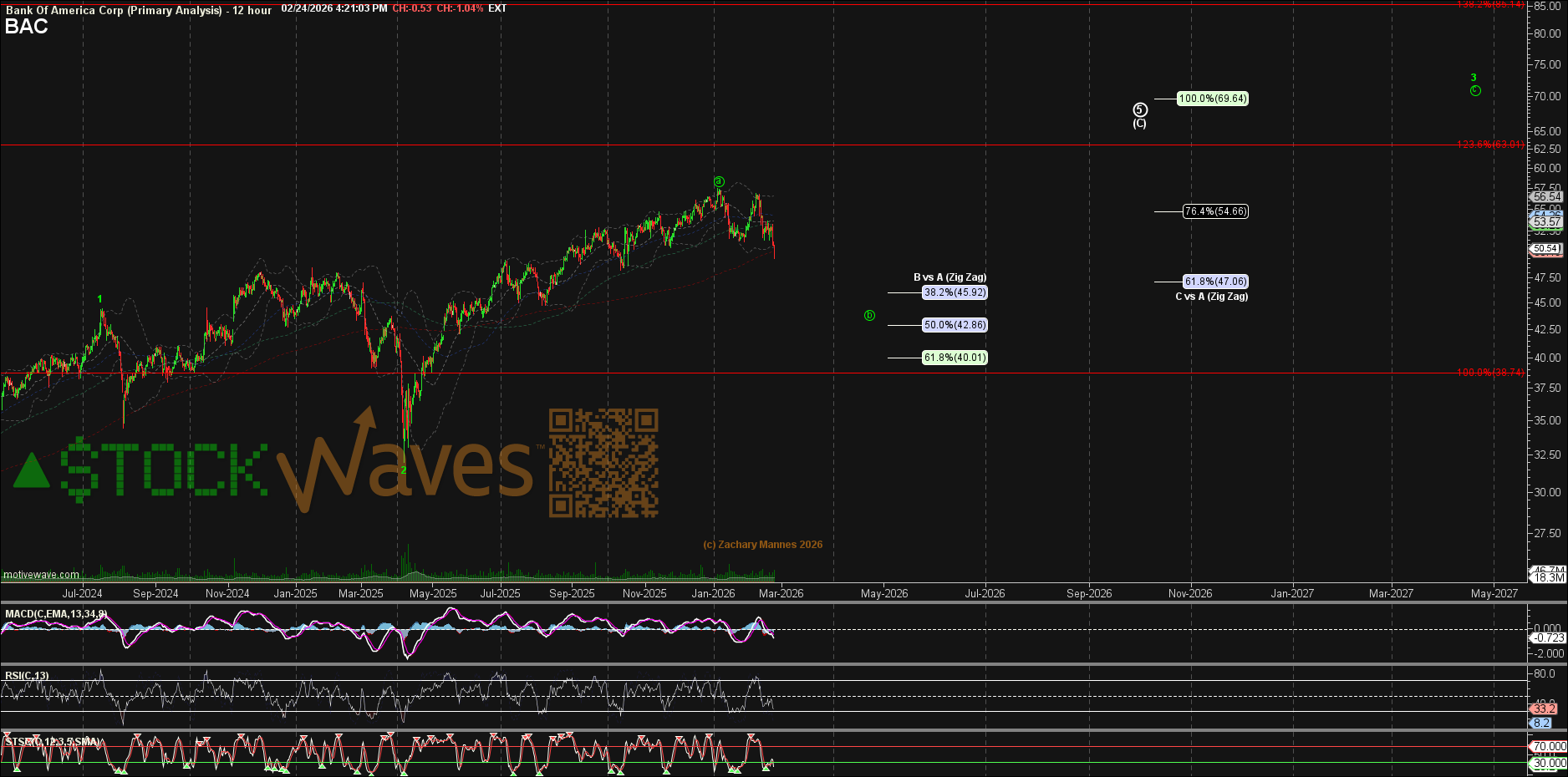
If the pullback stabilizes in the mid-$40s region and begins to progress in an organized manner, it would support the view that BAC is preparing for another upside extension. Ideally, this green path would finish the circle ‘b’ wave pullback in the $43–$46 area and then form a clear five-wave advance to signal circle ‘c’ is underway.
If that region fails, however, the tone shifts.
A sustained break beneath that support would increase the probability that the recent high marked something more significant—not merely a pause, but the beginning of a larger multi-month corrective phase. In other words, the market would be communicating that what looked like resilience was actually completion.
This is the paradox.
The balance sheet debate is intensifying at a moment when the long-term structure on the chart appears late in its cycle. This in and of itself does not confirm crisis. But it does suggest the margin for complacency may be narrowing—because the structure is reaching a point where disappointment can travel farther than optimism.
And as we often note:
Sentiment usually shifts before the story does.
⸻
Conclusion
Bank of America is not flashing distress signals.
It is flashing asymmetry.
On one side sits scale, franchise strength, and the market’s belief in insulation. On the other sits a balance sheet carrying meaningful duration exposure, concentrated commercial risk, and capital ratios that leave less room for error than many assume in a late-cycle environment. Neither side is decisive in isolation. Together, they create tension that price will eventually reconcile.
Markets do not wait for perfect clarity.
They rotate when certainty begins to fray.
Bank of America does not need to be failing for risk to expand. It simply needs sentiment to shift from assumption to scrutiny.
And when that shift occurs, it rarely announces itself in advance.
The question is not whether BAC is strong today.
It is whether this year marks the final phase of strength—or the opening act of a larger structural unwind.
