
ANET: Deep Buffers - Market Analysis for Nov 16th, 2026
 By
Levi
Moguls can be daunting obstacles for the uninitiated. But once understood, they are some of the funnest terrain on the mountain. As you learn and practice the movement, you no longer fight the bumps. It's a matter of absorption and fluidity. With strong, resilient knees you can ski moguls at speed, and you can actually ski nearly a straight line down the hill if you can just absorb the hits and maintain your velocity.
Arista Networks (ANET) built much of its name on the same idea. Its deep-buffer switches hold data in memory during microbursts, the short and intense traffic spikes common in AI workloads, so the network absorbs the hit rather than dropping packets. Built-in protection for the unexpected. How do we keep moving forward with all the potential disruptions and yet maintain our speed?
ANET just had a microburst of its own. On November 3, Arista reported third-quarter revenue of $3.66 billion, up 58.5% from a year earlier and its fastest growth since going public. Management also raised its 2026 forecast for the fourth time this year, to $13.3 billion. The stock rose 5% the next day. The day after that, it fell 10.8% while the S&P 500 dropped 4.4% in a broad selloff across AI infrastructure names.
How many times have we seen positive numbers receive a negative price reaction, and vice versa? News via headlines is rarely if ever the real motivator behind price moves. Crowd behavior is not dictated by a headline. If anything, it's the other way around. It is the overriding social mood that is in control, particularly at the turns.
ANET is one we have been watching with close care. The 4-hour chart from Zac Mannes follows ANET from its spring low through the August high, the correction into early November and the path we see from here.
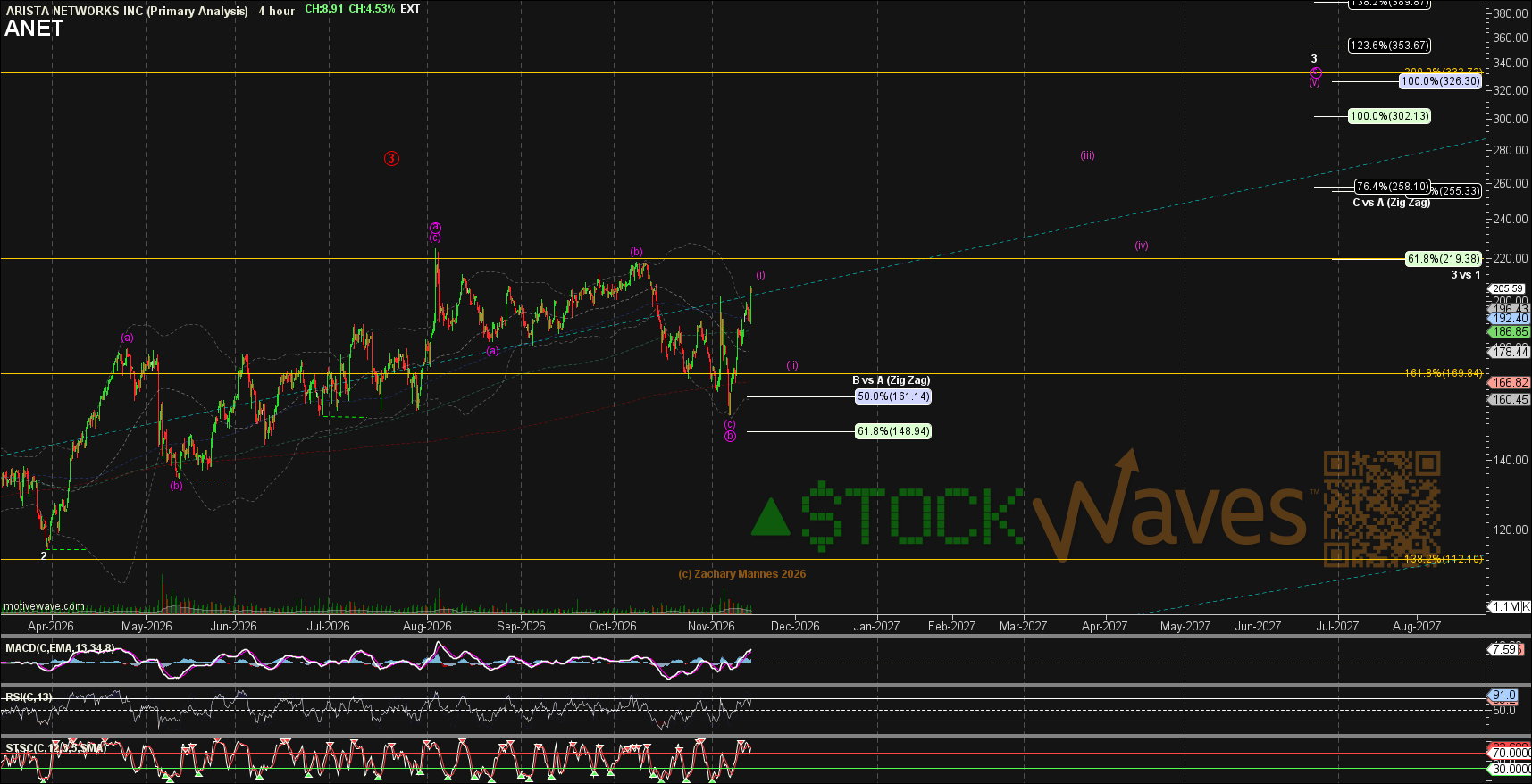
In October, price had risen to the prior swing highs, but the pattern was telling us it was a 'b' wave bounce. In plain terms, a 'b' wave is a countertrend rally inside a correction, and the 'c' wave that follows is the last leg down. Since 'c' naturally follows 'b', a pullback to the $160 to $170 area was the likely path. There will be frequent occasions where this happens. Just when it appears that price is going to break out, it's actually a corrective bounce followed by a sharp decline to reset sentiment.
We were looking for the $160 area to hold and for the earnings report to potentially serve as a catalyst for upside movement. Price touched $158.35, held for a day and then rallied sharply to $212.16 just a little over a week later.
The buffer held.
In this specific case, since we were projecting a 'c' wave down, it is the five wave structure that needs to complete to finish the correction. Although many times we will see a 1:1 'c' vs 'a' relationship, it is the five wave structure that is a better projection of the likely target. There is a completed a-b-c structure into the early November low. Thereafter came a sharp rally that can now be counted as wave (i) of the 'c' of the larger degree wave 3. The correction looks finished and the first leg of the next advance is in place.
Ideal near term support is $178 to $182, inside a wider support buffer of $171 to $185. If that support holds, price can reach for wave (iii) in the $303 to $352 range, with invalidation at the $158 low. Should price break that support buffer, then we would revisit the immediate bullish setup. Once support holds and price starts up, invalidation of the near term bullish scenario can be raised.
We want to see the near term support hold. Setups are not certainties. They are what we are able to identify as the most likely path, with specific parameters to either better confirm what we are seeing or to invalidate that projection.
The same goes for Arista's own guidance. There can be material change in forward looking statements. Typically, from what we have observed over hundreds of charts studied, the structure of price will point out a warning to us ahead of time. There are surprises, and that's why we diversify across setups and have invalidation levels for every trade.
ANET took its hit in November and kept its line. Stay flexible. Markets are fluid and dynamic, just like human behavior. Plot out your course. Know when you continue to be correct and when you need to adjust.
