
AMZN: The Crowd Decides What Day It Is
 By
Levi
By
Levi
Every spring, Amazon sends its shareholders a letter, and tucked in the back is a copy of the very first one, from 1997. It has ridden along every year since. That old letter promises decisions made for long-term leadership rather than for "short-term Wall Street reactions." Jeff Bezos boiled it down further in 2016: "it is always Day 1." Day 2, in his telling, is where a company stalls and the slow fade begins.
So Amazon's calendar doesn't move. Same date for almost thirty years.
The crowd keeps a calendar of its own, though. In 2026 it has flipped the page back and forth at least four times. That raises a question worth contemplating for a minute. If the company's date never changes, whose date is the stock keeping?
What Amazon Says It's Building
Amazon reports three businesses: North America, International and AWS. In April's letter, CEO Andy Jassy described a retail operation approaching $600 billion in sales, in a world where roughly 80% of retail still happens in physical stores. AWS reached a $169 billion annualized run rate in the second quarter, and the company says its AI and custom-chip businesses have each passed a $25 billion run rate.
The path forward, as management lays it out, runs through AI, which Jassy calls a multiplier across everything Amazon does. Alongside it sit Amazon's own chips, more than a million warehouse robots, faster delivery and the Amazon Leo satellite network. Funding it all is a capital budget of roughly $220 billion this year, with a substantial share of the cloud spending already tied to customer commitments, according to the company.
The same letter has a line we keep rereading. Amazon, it says, has long been "comfortable being misunderstood for long periods of time." In a sense, the company expects to be misread. What interests us is the misreading itself.
Big Stock, Bigger Crowd
There's a paradox here that can take some a while to appreciate. Amazon might be the most closely studied company on the board. Its filings get read line by line, its calls get dissected in real time, and 59 analysts carry bullish ratings on it. Facts that widely shared don't surprise anyone for long. So what's left to move the stock?
As best we can tell, it's how people feel about those facts. The numbers show up, and the mood decides what they mean. Robert Prechter, whose work brought Elliott to a wider audience, argued that social mood shapes how news gets received, not the other way around.
Size seems to make this stronger, not weaker. Amazon sits inside index funds, pension plans and millions of retirement accounts. The crowd here isn't a corner of the market. It pretty much is the market.
None of this means the business doesn't count. Over long stretches it gets its due, and Bezos said as much in 2000, writing to shareholders with the stock down more than 80%. The turns, though, are the crowd's to call. Amazon's 2026 makes that case better than we can.
Flipping the Calendar
In February, Amazon said it planned to spend about $200 billion on capital projects this year. The Street had penciled in around $146 billion. The stock fell hard and finished the month down 12%. Money pit. Day 2.
By late March, shares touched $196 and the company was worth roughly $2.1 trillion. Then the mood lifted, and here's what surprised some a little. It lifted before the first-quarter report. Shares were back at $221 by early April, weeks ahead of the numbers that would later get the credit. Day 1.
From a May high, the stock slid about 16% into Prime Day. Day 2.
On July 30, AWS posted 37% growth, its fastest in 18 quarters, and Amazon raised its spending plan to about $220 billion. A bigger version of the very plan the crowd punished in February. This time shares jumped 15.3% in one session, their best day since 2012. The next trading day they closed at a record $284.02, and Amazon crossed $3 trillion. Nearly a trillion dollars of value in about four months. Day 1.
Since then, the filings haven't changed. The worries have. Spending forecasts now stretch into 2027, and there's a newer fear that AI shopping agents could chip away at Amazon's ad business, one an analyst called overstated just this week. Shares closed Wednesday at $249.15, about 12% below that August record. Day 2, or at least the whispers of it.
Someone reading the fundamentals could fairly say AWS growth jumped from 28% to 37% between quarters, and that's real. It helps explain July. It's harder to square with a spring rally that started before the numbers, or a top that came the session after the celebration.
Which brings us to today's date.
Today’s Date on the Chart
Price structure is where the crowd keeps its calendar. Reading all of AMZN's prior structure shows us where we likely stand in the bigger picture, and from there we can project the most probable path.
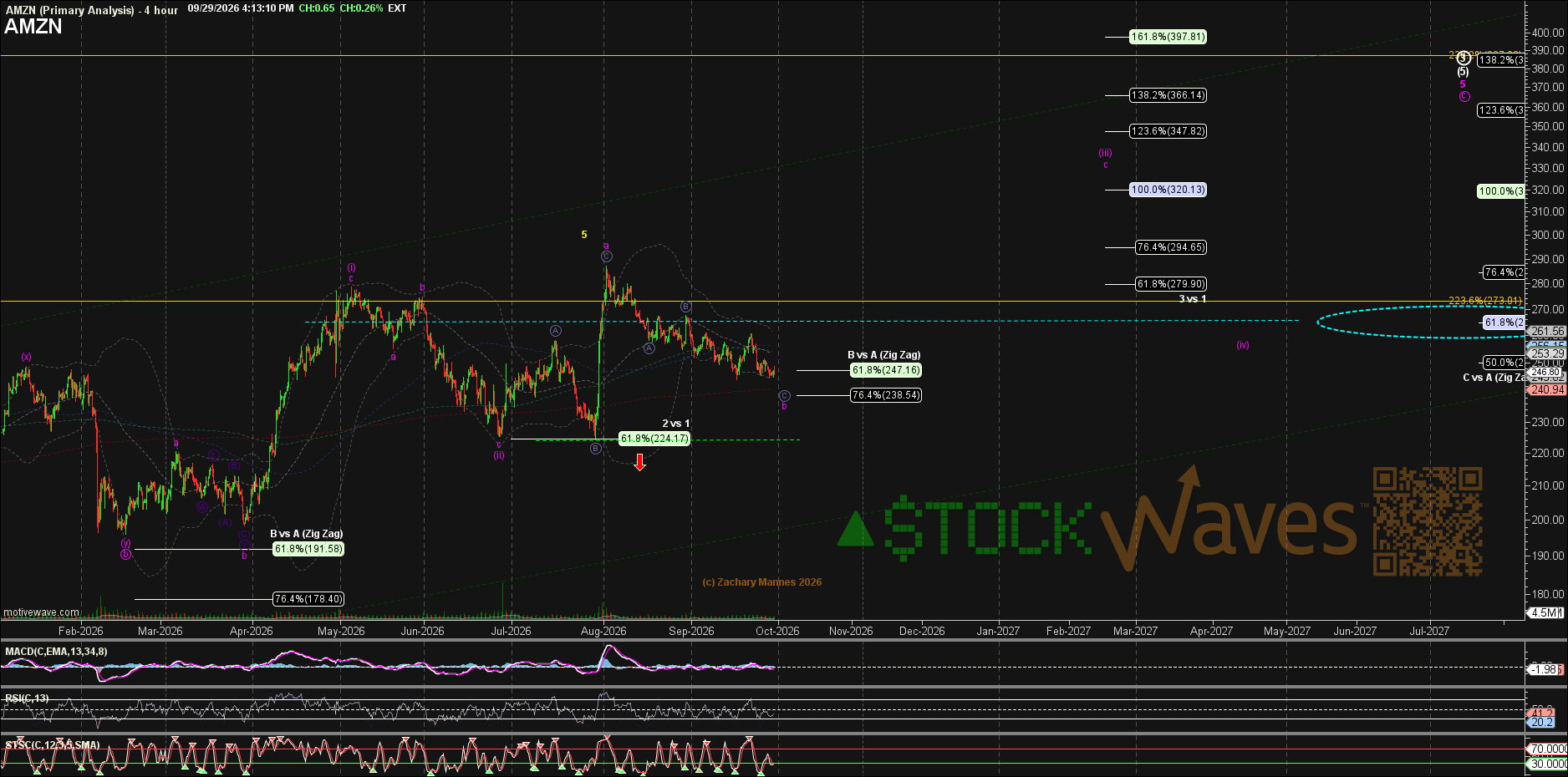
Zac Mannes is sharing a defined risk versus reward setup here. Price has likely completed a ‘b’ wave low in a larger wave (iii) of a developing diagonal. The following ‘c’ wave would take price to the standard target region in the $320 to $347 area. Invalidation of this immediate bullish scenario is a move below $224. If that count is right, the Day 2 whispers have run their course.
Day 1, Again?
Amazon will keep reprinting that 1997 letter, and next spring's edition will still say Day 1. That calendar is imperturbable. The one on the chart belongs to the crowd, and for a stock owned by nearly everyone, it's the calendar price answers to.
If the setup plays out, the crowd and the company may soon agree on the date.
