From Fear to Disbelief: Not the Time to Chase As Structure Will Dictate the Next Move
 By
By
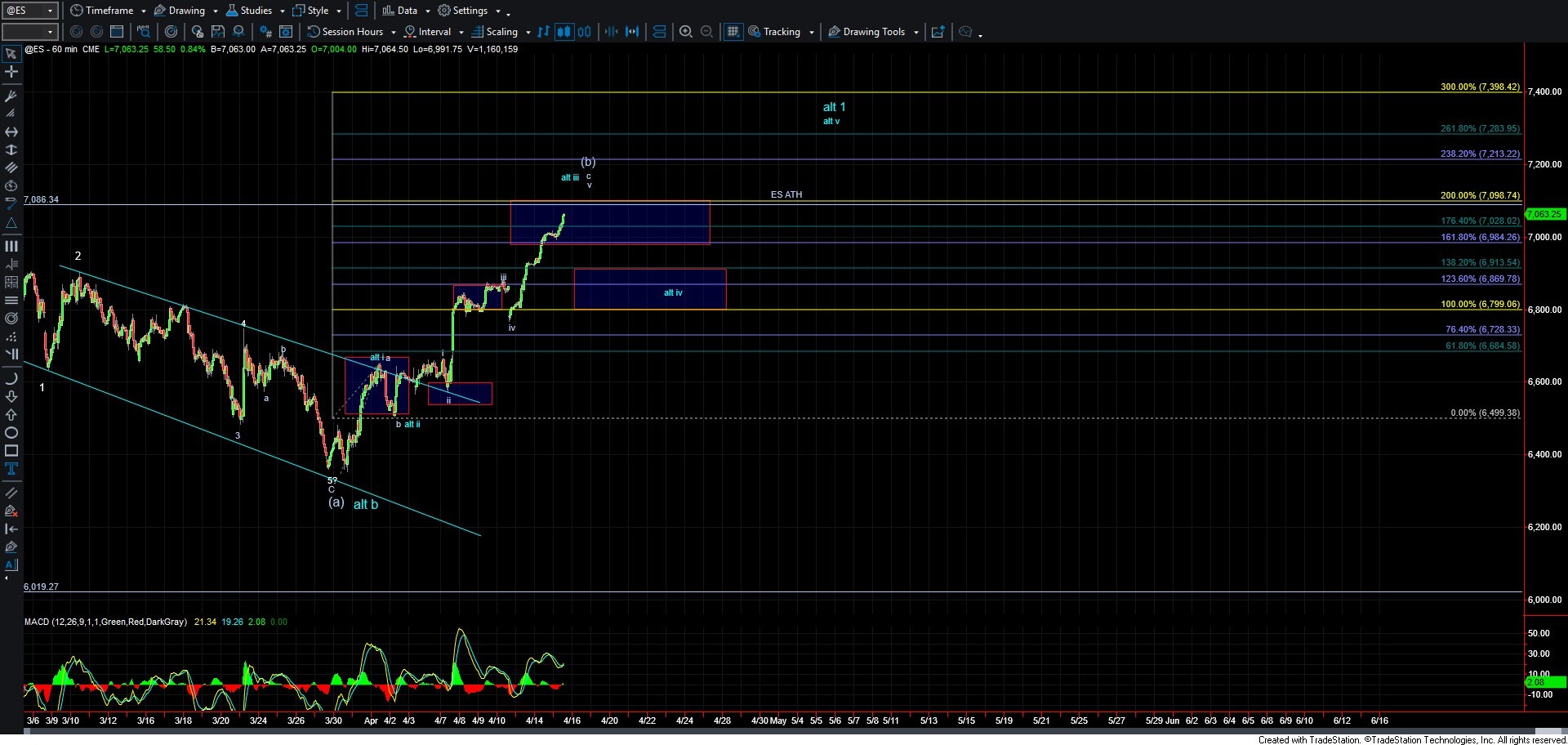
Today, we saw the market continue to push higher, with the SPX moving into new all-time high territory and the ES not far behind. To say this has been an impressive move off the lows would be an understatement. The ES has now rallied more than 11% in just 10 trading days, an aggressive move by any standard.
What makes this even more notable is that it comes on the heels of significant fear and uncertainty near the lows. It’s safe to say that the vast majority of market participants were not positioned for, nor expecting, this type of upside extension. However, from our perspective here at EWT, this move was not unexpected but rather anticipated. As we approached the lows, the pattern was clearly suggesting that a sharp reversal of this magnitude had a high probability of unfolding, and doing so quickly.
That pattern, of course, was the classic Elliott Wave Ending Diagonal we identified developing into the March 30th low. Elliott Wave principles tell us that once an Ending Diagonal completes, the reversal is typically sharp and often retraces the entire structure in less time than it took to form. More often than not, the retracement occurs in significantly less time, and that is exactly what we have seen play out over the past 10 sessions.
While many traders were focused on external news events, we remained focused on the structure of the chart, which provided a clear roadmap for this reversal.
Now that we have reached, and even exceeded, the initial Ending Diagonal target zone laid out on March 30th, the question becomes: what comes next?
Our expectation during the decline into the lows was that the reversal would represent a wave (b), to be followed by a larger and likely sharper wave (c) to the downside. This remains our primary count, as it continues to offer the cleanest and most straightforward interpretation from a probabilistic standpoint. However, the push through the ideal wave (b) resistance region does reduce the reliability of this path and forces us to more seriously consider alternate counts.
At present, the move off the lows still counts best as a three-wave structure, which supports the view that this is a white wave (b). For confirmation of a larger wave (c) lower, we would need to see a full five-wave move to the downside, followed by a corrective retrace, and ultimately a break of the 6913–6799 support zone.
Alternatively, if the market pulls back in a clearly corrective manner that holds that support region and is followed by a break above the wave iii high, it would suggest that the market has already completed a bottom in a larger wave b at the March 30th lows and is now working higher in a developing impulsive structure as laid out per the blue count.
For now, the white wave (b) topping scenario remains the simpler and therefore preferred count. But simplicity does not equate to tradability.
It’s important to understand that not all Elliott Wave patterns provide high-probability trade setups. Attempting to short a potential b-wave top, especially following a corrective move preceding it, is not one of those high-probability situations. We need confirmation. That confirmation comes in the form of a completed five-wave move down, followed by a corrective bounce. Until that occurs, short exposure carries an elevated risk.
At this stage, both the primary and alternate counts remain viable. The next directional move, and more importantly, its structure, will provide the clarity we need to determine which path is unfolding. From there, we can identify where the high-probability opportunities lie.
If you missed this move higher and feel the urge to chase or “make up” for missed gains, this is not the time to take unnecessary risks. The disciplined approach is to wait for a clean, high-probability setup and act when the market provides it. Could a news timing catalyst occur outside of regular trading hours and leave you without an entry? Of course. But more often than not, the market will present a structure that allows participation within proper Elliott Wave parameters before such a move unfolds.
From here, patience is key. Let the market dictate the next opportunity, and remain focused on avoiding emotionally driven decisions. Staying objective, especially in environments like this, is what ultimately leads to consistent success.
I’ll leave you with a passage from The Socionomic Theory of Finance, which I find highly relevant, particularly in moments like this. These are emotions I often feel when entering positions, and very much so in the long position we took last week:
"The vast majority of speculators, who buy when prices are elevated and sell when the markets falls, do not feel nervous and fearful upon acting; they feel relieved. They do not know they have actually increased their chances of losing or reduced their chances of gaining because, unconsciously, they have acted to reduce the discomforting feeling of missing out on gains or risking losses. Because their risk actually increases by both sets of actions, we may confidently conclude that such behavior is non-rational.
If you want to meet speculators who consciously take on risk, seek out the few who buy when others are panicking or sell short when the crowd is giddy. On taking the action, they will be nervous if not downright fearful, because the conscious portion of their minds understands they are taking on risk, and the unconscious portion is screaming not to do it."