
Wisdom Beyond Wall Street: Three Timeless Rules For Navigating The Market
 By
Will Barton
We welcome new subscribers that have recently joined us. The following is the "quick link" to our live google sheet:
HDI_Model_Portfolio-September_2026
Summary
- March 2020 proved that when panic sets in, emotional investors sell at generational bottoms; true wealth preservation requires understanding why your holdings produce cash flow before volatility hits.
- Just as wage earners must spend less than they make to build wealth, retirees must spend less than their portfolio generates to prevent capital depletion.
- Disappointment rarely stems from poor returns – it stems from unrealistic expectations. Investors who expect perpetual +15% equity returns are the most prone to abandoning their strategy during prolonged recessions.
- Build a durable retirement foundation on self-funded cash flow, keep withdrawals disciplined, and let realistic expectations guide your long-term wealth compounding.
= = = =
Good Morning HDI!
Investors are full of quotes. You'll find them in spades from Buffett, Munger, Graham, Lynch, and other prominent investors. We've used more than a few of them ourselves.
Yet, there is great wisdom from outside the investing world that we can incorporate into our investing habits as well. So today, we want to look at a few quotes that inspire us, even though they weren't intended as stock market advice.
Invest Time In Education
“If a man empties his purse into his head, no man can take it away from him. An investment in knowledge always pays the best interest.” – Benjamin Franklin
Ok, so this quote likely was never said by Benjamin Franklin. It started appearing in newspapers as a quote attributed to Franklin, 60 years after his death. However, it is good advice for anyone.
We learned this lesson at HDI in March 2020. The market was crashing; we were seeing many investments that were slashing their dividends, some preferred stocks suspended their dividends, and there was a lot of FUD (Fear, Uncertainty, and Doubt).
We learned two harsh realities in that period:
- We do not control readers' money. We write; we provide our opinions, but ultimately it is the readers of our content who decide what to do with their money.
- When someone is scared and no longer trusts you, there is nothing you can say to them to stop them from making a poor decision.
Long-time readers of our work will recognize a difference between our pre-COVID and post-COVID writing style. Post-COVID, we place a lot more emphasis on education. Instead of just throwing picks out there and talking about the virtues of that specific pick, we often mix in a much more detailed explanation as to why we invest in the types of picks that we do. We've turned to explaining "The Income Method", discussing our long-term approach, the safety guidelines we use, and articles that demonstrate what our strategy looks like.
When the next crash comes, and we promise you it will come, we want our readers to be equipped to handle it without panicking. That requires that we do more than just throw picks at you; we need to explain the method behind our strategy.
Whether you decide to follow our strategy or you have some other preference, we strongly encourage you to educate yourself about what you are holding and why. Have a strategy and know what your plan is when the market crashes.
While our portfolio and our income recovered from the COVID crash, unfortunately some readers lost money when they decided to sell in March at what proved to be, in hindsight, the bottom.
Live Within Your Means
"Financial peace isn't the acquisition of stuff. It's learning to live on less than you make, so you can give money back and have money to invest. You can't win until you do this." – Dave Ramsey
The heart of the Income Method is in producing income. However, the amount of income you can generate is going to be restricted by how much capital you have invested. If you have $100,000 in investments, you can't draw $50,000/year in income from it.
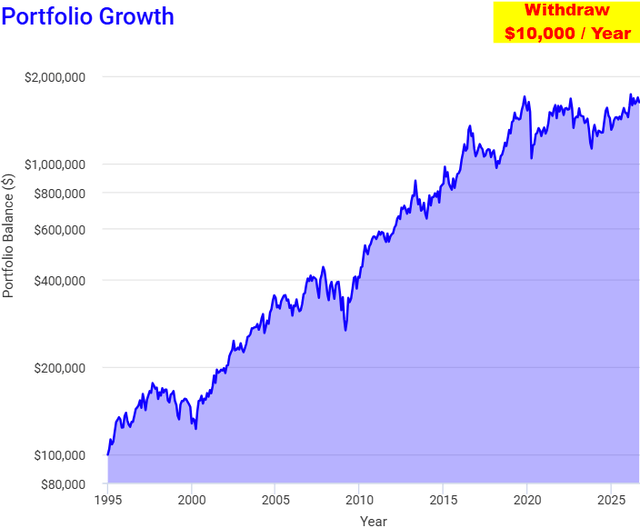
Consider Realty Income Corporation (O), one of the greatest income compounders. If you invested $100,000 in 1995 and withdrew $10,000/year adjusted for inflation each year, O's dividend growth and the fact that you were withdrawing less than its dividends would cause your principal to grow despite your withdrawals:
Portfolio Visualizer
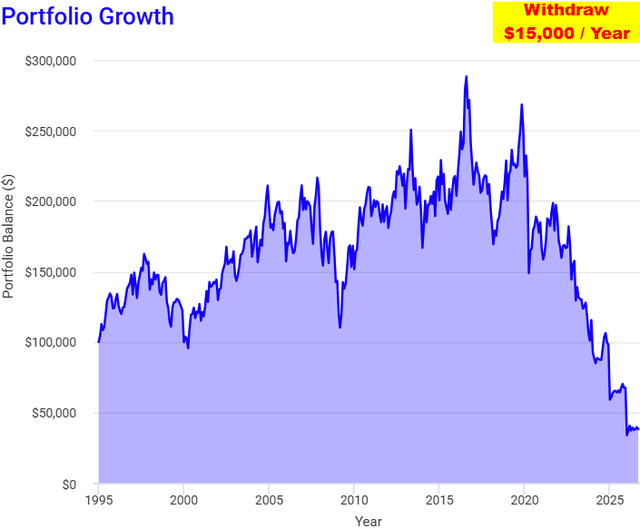
Yet, if you withdrew $15,000/year, suddenly you get a very different picture:
Portfolio Visualizer
It survived, but it doesn't have much left, and another year or two of withdrawals will bring it to $0.
We focus on maximizing our income, but at the end of the day, it doesn't matter how great an investment is if you are withdrawing too much. With a strategy that counts on selling for capital gains to fund withdrawals, it can work for long periods. The challenge is that you don't know if you are withdrawing too much or not, especially when the market is crashing. You don't know if it will be a short crash that you can wait out like COVID, or a prolonged decline where it doesn't recover to new highs for +10 years, as occurred during the Dot-com bust.
Our strategy fits with Dave Ramsey's advice in this quote – spend less than you make. We suggest withdrawing a maximum of 75% of the income your portfolio produces, leaving 25% to reinvest. This will ensure that you are always reinvesting to grow your income more, and you will receive real-time feedback on whether you are withdrawing an appropriate amount. You don't have to guess because you aren't withdrawing until after you've received the dividends.
If you find that your 25% cushion is eaten into during an event where there's dividend cuts, you can take action to get back on course. If you find that your 25% cushion expands to 50%, well now you can consider upgrading your lifestyle or giving away more as you deem appropriate. You've been doing this your whole life – you have an income; sometimes that income changes either up or down, and you modified your budget/lifestyle to adapt. The only difference in retirement is that your income is coming from a source other than wages.
Set Realistic Expectations
“Unexpected money is a delight. The same sum is a bitterness when you expected more.” – Mark Twain
In a letter to his brother, Mark Twain provided this bit of advice as his brother was awaiting a response from a publisher, whom he felt was getting too excited.
In the world of investing, we see this quite frequently. Investors go into earnings season with expectations, and sometimes even if earnings are objectively good, the stock will sell off because investors were expecting more.
With dividend stocks, we've seen prices react negatively if a company reduces its dividend, or even if it raises it but raises it less than investors were hoping for.
For many investments, changing the dividend is a strength, not a weakness. One of our holdings that changes its dividend somewhat frequently is Nuveen Preferred & Income Opportunities Fund (JPC), a CEF (Closed-End Fund) that invests in preferred equity. It reduced its distribution in 2026 to $0.0625/month. Yes, that is a reduction from the $0.0665/month it was in 2025, but it is much higher than the $0.044/month it bottomed at in 2023 and higher than the $0.061/month it was in 2019.
JPC adjusts its dividend as conditions for the preferred equity market change. It's a fund, and its distribution is going to come from the fund's ability to generate a total return from preferred stocks. Something it has done much more effectively than the largest preferred ETF:
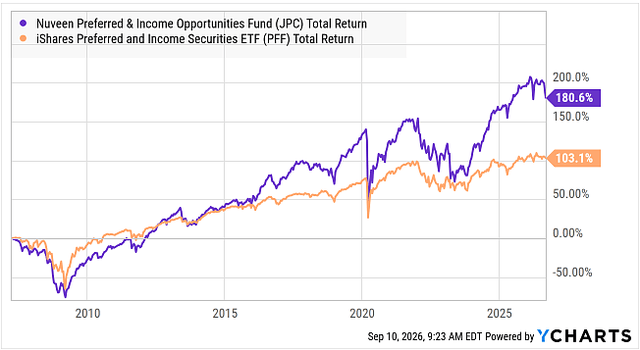
With JPC, you should expect it to provide you with a return that correlates with the returns of preferred equity. It will be higher during periods when preferred produce higher returns and lower during periods when preferred produce lower returns.
The question you should ask yourself with any fund is whether it is a sector you are bullish on and/or want exposure to. Ultimately, a CEF is structured to provide most of its total return through dividends. Since the portfolio it owns will experience varying returns year-to-year, the distribution is going to experience variation as well. Some managers will adjust the distribution quickly; others will wait until NAV is so low that they are forced to change it.
When buying any investment, you should have reasonable expectations of what its dividend might do. Some companies like Realty Income discussed above can grow indefinitely, and it's reasonable to expect that consistent growth is a possibility. They buy real estate, pay out less than 100% of their earnings, reinvest the excess plus any new capital to buy more real estate and grow the dividend.
A CEF doesn't work that way. They buy investments and then are required to pay out substantially all of their taxable return, including capital gains. They might be able to defer realizing gains, but they will eventually have to distribute them. With preferred equity that can be called by the issuer, the timing of realizing capital gains isn't always in management's control. So, they aren't growing their portfolio every year with retained cash. If you want your investment to compound, you have to choose to reinvest yourself and buy more shares.
If you approach an investment with an understanding of what type of dividend payer it will be: Something that retains cash flow for reinvestment to grow will typically have a lower starting yield with some dividend growth potential. Something that pays out almost every dollar it makes will have a higher yield but will be more likely to change its distribution if it is making more or less. Neither is "wrong", and having investments from both can provide a really nice dynamic for your portfolio.
Conclusion
Investing isn't all that different from any other endeavor in your life. If you choose to manage your own portfolio, it's going to require time, dedication, and education to be successful.
While a bull market tends to bring optimism, investing isn't going to be all unicorns and rainbows all the time. There will be large market swings, prices will crash, dividends will be cut, and money will not be infinite. You'll still need to buckle down and manage your cash flow responsibly.
Approaching the market and individual investments with realistic expectations will help protect you from being disappointed with good results. Investors who have very high expectations will be disappointed even by very good results. There's a lot of historical information to look at what has been normal in the past. The market has been on a great bullish run from 2010 to today, with only a slight interruption during COVID and 2022. This has led to a lot of investors who have never invested through a real recession feeling invincible. They've come to expect +15% returns, which is dramatically higher than what the market has produced over the long term. The worst part is that investors with unrealistic expectations are often those who become the most disillusioned when reality smacks the market in the face.
Take these bits of wisdom, and work them into your investing mindset. Because, at the end of the day, we believe a healthy mindset is the most important tool for becoming a successful investor.
