
Trading Options: Simpler -- and Safer --Than You Think
 By
Lou Alfieri
By
Lou Alfieri
Trading options can seem intimidating at first. I know plenty of traders who feel this way. For some complex strategies, that fear is understandable. But for basic options, trading can be as simple as buying and selling a stock.
Before dismissing options outright, it is worth taking a step back to see just how straightforward and powerful they can be.
Like any tool, options come with pros and cons. But used correctly, even a single option contract can offer significant leverage, allowing you to control a large position with relatively little capital. At the same time, your risk is clearly defined: you can never lose more than what you paid for the option.
That combination: high upside with limited downside, is exactly why options deserve a place in every trader’s toolbox.
I. What is an Option?
There are just two types of basic options: calls and puts. When you buy a stock, you receive a certificate that entitles you to part ownership in a company. When you buy a call option, you receive a contract that gives you the right to buy 100 shares of a stock or other exchange-traded product (collectively, just “stock”). When you buy a put option, you receive a contract that gives you the right to sell 100 shares of stock.
*Notice that when you buy a put or a call, all you are buying is a right to do something; you are not buying or selling ownership in the company. Only after you exercise an option are the shares added to or removed from your account.
Before we move on, there are two elements of an option that one needs to understand: strike price and termination date. As discussed, the option itself gives you the right to buy or sell 100 shares of stock. The strike price is the price you are agreeing to pay or receive for one of those shares, and the termination date, often called the exercise date, is the date that the options contract expires.
If you own a call or put, and do not sell it or exercise it before it expires, then your right to buy or sell 100 shares vanishes and you will be out the cost of the option. (In fact, it is the terminal nature of options contracts that introduces many of the intricate factors that go into that option’s price.) The factors that enter into an option’s price are myriad and include ‘the Greeks’ and a premium extracted by options dealers and/or market makers as well. Like complex options strategies, including writing options contracts, the greeks are outside the scope of this article, though we will be discussing time decay.
II. Using Options for Risk Management and Outsized Gains
One of the most powerful, and often overlooked, benefits of options is how precisely they allow you to manage risk.
Rather than committing a large portion of your portfolio to a single trade, options allow you to define your risk in advance. A disciplined trader might choose to risk just 1% - 5% of total account value on any one idea by purchasing an option. That 5% represents the maximum possible loss on the trade—no surprises, no margin calls, and no catastrophic drawdowns.
At the same time, that limited risk can still control a much larger notional position in the underlying stock. If the trade works, the return on that 5% allocation can be many multiples of the original investment. If it doesn’t, the damage to the overall portfolio is modest and easily recoverable.
This is a fundamentally different approach from buying shares outright, where meaningful gains often require meaningful capital, and meaningful losses can materially impair a portfolio. Stop losses on shares are not infallible.
Options as a Portfolio Tool, Not a Gamble
Used correctly, options are not about “swinging for the fences.” They are about asymmetry: risking a small, known amount of capital for a potentially much larger payoff.
For long-term portfolio growth, this means:
· You don’t need to be right often to make money
· You can survive being wrong without derailing your account
· Capital stays available for future opportunities
By allocating a small, fixed percentage of your portfolio to high-conviction option trades, you preserve the bulk of your capital while still giving yourself exposure to meaningful upside. Over time, this approach can compound gains while keeping risk tightly controlled.
In other words, options, when used responsibly, are not a replacement for sound investing. They are a risk-managed enhancement to it.
A Simple $100,000 Portfolio Example:
Assume you have a $100,000 trading account and you follow a rule of risking no more than 5% of your portfolio on any single trade. That means your maximum risk per trade is $5,000.
Instead of using that $5,000 to buy shares outright, you use it to purchase a call or put option. That option might control $40,000, $60,000, or even $100,000 worth of stock, depending on the strike price and expiration. Meanwhile, your maximum possible loss remains capped at $5,000.
If the trade works and the option doubles or triples in value, your account benefits meaningfully. A single successful trade can add 10%–15% to your portfolio. If the trade fails, your account declines by just 5%, leaving 95% of your capital intact and available for future opportunities.
Contrast this with buying shares outright: meaningful gains often require committing a much larger portion of capital, and adverse moves can result in losses that materially damage the portfolio.
By consistently risking a small, fixed percentage of your account on high-conviction option trades, you create an asymmetric payoff structure:
· Losses are limited and survivable
· Winners have an outsized impact
· Capital is preserved for the long term
This approach allows traders to pursue growth aggressively without ever putting the entire portfolio at risk. This is exactly how simple options are meant to be used. In fact, my plan for the next major bear market is to place most of my accounts in treasuries while risking just a small percentage of my capital on more short-term options plays in the VIX & Index/Sector Trading Room.
III. Buying an Option
Once you learn how to read your broker’s option chain, trading a basic option works exactly the same as trading a stock. First, one should go to their broker’s website and watch or read any tutorials on how to physically purchase an option. There, you will encounter an “options chain;” an options chain is simply a table of all available choices. (In the VIX Room, we provide a subset of these to choose from for any one trade, as well as share which contract we are choosing for ourselves.). Here is a sample options chain from Fidelity:
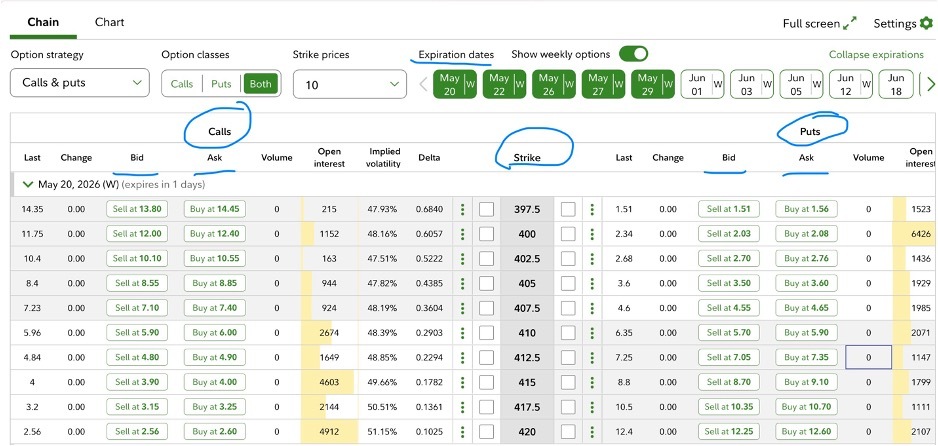
In this table you see two halves: calls on the left side and puts on the right side. The various strike prices are listed in the central column, and the various expiration dates are listed across the top. By now, you should already know if you’re shopping for a call or a put. So, once you select one of the expiration dates, it is just a matter of finding the strike price you want and then looking at the bid and ask price. The price halfway between the bid and the ask is the ‘mid’ price and can serve as a good approximation for the cost of the option (although sometimes the computers get it wrong, so care should be taken here).
If the cost is acceptable, purchasing the option is as simple as selecting that option from the menu or clicking on the asking price. This transaction is called a “buy to open” because you are opening the position by buying the call or put. (Note that since we are simply buying calls or puts we never choose “sell to open.”).
This will bring up a trade ticket where you can ensure you are placing a limit order and can set the limit to a price slightly above the mid price. The option will appear in a trade ticket just like a stock would and from there you just place and confirm the trade. The option will then appear in your account and the cost of it will have been deducted from your account’s balance. With that, the hard part of the process is over.
Note that when trading a single option, you will be presented with 4 choices:
Buy to Open
Sell to Close
Sell to Open
Buy to Close
When we go to buy an option, we are just “Buying to Open” the position. When we are selling our options position, we will select, “Sell to Close.”
IV. Holding an Option (Why it Moves Differently)
Once a call or put option is sitting in your account, you will notice that its price might not always move in perfect sync with the underlying stock. The fact that your option has an expiration date has a lot to do with this.
Intrinsic Value vs. Time Value: If your option is already profitable (known as “in the money”), it has intrinsic value. But if there is still time before expiration, it also has extra value—because the stock could move even further in your favor. As time passes, that extra value shrinks. This is knows as “time decay.”
For example, suppose you own one TSLA call option that gives you the right to buy 100 shares of TSLA at $600 per share, expiring on December 31, 2026. Both TSLA’s stock price and the amount of time remaining until expiration play a major role in determining the value of this option. Assume TSLA is trading at $700 on December 30, just one day before expiration. You could exercise the option and purchase 100 shares at $600 per share, for a total cost of $60,000. Once those shares are in your account, you could immediately sell them at $700 per share (the market price on Dec. 30th), generating $10,000 in proceeds. That results in a $10,000 profit. Accordingly, the value of your call option will be in the ballpark of $10,000, it’s “intrinsic value.”
Now let’s adjust the timeline. You still hold the same TSLA $600 call expiring on December 31, 2026, and TSLA is still trading at $700—but now it is January 1, 2026, with a full year remaining until expiration. The option still has its intrinsic, “in-the-money” value of $10,000. However, because there is substantial time remaining, the stock could move even higher before expiration. That additional possibility increases the value of the option beyond its intrinsic value. This extra amount is known as time premium. As expiration approaches, this time premium erodes, typically at an accelerating rate, until it disappears entirely at expiration.
This decrease in time premium as expiration draws closer is called, “time decay” (or “theta decay”) and is one of the biggest risks trading options. It means that, all else being equal, the value of your option will decrease over time. As such, the profit you expect to make on the option must account for this. In the VIX Room all of this is handled for you. Again, even with time decay working against us, the most we can lose on the option is the premium paid.[1]
V. Selling an Option
This is the easy part. Selling your option, put or call, consists of selecting it from the list of positions in your account and selecting, “Close Position” or “Sell to Close,” depending on your broker.
VI. Summary
As you can see, most of the work involved in options trading comprises selecting your preferred strike price and expiration date. The options chain is just a table, a menu of choices. Buying an options contract off the options chain is not difficult once you learn from your broker how their options chain table is set-up.
While you hold the position, you will notice that it does not trade like a stock, it will experience convexity and decay, and the options price takes into account other factors including future dividend accruals and implied volatility. And while all of that makes for fascinating topics in themselves, you don’t need to understand them if you are trading with a service such as the VIX Room.
Finally, as the trade matures, we simply close it when we feel our targets have been met or we feel the profits are at risk of a drawdown. It really is that easy. Options are one of the fastest ways to grow an account and thus deserve consideration. Used properly they are not to be feared, but should be understood and part of every traders’ toolbox.
HELPFUL HINTS
1. Double-check every trade: The first and worst place to make a mistake is in the order entry. I always double-check or even triple-check the trade ticket before submitting. A small mistake here can have a big impact on your account.
2. Always buy more time than you think you will need. This provides wiggle room for managing the position.
3. Start simply: we do not need complex strategies to profit from options. Simulator trading is the best way to acclimate to trading options.
[1] Just to be clear, there are some complex options strategies that involve selling calls or puts to open a position (as opposed to buying a call or put to open the position). Those strategies could involve losing more than the premium paid for the option. That is not what we are talking about here. For further education on options strategies, please watch Garrett Patten’s Basic Options Strategies video.
